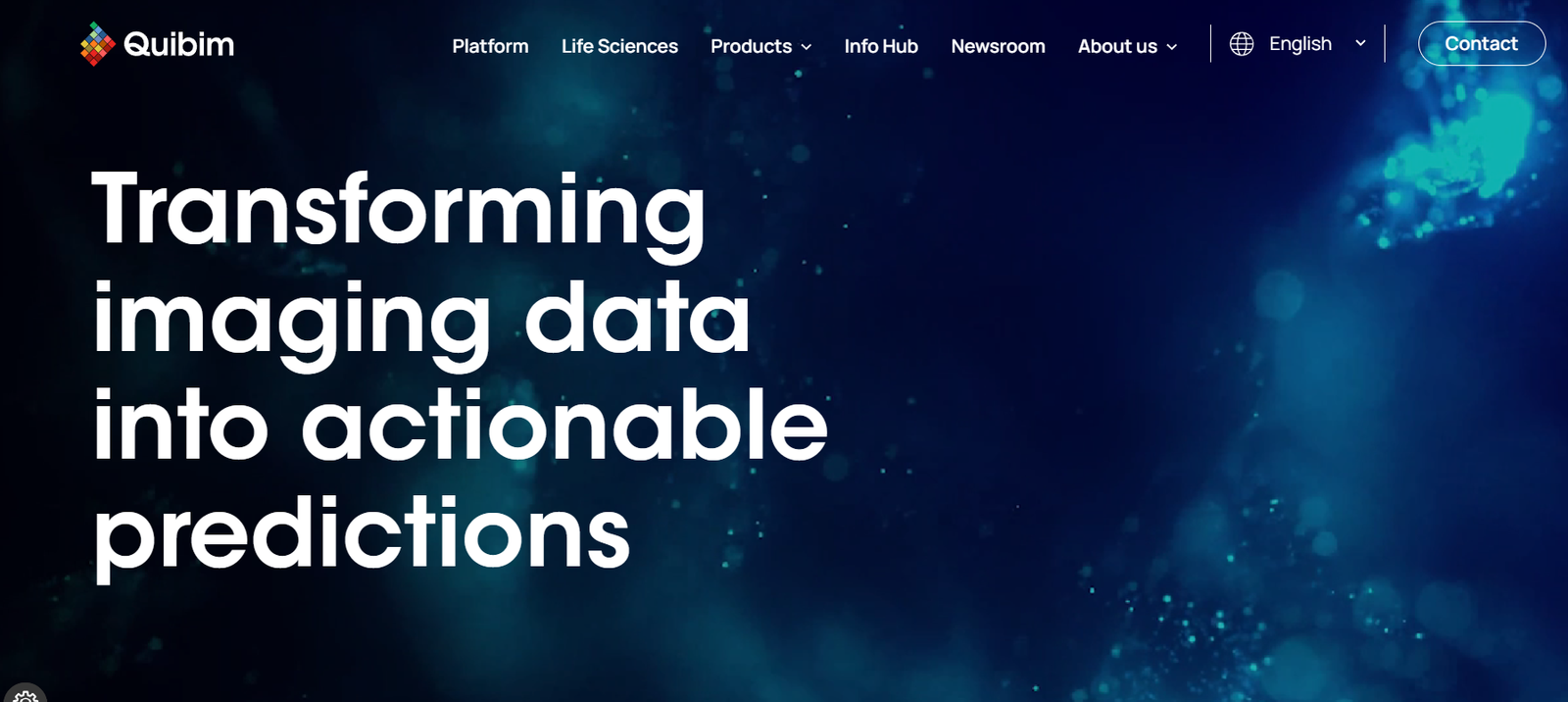
Quibim is a medical imaging AI platform that specializes in transforming traditional medical images into quantifiable biomarkers using advanced radiomics and artificial intelligence. Designed for healthcare providers, researchers, and pharmaceutical companies, Quibim offers a suite of tools that deliver deeper insights from imaging data to support diagnosis, treatment monitoring, and drug development.
Headquartered in Valencia, Spain, with a growing international presence, Quibim integrates cutting-edge machine learning models with standardized imaging protocols to uncover patterns that are invisible to the human eye. The platform covers a wide range of applications across oncology, neurology, and musculoskeletal diseases, turning medical images into a powerful source of objective, reproducible data.
Quibim’s core value lies in its ability to go beyond visual interpretation, enabling clinicians and researchers to detect disease progression early, monitor treatment efficacy, and develop more personalized treatment strategies.
Features
AI-Powered Radiomics: Quibim uses radiomics to extract quantitative data from standard medical images such as MRI, CT, and PET scans. These data points provide insights into tissue characteristics, tumor heterogeneity, and more.
Disease-Specific Imaging Biomarkers: The platform includes disease-specific modules tailored to various clinical domains like oncology, neurology, and rheumatology, allowing precise disease detection and monitoring.
Quibim Precision® Platform: This is the company’s cloud-based, end-to-end AI imaging analysis system. It enables image data management, processing, and analysis through a centralized, secure environment.
Regulatory Compliance: Quibim’s tools are compliant with GDPR and ISO standards. Certain modules are CE-marked, making them suitable for clinical use in Europe.
Integration with PACS and DICOM Standards: The platform supports full integration with existing imaging infrastructure and adheres to DICOM and HL7 standards, ensuring seamless clinical workflows.
Cloud-Based and Scalable: The solution is cloud-native and can scale easily from small hospital departments to enterprise-level research collaborations across multiple sites.
Custom AI Model Deployment: Quibim allows institutions to deploy their own AI models or collaborate on new algorithm development, making it a versatile platform for AI research and innovation.
Data Anonymization and Federated Learning: Built-in privacy-preserving technologies support safe multi-institutional data sharing and AI training without compromising patient confidentiality.
How It Works
Quibim’s workflow begins with the ingestion of medical imaging data, typically from radiology archives or clinical trials. Once images are uploaded to the Quibim Precision® platform, the system processes them through advanced AI models and radiomics pipelines.
The platform extracts a vast array of quantitative imaging biomarkers from the scans. These biomarkers can include volume, shape, texture, and intensity measurements that are often missed in visual readings.
Each processed scan produces a detailed report with biomarker values and visual overlays, helping clinicians understand subtle changes in tissue or tumor characteristics. These reports can then be used to support diagnoses, monitor disease progression, or evaluate response to therapy.
For research users, Quibim provides tools to group, compare, and statistically analyze large datasets, making it ideal for retrospective studies, algorithm training, and multi-center clinical trials.
By automating this process and integrating it into existing imaging workflows, Quibim accelerates time-to-insight and enhances the reproducibility of medical imaging analysis.
Use Cases
Quibim is widely used across clinical, research, and pharmaceutical settings.
In oncology, the platform is used to assess tumor heterogeneity, monitor response to immunotherapy, and predict treatment outcomes by analyzing longitudinal changes in tumor biomarkers.
In neurology, Quibim’s tools are used to detect early signs of neurodegenerative diseases like multiple sclerosis and Alzheimer’s disease. Quantitative imaging biomarkers help track lesion volume, brain atrophy, and microstructural changes.
Musculoskeletal use cases include the analysis of cartilage degeneration and bone lesions in conditions like osteoarthritis and rheumatoid arthritis, supporting early intervention and personalized treatment.
Pharmaceutical companies use Quibim to enhance clinical trials by integrating imaging biomarkers as endpoints, accelerating drug development, and increasing the statistical power of studies with quantifiable imaging data.
Radiology departments benefit from the platform’s ability to deliver consistent, data-driven reports that enhance clinical decisions and reduce diagnostic subjectivity.
Pricing
Quibim does not disclose specific pricing on its public website. Pricing typically depends on several factors including the number of users, the volume of imaging studies processed, deployment method (cloud vs. on-premise), and the number of modules or disease-specific packages required.
The company offers custom solutions for hospitals, research institutions, and pharma clients. Prospective users are encouraged to contact Quibim directly for a tailored quote based on organizational needs and intended use.
Strengths
Quibim’s main strength is its ability to convert standard medical images into a rich set of quantitative biomarkers using validated AI and radiomics methodologies. This makes it especially powerful in precision medicine and clinical research.
The platform’s disease-specific focus allows it to provide targeted solutions that are highly relevant to clinicians and researchers working in oncology, neurology, and musculoskeletal diseases.
Another strength is its flexibility. Users can access pre-trained AI tools or develop and deploy their own models, making it suitable for both clinical practice and research environments.
Its seamless integration with existing hospital systems and compliance with international standards ensure that it fits securely and efficiently into medical workflows.
Finally, the platform’s scalability makes it an ideal choice for organizations ranging from individual hospitals to large, multi-center research networks.
Drawbacks
One drawback of Quibim is that its advanced capabilities may require a learning curve for users who are unfamiliar with radiomics or AI in medical imaging.
Another potential limitation is the lack of transparent pricing, which could make it difficult for smaller organizations to assess cost feasibility without engaging in a sales consultation.
As with many AI imaging tools, the performance of the system can depend on the quality of the imaging data input, and not all datasets may yield optimal results without proper standardization.
While the platform is CE-marked and complies with regulations, some modules may not yet have FDA approval for clinical use in the United States, which may limit certain deployments in that region.
Comparison with Other Tools
Quibim competes with other AI radiology platforms such as Aidoc, Arterys, and Blackford Analysis.
Aidoc focuses heavily on acute care radiology and triage in real time, particularly for emergency settings. It excels in speed and immediate decision support.
Arterys provides cloud-native AI for multiple organs and supports collaborative workflows, making it strong for general imaging.
Blackford offers a marketplace of AI applications, acting as a platform integrator for multiple third-party models.
What sets Quibim apart is its focus on radiomics and quantitative imaging biomarkers, offering much deeper analytical capabilities than platforms designed primarily for triage or alerting.
Quibim is better suited for use cases that require precision, research-grade data extraction, and detailed disease characterization rather than just detection or prioritization.
Customer Reviews and Testimonials
Quibim features several success stories and partnerships on its website, though individual customer reviews are limited in public forums.
Healthcare and research institutions across Europe and North America have adopted the platform, including partnerships with leading hospitals, universities, and pharmaceutical companies.
The company also collaborates with global initiatives such as the EU’s Innovative Medicines Initiative (IMI), demonstrating a strong presence in academic and clinical research environments.
For testimonials, prospective clients can explore published use cases or reach out to Quibim for customer references and case study documentation.
Conclusion
Quibim is a highly sophisticated AI imaging platform that unlocks new diagnostic and research potential by converting standard medical images into quantitative biomarkers. With its powerful radiomics engine, disease-specific solutions, and clinical-grade infrastructure, it stands out as a leading tool for precision medicine, research, and pharmaceutical innovation.
Whether used to support radiologists with more objective insights or to strengthen data collection in clinical trials, Quibim delivers value by enhancing the depth, reproducibility, and clinical utility of imaging data.
While it may require technical understanding and setup, the long-term benefits of accurate, data-rich imaging analysis make Quibim a strong investment for institutions committed to advancing personalized medicine.