
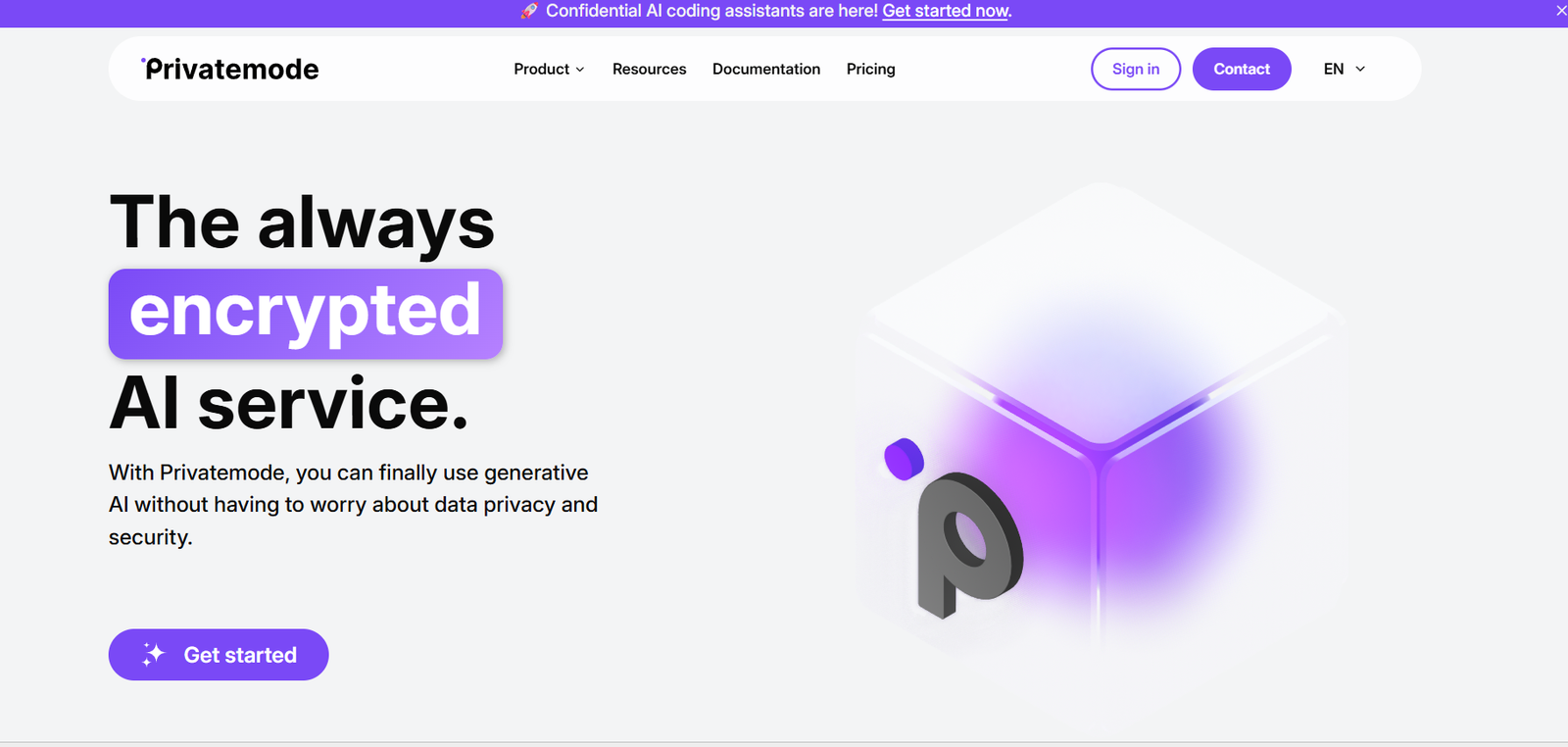
PrivateMode is a privacy-first GenAI platform built for enterprises that need to adopt generative AI without compromising sensitive data. It provides an infrastructure layer that ensures enterprise data privacy, security, and compliance when using large language models (LLMs) like GPT-4, Claude, and Mistral.
Designed to serve security-conscious industries such as finance, healthcare, legal, and government, PrivateMode enables teams to build custom LLM-powered applications with complete control over data retention, access, and sharing.
The platform acts as a privacy gateway that mediates interactions between end users and LLMs, applying encryption, redaction, anonymization, and policy-based enforcement before any data reaches an external model. With PrivateMode, enterprises can confidently adopt GenAI tools for productivity, knowledge management, or customer engagement—without exposing regulated or confidential data.
Features
PrivateMode delivers a range of enterprise-grade features to secure and govern generative AI usage.
The core feature is the privacy firewall, which inspects all data prompts sent to LLMs and applies configurable transformations such as redaction, encryption, and token substitution before forwarding.
The platform includes zero data retention, ensuring that no customer data is stored by LLMs or intermediary services during interactions.
It supports data tagging and classification, allowing enterprises to apply different handling rules for different types of content, such as PII, PHI, or trade secrets.
PrivateMode offers real-time policy enforcement, blocking or modifying prompts that violate organizational data-sharing rules.
It integrates with enterprise identity and access management (IAM) systems to ensure only authorized users can interact with GenAI systems and audit their activities.
The platform includes observability and audit logs, providing full traceability of who accessed what data and what LLM interactions occurred.
PrivateMode also supports multi-LLM orchestration, allowing enterprises to route different queries to different models (such as GPT-4 or Claude) based on context, performance, or cost.
How It Works
PrivateMode is deployed as a middleware layer between users and large language models. Users interact with AI applications as usual, but all prompts are first routed through the PrivateMode infrastructure.
When a user submits a prompt, the platform’s privacy engine scans the content in real time, classifies it, and determines whether it contains sensitive or restricted data.
Based on predefined organizational policies, the engine then takes action—redacting PII, substituting tokens, encrypting identifiers, or blocking the request entirely if needed.
Only after the privacy transformations are applied is the prompt forwarded to the selected LLM endpoint. The LLM generates a response, which may also be filtered or modified by PrivateMode before being shown to the user.
All activity is logged with user, timestamp, model, and policy enforcement data, ensuring complete auditability and governance over GenAI usage.
Use Cases
Financial institutions use PrivateMode to allow employees to use AI tools without risking exposure of customer data or transaction records.
Healthcare providers use the platform to integrate GenAI into patient care workflows while remaining compliant with HIPAA and protecting patient identifiers.
Legal teams use PrivateMode to summarize and analyze case documents or contracts without leaking privileged or confidential information to third-party models.
Government agencies implement the platform to securely explore LLM use cases like knowledge retrieval, internal documentation, or citizen communication under strict compliance controls.
Enterprises of all sizes use it to safely develop internal AI copilots, customer support bots, or analytics assistants that interact with sensitive business data.
Pricing
PrivateMode does not publish pricing information publicly, indicating a custom pricing model based on usage, deployment preferences, and enterprise requirements.
Prospective customers are encouraged to request a demo or contact the team for a personalized quote.
Pricing is likely to vary based on the number of users, volume of prompts, LLM endpoints used, and whether the solution is deployed in a fully managed cloud environment or on-premises.
PrivateMode positions itself as a premium privacy solution for organizations with high security, compliance, and governance requirements.
Strengths
One of PrivateMode’s strongest advantages is its privacy-by-design architecture, which enforces guardrails before any data reaches third-party LLMs.
Its support for zero data retention and real-time redaction ensures compliance with strict data protection laws such as GDPR, HIPAA, and the DPDP Act.
The multi-LLM orchestration feature gives teams flexibility to route traffic to different LLMs based on cost, speed, or data sensitivity.
PrivateMode’s enterprise identity integrations and detailed audit logs make it a robust choice for regulated industries.
It is model-agnostic, which means organizations can integrate it with multiple LLM providers without vendor lock-in.
Drawbacks
PrivateMode is tailored for large enterprises and may not be suitable or affordable for small teams or startups without formal data governance needs.
The lack of public pricing may deter early evaluation or experimentation by smaller organizations.
Some features such as policy creation and data classification may require specialized onboarding and configuration.
The platform appears to be focused on backend infrastructure, meaning it is better suited for organizations with engineering or DevSecOps resources to integrate it into custom applications.
There is currently limited public visibility on reviews or case studies, which may affect adoption among more cautious buyers.
Comparison with Other Tools
Compared to broader GenAI governance tools like OpenAI’s team/enterprise features or Azure OpenAI’s content filters, PrivateMode provides deeper and more customizable privacy controls at the infrastructure level.
Unlike general-purpose DLP tools such as Nightfall AI or BigID, which operate across email or file systems, PrivateMode is purpose-built for LLM usage protection, making it uniquely suited for AI integration scenarios.
Tools like PromptLayer focus on LLM observability but lack real-time privacy enforcement, which is core to PrivateMode’s offering.
Compared to enterprise prompt firewalls like Lakera, PrivateMode provides more advanced orchestration and identity management integrations, giving it an edge in large-scale deployments.
Customer Reviews and Testimonials
At the time of writing, PrivateMode does not have publicly listed customer reviews or ratings on platforms like G2, Capterra, or Product Hunt.
However, the website includes clear messaging around enterprise adoption in sectors like finance, healthcare, and government.
Early adopter feedback highlights strong performance in data redaction accuracy, policy enforcement reliability, and LLM flexibility.
Case studies and testimonials are expected as the platform scales and adoption increases across more regulated sectors.
Conclusion
PrivateMode is a robust and future-ready platform for enterprises seeking to integrate generative AI into their workflows without compromising on privacy, security, or compliance. Its AI-driven privacy firewall, real-time policy enforcement, and model-agnostic architecture make it a strategic solution for organizations in regulated industries.
By enabling responsible and secure GenAI usage, PrivateMode helps businesses unlock AI productivity benefits while maintaining strict control over sensitive data.
For enterprises building LLM-powered tools or enabling employee access to GenAI, PrivateMode offers peace of mind and operational confidence.


