
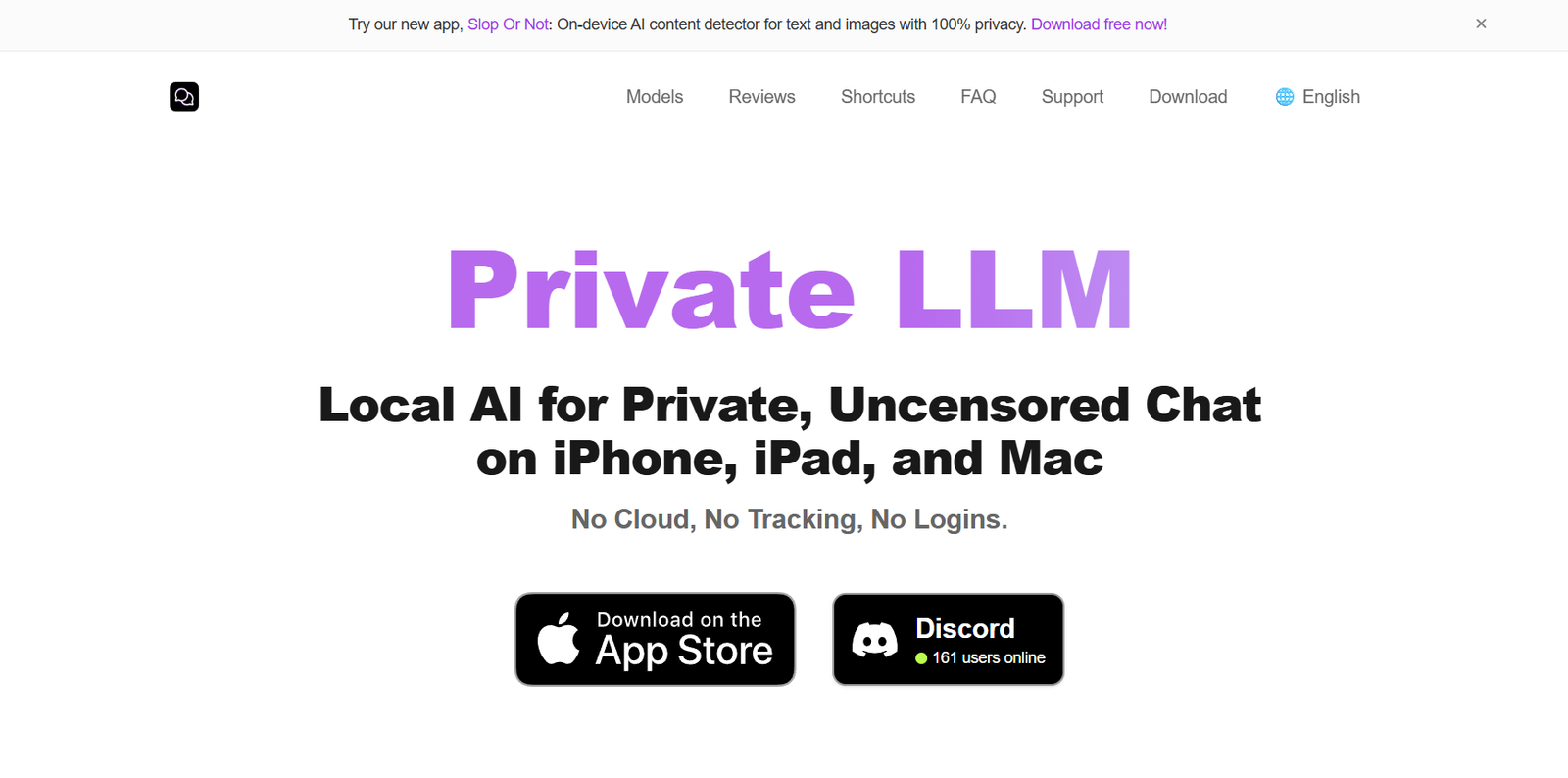
PrivateLLM is a privacy-first AI platform that enables businesses to deploy large language models (LLMs) securely and locally, without sending data to external servers. Designed for organizations with strict data governance requirements, PrivateLLM allows teams to run generative AI models directly on their infrastructure—whether that’s on-device, in a private cloud, or in a secure environment.
By focusing on complete data control, PrivateLLM addresses growing concerns around sensitive data exposure in AI workflows. The platform empowers enterprises to harness the power of generative AI while complying with regulations like GDPR, HIPAA, or internal IT security protocols.
PrivateLLM is ideal for businesses that want to integrate powerful AI features—like text summarization, content generation, code assistance, and internal chatbots—without compromising on privacy or relying on third-party APIs.
Features
PrivateLLM offers a wide range of features that cater to security-conscious organizations building with AI.
Local Model Deployment
PrivateLLM enables deployment of large language models on local servers, private cloud, or on-premise devices. No data ever leaves the organization’s infrastructure.
No Internet Required
The system operates fully offline, ensuring complete isolation of sensitive workloads. This makes it suitable for air-gapped environments and regulated industries.
Web UI and API Integration
PrivateLLM comes with a user-friendly web interface and REST APIs, allowing seamless integration into internal tools, workflows, and applications.
Embeddings and RAG Support
The platform supports embeddings and Retrieval-Augmented Generation (RAG), making it suitable for document search, internal knowledge assistants, and Q&A bots.
Custom Model Support
Organizations can bring their own models or use supported open-source LLMs. The platform is compatible with models like Mistral, Llama 2, and Code Llama.
Containerized Deployment
The platform is available via Docker containers for fast setup, portability, and ease of deployment across different environments.
Multi-Modal Capability
PrivateLLM supports not only text but also images and audio in some configurations, expanding its application potential.
Security-Focused Architecture
With full control over access and logs, the system is designed with IT and security teams in mind, ensuring transparency and compliance.
How It Works
PrivateLLM is designed for self-hosting and starts with a simple containerized deployment. Organizations can pull the PrivateLLM Docker image, configure access controls, and deploy the platform inside their own network—whether on bare metal, in a private cloud, or on air-gapped systems.
Once deployed, users can interact with LLMs through the web UI or integrate them into their applications using REST APIs. The platform offers flexibility to load different open-source LLMs like Llama 2, Mistral, or custom models trained internally.
For teams working with documents, PrivateLLM provides embeddings and vector search functionality, allowing integration of RAG techniques. This enables question-answering bots and knowledge assistants to be built entirely within the organization, without leaking any data to the cloud.
The system does not require internet access at any stage and is optimized for running offline, making it compliant with even the strictest security policies.
Use Cases
PrivateLLM can be used across industries and enterprise teams where data confidentiality is paramount.
Internal Chatbots
Companies can build internal helpdesk assistants that answer employee questions using internal documentation—all without relying on external AI services.
Secure Document Processing
Legal, finance, and healthcare teams can extract insights, summarize, or search across sensitive documents without uploading them to the cloud.
Coding Assistants
Engineering teams can deploy code-focused LLMs like Code Llama to assist with auto-completion, debugging, or documentation, while keeping proprietary code secure.
Research and Development
Private R&D labs can use LLMs for literature review, summarization, and knowledge management without risking intellectual property exposure.
Offline AI Applications
Air-gapped environments or remote field operations can still benefit from LLM capabilities without requiring internet connectivity.
Healthcare Diagnostics
Medical teams can run AI on local infrastructure to assist in decision-making without exposing patient records or violating data regulations.
Pricing
As of the latest available information on the PrivateLLM website, pricing details are not publicly listed. The platform follows a request-based pricing model, which typically means organizations must contact the team to get a quote based on their deployment requirements and use case.
This often includes factors such as the number of users, model size, infrastructure configuration, and support level. Since PrivateLLM is tailored to enterprises with unique data security needs, a customized pricing approach ensures alignment with IT, legal, and compliance requirements.
Strengths
PrivateLLM’s main strength is its complete focus on privacy and on-device model deployment. Unlike cloud-based AI tools, it gives organizations full control over their data, making it highly suitable for industries where confidentiality is critical.
The platform’s compatibility with popular open-source LLMs, along with RAG support, allows businesses to build custom AI applications that are both powerful and secure. Containerized deployment ensures ease of use for IT teams, while the offline operation aligns with enterprise security standards.
PrivateLLM also stands out by offering REST API support, making it easy to integrate into existing internal tools and workflows.
Drawbacks
One limitation is the absence of publicly available pricing or feature comparison, which can make it difficult for potential users to evaluate the solution without scheduling a demo.
Another potential drawback is the platform’s reliance on local infrastructure, which may require organizations to have IT capacity and hardware capable of running LLMs. This could be a barrier for smaller teams or startups that lack in-house infrastructure.
Additionally, while PrivateLLM supports several open-source models, it may not yet match the scale or performance of cloud-based AI platforms running proprietary LLMs with billions of parameters.
Comparison with Other Tools
Compared to tools like OpenAI’s ChatGPT or Google’s Gemini, which operate as cloud-hosted AI services, PrivateLLM offers a fully private, offline-first approach.
ChatGPT and Gemini are ideal for public or general-purpose use but require sending data to the cloud, which may not be acceptable for industries with strict compliance regulations. In contrast, PrivateLLM keeps all data on local infrastructure, ensuring that nothing leaves the organization’s control.
Tools like Ollama or LM Studio also support running models locally, but PrivateLLM adds enterprise-grade capabilities like containerized deployment, API access, and support for air-gapped environments. This makes it more suitable for IT-managed, security-sensitive settings compared to hobbyist or developer-focused tools.
Customer Reviews and Testimonials
As of the current update, no public customer reviews or third-party testimonials are listed on the PrivateLLM website or review platforms such as Product Hunt, G2, or Capterra.
However, the platform appears to be in active development and is targeting early adopters in privacy-sensitive industries. Organizations interested in evaluating the tool can request a demo directly from the website and assess the platform based on their specific requirements.
Conclusion
PrivateLLM is a compelling solution for enterprises seeking a private, secure, and offline approach to deploying large language models. With full support for on-device deployment, API access, and modern open-source models, it provides businesses with the tools to integrate AI into their workflows without compromising data privacy.
Its design is well-suited for industries such as healthcare, law, government, and finance, where confidentiality and compliance are non-negotiable. While it may require some IT overhead and does not offer immediate public pricing, the trade-off is a level of privacy and control that few platforms can match.
For organizations prioritizing security and data sovereignty in their AI initiatives, PrivateLLM presents a powerful and future-ready option.


