
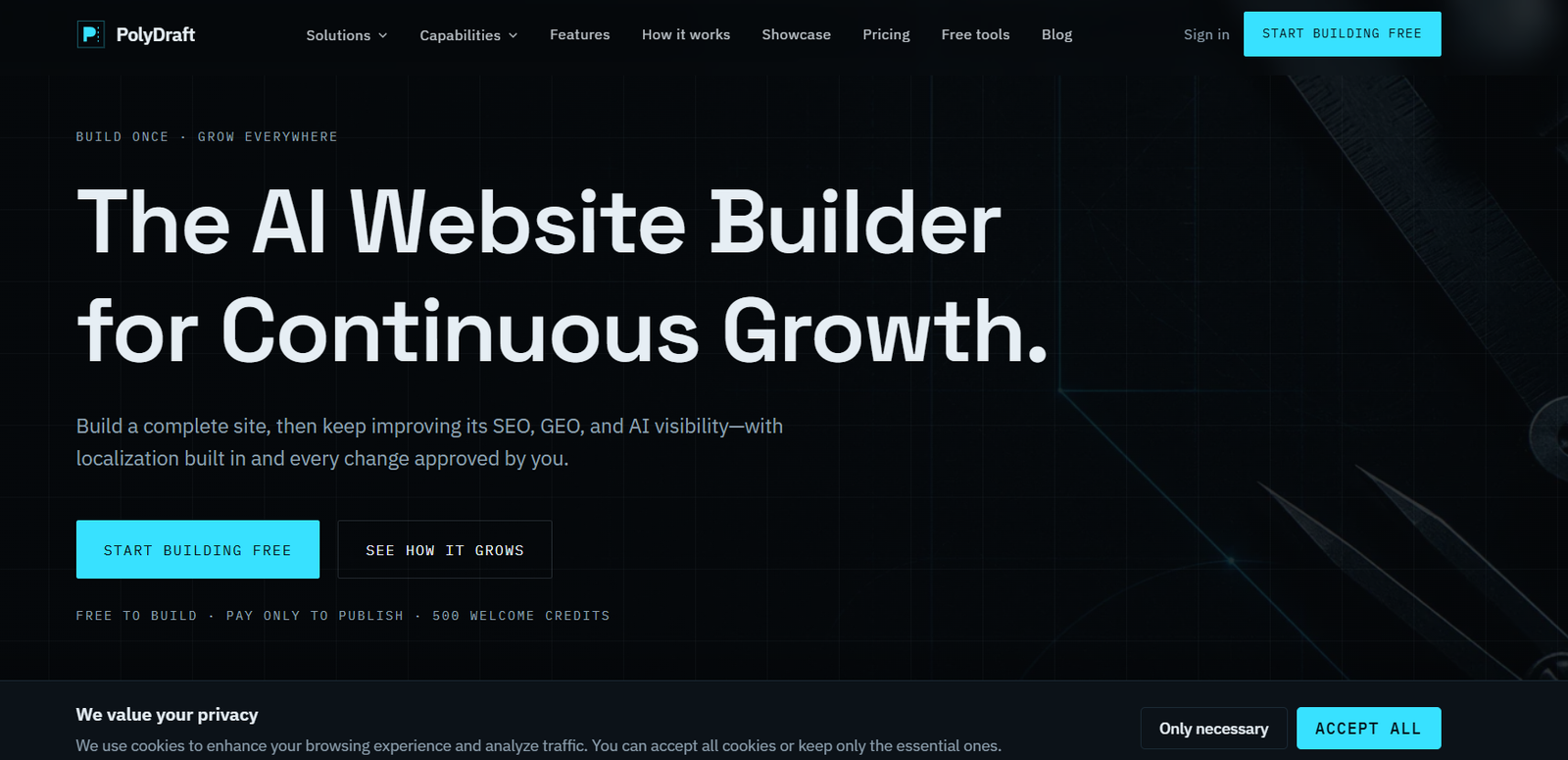
PolyDraft is an AI-powered website builder designed to create complete business websites rather than individual pages or basic templates.
Users can describe their business in plain language or provide an existing website URL. PolyDraft then researches the market, analyzes competitors, identifies relevant search opportunities, plans the website structure, creates design directions, writes the content, builds the pages and produces a live preview.
A major focus of PolyDraft is search visibility.
The platform performs keyword research before writing the website and uses information such as search volume, keyword difficulty and intent to help determine which topics individual pages should target.
Traditional SEO elements such as titles, meta descriptions, structured data, canonical URLs, breadcrumbs, XML sitemaps and robots.txt files are generated as part of the website.
PolyDraft also focuses on Generative Engine Optimization, or GEO. Websites can include llms.txt, AI-crawler guidance, answer-first content structures and consistent entity information intended to make content easier for AI search and answer engines to understand.
The platform supports multilingual websites in up to 100 content languages, including right-to-left languages. It uses transcreation rather than relying only on literal word-for-word translation.
Another important difference is website ownership. Finished websites deploy to the customer’s own cloud account and domain instead of requiring permanent hosting inside PolyDraft.
Users can build and preview a complete website for free. A paid plan is required when they are ready to publish.
Features
AI Website Builder
PolyDraft can turn a plain-language business description into a complete website.
The AI handles research, planning, copywriting, design, development and quality checks.
Existing Website Redesign
Users can provide an existing website URL as the starting point.
PolyDraft can use the existing business information while developing a new website.
Business Knowledge Base
The platform creates a verified knowledge base from information supplied by the business.
This acts as the source of truth for website copy and future updates.
Competitor Research
PolyDraft analyzes relevant competitor websites on the open web.
This helps the system understand the market before planning pages and content.
Keyword Research
Search research is performed before website copy is written.
The platform can consider monthly search volume, keyword difficulty and search intent.
One Primary Keyword Per Page
PolyDraft attempts to assign one main commercial keyword to each page.
This is intended to reduce situations where multiple pages on the same website compete for the same search intent.
SEO-Driven Site Architecture
Keyword research is used to help determine the overall page structure rather than being added only after the website has been created.
AI Copywriting
PolyDraft writes website content according to the business information, target audience and search strategy.
Honest-Content Policy
The platform states that it does not fabricate customer names, testimonials or business statistics.
AI-generated imagery is intended for atmospheric use rather than pretending to show a company’s real products.
Six Design Directions
Users can choose from six AI-generated visual directions before committing to a design.
Reference-Based Design
PolyDraft can use an uploaded visual reference to guide the design system.
Motion Effects
The platform provides Essential, Signature and Max motion tiers for adding visual movement to websites.
Reduced-motion accessibility preferences are respected.
Responsive Design
Generated websites are designed to work across desktop and mobile screen sizes.
Technical SEO
PolyDraft automatically generates important technical SEO elements.
These include page titles, meta descriptions, structured data, canonical URLs, breadcrumbs and heading structures.
Schema.org Structured Data
Structured data is generated to help search engines understand website content.
XML Sitemap
Websites receive an automatically generated XML sitemap.
Robots.txt
PolyDraft generates a robots.txt file for the website.
llms.txt
Every PolyDraft website can publish an llms.txt file.
This provides a machine-readable map of important website content for AI systems.
AI Crawler Access
The generated robots.txt can explicitly welcome crawlers such as GPTBot, ClaudeBot and PerplexityBot.
Answer-First Content
Important content sections can be structured so that the central answer appears first and supporting explanation follows.
This is intended to make individual passages easier for AI answer engines to understand and quote.
Continuous SEO
PolyDraft is designed to continue helping after a website is launched.
It can identify opportunities for new topics, internal links, content improvements and technical changes.
Human Approval
Recommended updates are not automatically published without user involvement.
Users can review proposed changes, request revisions and decide what goes live.
Internal Linking
PolyDraft creates and manages internal-link relationships across website pages.
Internal-Link Manager
Website administrators receive a dedicated tool for managing internal links.
Blog CMS
Every generated website can include a built-in blog content management system.
The CMS provides a rich-text editor and categories.
Inquiry Inbox
Customer enquiries can be collected inside the website’s admin area.
Lead information can include the visitor’s country of origin.
Image Library
Website owners can manage images through the built-in admin interface.
AI-generated images can later be replaced with real photographs without changing the image URL.
Translation Manager
Multilingual sites include tools for managing translated content.
Script Injection
Users can add external scripts for services such as analytics and chat tools.
REST Content API
External applications can publish content through the site’s REST API.
Multilingual Websites
PolyDraft supports up to 100 content languages, depending on the selected plan.
Hreflang
Multilingual pages receive hreflang information to help search engines understand language and regional variations.
Right-to-Left Languages
Languages using right-to-left scripts are supported.
Examples include Arabic, Hebrew, Persian and Urdu.
Transcreation
Localization is designed around meaning and local marketing language rather than direct word-for-word translation.
Protected Manual Translations
Translations edited manually by the user are protected from being overwritten by future automatic translation passes.
Own-Cloud Deployment
Finished websites can be deployed to infrastructure controlled by the customer.
This reduces dependence on permanent vendor hosting.
Own Domain
Customers can publish websites using their own domains.
No PolyDraft Hosting Fee
PolyDraft does not charge a separate platform hosting fee for websites deployed to the customer’s own cloud infrastructure.
Cloud-provider charges may still apply.
Source Code Export
Full source-code export is available on Agency and Enterprise plans.
Project Transfer
Project transfer to client accounts is available on Pro and higher plans.
White Label
Agency and Enterprise customers receive white-label badge control.
This is particularly useful for agencies delivering websites to clients.
How It Works
- Create a PolyDraft account.
- Receive the initial welcome credits.
- Describe your business in plain language or provide an existing website URL.
- Add accurate information about your products, services, audience and goals.
- Upload relevant brand assets and real product photographs when available.
- PolyDraft creates a business knowledge base.
- The AI researches the market and relevant competitors.
- Keyword research identifies search volume, difficulty and intent.
- PolyDraft creates a page-by-page website plan.
- Review the proposed structure and content strategy.
- Explore the generated design directions.
- Select the preferred visual approach.
- PolyDraft writes and builds the complete website.
- Review the website through the live preview.
- Ask the AI for revisions through chat.
- Check content, images, claims and business information carefully.
- Subscribe when you are ready to publish.
- Deploy the finished website to your own cloud account and domain.
- Use the built-in CMS and admin tools to manage the website.
- Review future SEO, GEO, internal-linking and localization recommendations.
- Approve only the updates you want to publish.
Use Cases
Small Businesses
Small businesses can create professional websites without separately hiring a designer, copywriter and SEO specialist for the initial build.
Startups
Startups can quickly turn their positioning, product information and target audience into a complete website.
Agencies
Agencies can build and deliver websites for multiple clients.
Higher plans provide project transfer, team access, white labeling and source-code export.
Freelancers
Freelancers can use PolyDraft to accelerate research, content creation, website design and client delivery.
SEO Professionals
SEO specialists can use the platform to build sites around keyword research, internal linking and technical SEO foundations.
GEO Professionals
Teams working on AI-search visibility can use llms.txt, crawler controls, structured data and answer-first content.
International Businesses
Companies entering multiple markets can build localized websites across numerous languages.
Export Businesses
Businesses targeting customers in several countries can combine localized content with market-specific search strategies.
Marketing Teams
Marketing teams can manage blog content, images, translations, internal links and website updates without rebuilding the entire site.
Website Redesigns
Companies with outdated websites can provide their existing URL and use PolyDraft to develop a new version.
Pricing
PolyDraft allows users to build and preview a complete website before paying.
New accounts currently receive:
500 welcome credits
Adding a payment method can provide:
4,000 bonus credits
The company states that adding the card for this bonus does not start a subscription. A small temporary verification hold may be used and released.
Starter
$39 per month
or
$390 per year
Includes:
4,000 credits per month
Up to 2 projects
Up to 10 languages per site
1 sandbox with sessions up to 6 hours
2 GB storage
Up to 5 invites
One-click deployment
Starter is suitable for small businesses and users managing a limited number of websites.
Pro
$99 per month
or
$990 per year
Includes:
10,000 credits per month
Up to 10 projects
Up to 30 languages per site
2 sandboxes with sessions up to 24 hours
5 GB storage
Up to 10 invites
One-click deployment
Additional professional and project-management capabilities
Agency
$299 per month
or
$2,990 per year
Includes:
30,000 credits per month
Up to 100 projects
Up to 100 languages
10 team seats
White-label badge control
Full source-code export
Agency-focused delivery capabilities
Enterprise
Enterprise pricing is customized.
It is intended for organizations requiring custom seat counts, higher credit allowances, procurement arrangements and larger-scale usage.
Credit System
Credits are consumed by activities such as:
Website building
Keyword research
Web research
AI image generation
Live preview time
Storage
Subscription credits refresh each month.
Purchased credits do not expire.
Refunds
PolyDraft currently accepts refund requests within 14 days of purchase, subject to its applicable policies.
Strengths
Complete websites can be built before paying.
Combines AI design, copywriting and development.
Performs market research before building.
Includes live keyword research.
Uses search volume, difficulty and intent in content planning.
SEO is integrated into the website architecture.
Generates technical SEO automatically.
Includes structured data.
Generates XML sitemaps and canonical URLs.
Includes llms.txt.
Supports AI-crawler-friendly robots.txt configuration.
Focuses on both SEO and GEO.
Provides continuous SEO recommendations after launch.
Keeps a human approval step before publishing changes.
Supports up to 100 content languages.
Provides hreflang automatically.
Supports right-to-left languages.
Uses transcreation for localization.
Includes a built-in CMS.
Provides an inquiry inbox.
Includes image and translation management.
Deploys to the customer’s own cloud account.
A deployed website remains online independently of an active PolyDraft subscription, subject to the customer’s own hosting arrangements.
Agency plans provide full source-code export.
Useful white-label capabilities for agencies.
Purchased credits do not expire.
Drawbacks
The Starter plan begins at $39 per month, which is more expensive than some basic DIY website builders.
Credits are consumed by several activities, so heavy AI usage can require additional capacity.
Subscription credits refresh monthly rather than accumulating indefinitely.
Full source-code export requires Agency or Enterprise.
The platform’s advanced SEO and GEO approach may be more than users need for a very simple personal website.
AI-generated keyword strategies still require human judgment.
Search volume and keyword difficulty do not guarantee rankings.
GEO techniques such as llms.txt and AI-crawler access cannot guarantee inclusion or citations in AI-generated answers.
Generated website copy should always be reviewed for factual accuracy.
AI-generated images may not be appropriate for businesses that require authentic product or staff photography.
Customers remain responsible for their own cloud infrastructure after deployment.
Businesses requiring highly customized application logic may still need professional developers.
Privacy and Security
PolyDraft is operated by BlackMonolith, Inc.
The company’s Privacy Policy was updated in August 2026.
PolyDraft collects information such as account details, submitted business content, brand assets, usage information and technical data required to operate the service.
Payments are processed through Stripe. PolyDraft states that it does not store complete payment-card numbers.
The service uses infrastructure providers including Supabase, Cloudflare R2 and Daytona.
PolyDraft states that it does not use customer content, prompts or generated outputs to train its own AI models.
External AI providers process the information necessary to generate requested results and are used under business arrangements.
The company states that it does not sell personal information or share it for cross-context behavioral advertising.
From a publishing perspective, PolyDraft maintains a human-approval model. AI can research, write and build the website, but the user decides what is ultimately published.
Businesses handling confidential information should review the latest privacy, security and contractual terms before uploading sensitive materials.
Comparison with Other Platforms
PolyDraft competes with AI website builders and hosted platforms such as Wix, Squarespace, Framer, Webflow and other AI-assisted site generators.
Its primary distinction is that it approaches the website as an ongoing search and growth system rather than simply generating a homepage from a prompt.
Research happens before content creation. PolyDraft analyzes the market and keyword opportunities and then uses those findings to plan individual pages.
Compared with basic AI website generators, it provides a stronger emphasis on technical SEO, structured data, internal linking and keyword ownership.
It also adds GEO-oriented elements such as llms.txt, answer-first content and explicit AI-crawler access.
Another important distinction is infrastructure ownership. PolyDraft websites can deploy to the customer’s own cloud account rather than requiring the website to remain permanently hosted inside the builder’s ecosystem.
For agencies, Agency and Enterprise plans add full source-code export and white-label capabilities.
PolyDraft is therefore particularly suited to businesses that care about long-term SEO, AI-search visibility, multilingual expansion and control over their website infrastructure.
Customer Reviews and Testimonials
PolyDraft’s official website emphasizes product capabilities, technical explanations, demonstrations and its own website-building methodology rather than relying heavily on customer testimonials.
The company also follows an explicit honest-content policy stating that generated websites should not fabricate reviews, client names or business statistics.
A large body of independently verified customer reviews is not prominently available on the official website.
PolyDraft reports that more than 100 websites have been built across more than 20 industries. These figures are company-reported and should not be treated as independently verified adoption statistics.
The most practical way to evaluate the platform is to use the free build process. Users can create a complete website and inspect the research, design, copy, SEO structure and live preview before paying to publish.
Conclusion
PolyDraft is an AI website builder designed around a broader goal than simply producing attractive web pages.
It combines market research, keyword planning, copywriting, design, development, technical SEO, GEO, multilingual localization and ongoing website optimization in a single workflow.
Its search-first approach is particularly notable. Keyword research happens before pages are written, while technical elements such as structured data, canonical URLs, sitemaps, internal links and metadata are generated as part of the build.
For AI-search visibility, PolyDraft adds llms.txt, AI-crawler controls, consistent entity signals and answer-first content structures. These measures can make a website easier for AI systems to discover and interpret, although they cannot guarantee AI citations or rankings.
Another major advantage is ownership. Published websites can run on infrastructure controlled by the customer, reducing dependence on permanent vendor hosting. Agency and Enterprise customers can also export the full source code.
Users can build and inspect an entire website for free, with paid plans beginning at $39 per month when they are ready to publish.
Overall, PolyDraft is best suited to small businesses, startups, agencies, freelancers, marketers, SEO professionals and international brands that want AI to handle much of the website-production process while maintaining human approval and greater control over the finished site.


