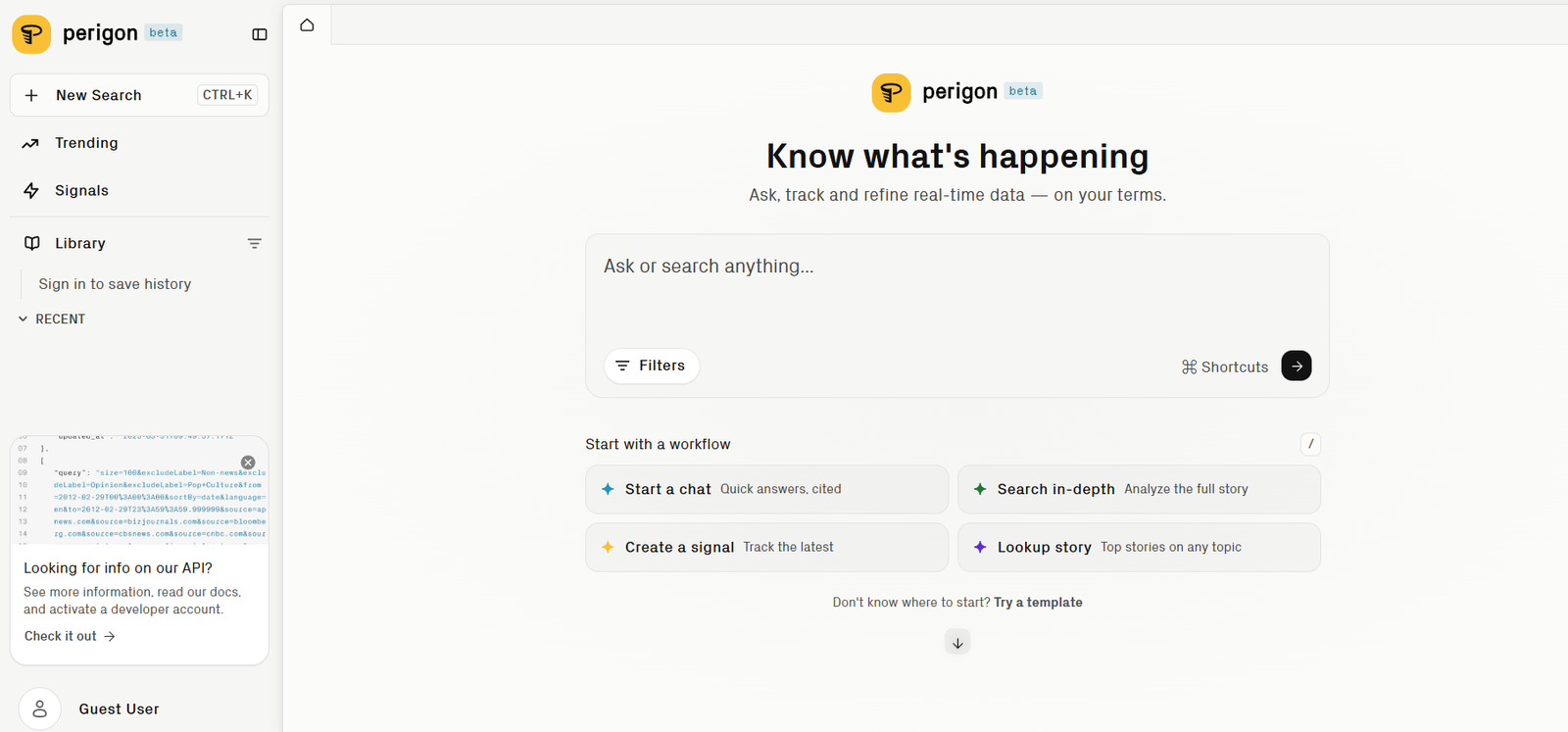
Perigon AI is a real-time news intelligence platform that aggregates, filters, and analyzes global news content from over 100,000 sources. It offers businesses, developers, and analysts structured access to global news data in real time, using AI and natural language processing (NLP) technologies to transform unstructured articles into machine-readable insights. Whether you’re building news apps, conducting media monitoring, or analyzing trends, Perigon enables intelligent decision-making based on global news coverage.
Founded to solve the problem of news fragmentation, bias, and overload, Perigon acts as a data refinery — turning the chaotic world of global news into structured, clean, and actionable information. Its API gives users access to millions of real-time and historical news articles, enriched with metadata like sentiment, bias, topic classification, and geolocation.
Features
1. Real-Time News Aggregation
Perigon continuously pulls articles from over 100,000 sources globally, including major publications, niche outlets, blogs, and newswires. The data is de-duplicated, normalized, and timestamped for high-quality feeds.
2. Natural Language Processing (NLP) Enrichment
The platform uses proprietary AI models to enrich articles with key metadata. This includes topic detection, named entity recognition (NER), sentiment analysis, geographic tagging, and media bias ratings.
3. Structured News API
Perigon’s core product is its News API, which allows developers to query and filter structured news data. Users can filter by keyword, topic, entity, sentiment, source, location, and more.
4. Bias and Sentiment Scoring
Perigon provides a unique feature that evaluates the political bias and sentiment of each article and source. This enables media monitoring that accounts for bias and supports fact-based decision-making.
5. Historical Archive
Access to years of archived articles is available, making it useful for trend analysis, competitive intelligence, and historical data modeling.
6. Event Detection and Clustering
Articles about the same event are clustered together for easier analysis. This helps users track stories and see how they evolve over time and across different regions or perspectives.
7. Alerts and Webhooks
Perigon offers custom alerts via webhooks or email when new stories match predefined criteria. Ideal for real-time monitoring applications.
How It Works
Perigon AI operates via a robust, developer-friendly News API:
Data Collection: Articles are scraped and ingested in real time from over 100,000 sources.
Normalization: Duplicate articles are removed and content is standardized.
Enrichment: NLP models add metadata such as topics, sentiment, bias, and named entities.
Filtering: Users can query using a wide range of parameters, including time, keywords, source credibility, and geographic location.
Delivery: Results are delivered in structured JSON format through the API, webhooks, or direct integrations.
Users can implement the API into custom dashboards, internal applications, or external products such as news aggregators or market research platforms.
Use Cases
1. News Aggregation Platforms
Companies building consumer-facing news apps can use Perigon to fetch timely, categorized, and bias-tagged news content in real time.
2. Competitive Intelligence
Enterprises can monitor competitors, partners, or industry trends using Perigon’s structured data and alerts.
3. ESG and Risk Monitoring
Financial institutions and ESG analysts use Perigon to identify events like fraud, scandals, or environmental violations in real time.
4. Academic Research and Journalism
Universities and think tanks leverage the API for media bias studies, trend analyses, and journalistic research.
5. AI Model Training
ML practitioners use Perigon’s enriched and labeled data for training NLP models or developing sentiment classifiers.
6. Government and Policy Monitoring
Policy analysts and public sector institutions use the tool to monitor media narratives and geopolitical developments.
Pricing
Perigon offers transparent pricing based on usage and features. While full pricing details may vary based on custom plans, the official website provides these general tiers:
1. Free Tier
Limited API requests
Access to basic filters
Developer testing only
2. Growth Plan
Starting at $99/month
Higher request limits
Includes access to sentiment, bias, and topic metadata
3. Enterprise Plan
Custom pricing
Bulk access to historical data
Webhooks, SLAs, and dedicated support
Custom onboarding and integration
Visit the Perigon Pricing Page for the most up-to-date plan details and enterprise-level options.
Strengths
1. High Data Quality
Perigon’s normalization and deduplication processes ensure users receive clean, reliable content.
2. Advanced Metadata
Sentiment, topic, bias, and geotagging features are not commonly found in traditional news APIs.
3. Real-Time Speed
News is indexed within seconds of publication, which is critical for time-sensitive applications.
4. Developer Friendly
RESTful API with detailed documentation and SDKs for easy integration.
5. Transparent Bias Metrics
Perigon’s approach to media bias and sentiment is valuable for users looking to mitigate echo chambers or misinformation.
Drawbacks
1. Limited Free Tier
The free plan is very restricted, making it difficult for startups or hobby developers to test long-term.
2. No Front-End Dashboard
As of the current offering, Perigon is an API-first platform. Non-technical users may find it challenging without a custom interface.
3. Language Support
While Perigon covers international sources, deep NLP features like sentiment and bias tagging may be stronger in English than other languages.
Comparison with Other Tools
vs. GDELT
GDELT offers a massive open database of global news events but lacks Perigon’s API-centric ease-of-use and real-time focus. GDELT data is more suitable for researchers; Perigon targets developers and real-time use cases.
vs. NewsAPI.org
NewsAPI provides aggregated headlines from a range of sources but lacks Perigon’s deep metadata tagging (e.g., bias, sentiment, event clustering). Perigon is more advanced for analytics and filtering.
vs. ContextualWeb News API
ContextualWeb is simpler and more affordable for basic use cases but doesn’t offer Perigon’s level of content enrichment or structured clustering.
Customer Reviews and Testimonials
Perigon is well-received on developer and product platforms. According to Product Hunt, users appreciate its data quality, bias detection, and real-time accuracy. Key feedback includes:
“Exactly what we needed for our news aggregation app — fast, clean, and flexible.”
“The bias and sentiment features are incredible. Saved us months of work.”
“Great documentation and support. Was able to get up and running in under 30 minutes.”
These reviews highlight the platform’s value for both solo developers and enterprise teams.
Conclusion
Perigon AI stands out as a powerful, real-time news intelligence solution designed for developers, analysts, and businesses that rely on global news insights. Its structured API, bias and sentiment scoring, and real-time clustering make it an excellent choice for applications that demand high-quality, enriched news data.
Whether you’re building a news aggregation app, conducting media monitoring, or developing AI models, Perigon provides the tools to unlock insights from global news in a reliable and scalable way.