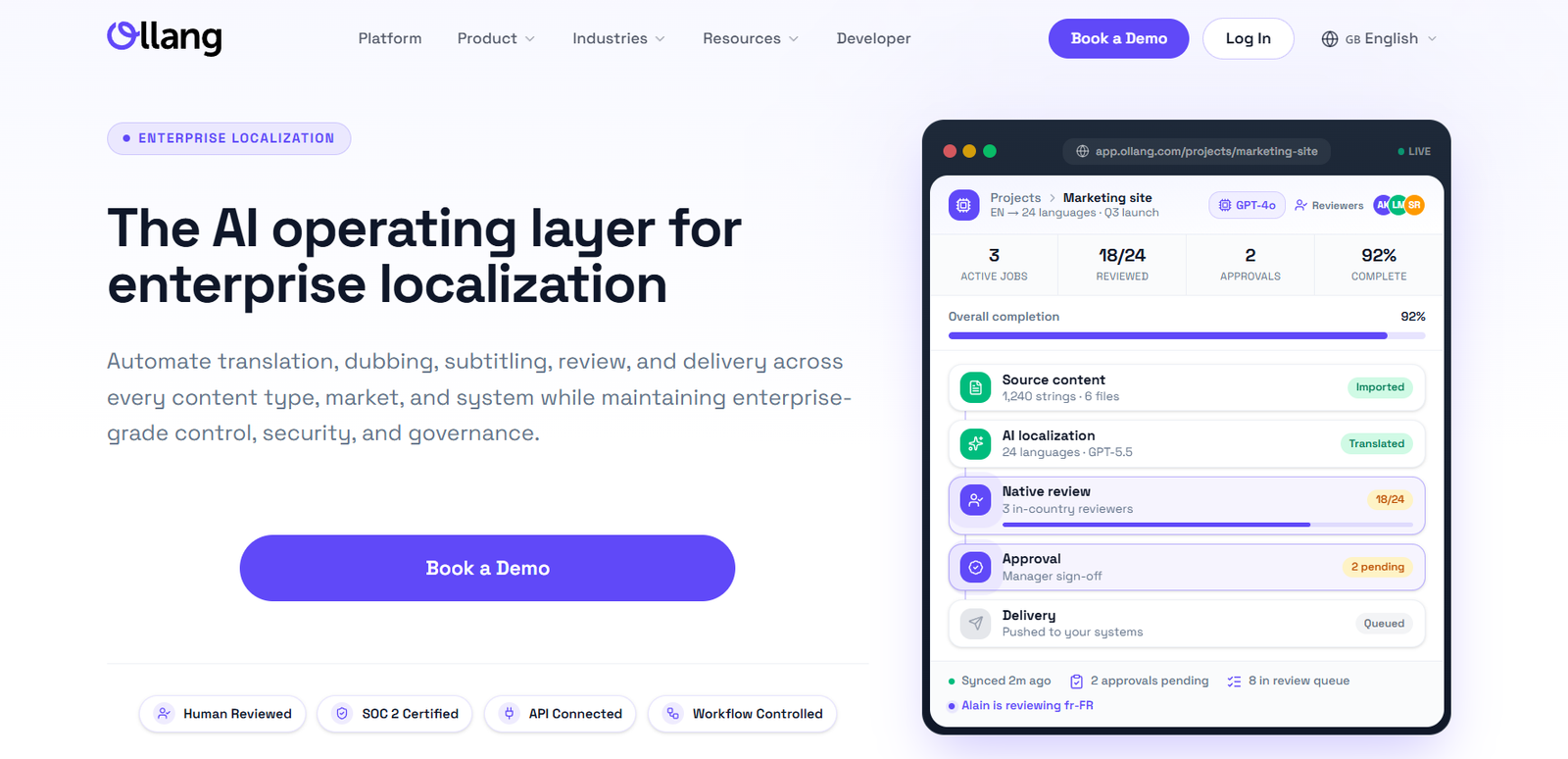
Ollang is an AI-powered enterprise localization platform designed to help organizations translate and adapt content for audiences across different languages and markets. It brings AI translation, human review, approvals, workflow management and content delivery into a unified localization environment.
The platform supports localization across text, video, audio, websites and business content. Companies can use it for translation, AI dubbing, subtitling, closed captions, website localization and other multilingual content requirements.
A major part of Ollang’s approach is combining AI automation with native-speaking human expertise. AI can handle high-volume translation quickly, while important or sensitive content can be routed to professional reviewers for language quality, cultural relevance and final approval.
Ollang is particularly suited to enterprises, media companies, SaaS businesses, ecommerce companies, gaming businesses and other organizations producing content for multiple international markets.
Features
AI Translation
Ollang uses AI to translate content across languages and formats. Organizations can process large volumes of multilingual content while managing translation, review and publishing through the same platform.
240+ Languages and Dialects
The broader Ollang platform supports more than 240 languages and dialects, including complex character sets and right-to-left languages. Support can vary by individual product or service.
AI Dubbing
Ollang provides AI-powered dubbing for video and audio content. Its technology can generate localized voice content without requiring every project to follow a conventional studio dubbing process.
Human and Hybrid Dubbing
Businesses can also use professional voice artists or combine AI with human dubbing. This hybrid approach allows automation to handle suitable portions while human professionals work on content requiring greater creative or linguistic attention.
Subtitling
Ollang provides multilingual subtitling for video content. Its workflow combines technology with professional language review to improve synchronization and localization quality.
Closed Captioning
The platform can generate and localize closed captions, helping organizations make video and audio content more accessible to audiences in different markets.
Website Localization
Ollang can translate and continuously localize websites. Businesses can connect websites using supported integrations, APIs or other implementation methods and publish localized versions for international markets.
SEO Localization
Website localization includes support for elements such as localized metadata, hreflang information and URL structures. This can help businesses build search-friendly versions of their websites for different languages.
Continuous Content Sync
When website content changes, Ollang can detect updates and process new or modified content. This reduces the need to manually restart localization every time a website is updated.
Glossary Management
Businesses can define preferred terminology and brand-specific language. This helps maintain consistency across different translations, pages and markets.
In-Context Editing
Website translations can be reviewed in the context of the actual page, helping teams understand how translated content appears within the final user experience.
Workflow Automation
Ollang allows organizations to create workflows that move content through AI translation, human review, approval and publishing stages.
Native-Speaking Review
Organizations can route selected content to native-speaking reviewers. This human layer can help identify cultural, linguistic and contextual issues that automated translation may overlook.
Review and Approval Management
Teams can manage reviews, comments, approvals and final sign-off within a shared localization workflow rather than coordinating these processes through separate tools.
Multi-Model AI System
Ollang can orchestrate different AI models and APIs within its localization environment. This allows the platform to select appropriate technology according to the language, content type and workflow.
Live AI Dubbing
Ollang also provides real-time AI dubbing for live content. The service is designed for applications such as live broadcasts, sports commentary, news and conferences.
Its live dubbing solution supports more than 30 language pairs and can work with standard streaming technologies such as WebRTC and RTMP.
Voice Cloning
For supported live dubbing workflows, Ollang can reproduce characteristics of the original speaker’s voice in another language, helping maintain a more consistent listening experience.
Localization Dashboard
Organizations can manage localization projects from a centralized console. Teams can monitor translation progress, review status, approvals, publishing and other project information.
Analytics and Insights
Ollang provides visibility into localization performance, including quality, turnaround times, workflow progress and other operational metrics.
API and Developer Tools
Developers can integrate Ollang into existing applications and workflows through APIs. The platform also provides an MCP server, SDK and AI-oriented integration options.
CMS Integrations
For website localization, Ollang supports integrations with platforms such as WordPress, Webflow and Contentful, along with additional content-management systems.
Enterprise Security
Ollang provides enterprise-oriented security capabilities including encryption, single sign-on and role-based access controls. The company states that its platform is SOC 2 certified and supports enterprise compliance requirements.
How It Works
Step 1: Create an Account or Contact Ollang
Users can start through the Ollang platform, while organizations with larger requirements can contact the company for a demonstration.
Step 2: Add the Content
Upload video, audio, documents or other supported content. Website localization customers can connect their website or content-management system.
Step 3: Select Languages
Choose the target languages and markets where the content needs to be localized.
Step 4: AI Processes the Content
Ollang uses AI to translate, subtitle, dub or otherwise localize the source material according to the selected workflow.
Step 5: Apply Human Review
Content that requires additional quality assurance can be routed to native-speaking reviewers, translators or voice professionals.
Step 6: Review and Approve
Teams can inspect localized content, request changes and complete internal approval processes before publication.
Step 7: Publish or Export
Approved content can be delivered back to connected systems or downloaded for further use, depending on the workflow.
Step 8: Automate Recurring Localization
Organizations can create workflows so future content automatically moves through translation, review, approval and publishing stages.
Step 9: Monitor Results
Teams can use the platform dashboard to follow project status, quality indicators and localization performance.
Use Cases
Media and Entertainment
Media companies can translate subtitles, captions and audio for movies, television programs, online videos and other entertainment content.
Video Creators
Creators producing videos for international audiences can use AI dubbing and subtitles to make their content available in additional languages.
SaaS Companies
Software companies can localize websites, interfaces, onboarding material, product information and customer communication for new international markets.
Ecommerce Businesses
Online retailers can translate websites, product pages and customer-facing content for shoppers in different countries.
Marketing Teams
Marketing departments can localize campaigns, landing pages, videos and creative content while maintaining consistent terminology and brand messaging.
Customer Support Teams
Companies can translate help centers, FAQs, knowledge bases, educational resources and support documentation.
Gaming Companies
Gaming businesses can use multilingual localization workflows for text, audio and other content intended for players in different regions.
Broadcasters
Broadcasters can use subtitling, captions and dubbing to distribute programs to audiences speaking different languages.
Live Events
Live dubbing can be useful for international conferences, presentations, broadcasts and other events requiring real-time multilingual audio.
Enterprise Operations
Global organizations can localize internal documentation, training materials, policies, certifications and operational information.
Developers
Development teams can use Ollang APIs, MCP and SDK capabilities to integrate localization directly into applications, content pipelines and automated deployment workflows.
Pricing
Ollang does not currently provide clear standard pricing packages on its main official website.
The platform offers options to get started, request a demonstration or contact sales depending on the localization service and enterprise requirements.
Since pricing can depend on content volume, languages, workflow requirements, AI and human review needs, prospective customers should contact Ollang for a current quotation.
Pricing details are not clearly mentioned on the official website.
Strengths
One of Ollang’s main strengths is that it combines several localization functions within one platform. Businesses can manage translation, dubbing, subtitles, reviews, approvals and delivery without building completely separate workflows for each task.
The combination of AI automation and native-speaking human review is useful for businesses that want faster localization while retaining quality control.
Its support for more than 240 languages and dialects across the broader platform makes it suitable for organizations operating across many international markets.
Ollang also handles different content formats, including websites, video, audio and text, making it more versatile than tools dedicated exclusively to document translation or video dubbing.
API, MCP and SDK support can be valuable for businesses wanting localization to become part of their existing software and content pipelines.
Live AI dubbing is another notable capability for broadcasters, event organizers and companies producing real-time content.
Drawbacks
Ollang is increasingly positioned as an enterprise localization platform, which means it may provide more functionality than an individual creator or small business requires.
Pricing is not clearly published on the main website, making direct cost comparisons with self-service localization tools more difficult.
Businesses using advanced workflows may require setup and integration work before they can take full advantage of automated localization.
Human review can improve quality, but adding professional review may also affect turnaround time and overall project cost compared with completely automated translation.
The number of supported languages can differ between services. For example, the broader platform supports more languages than some specialized offerings such as website localization or live dubbing.
Comparison with Other Platforms
Ollang competes broadly with AI translation, dubbing, localization management and multilingual content platforms.
Many AI translation tools concentrate primarily on converting text from one language to another. Ollang takes a wider approach by connecting AI translation with native-language review, approvals, workflow automation and publishing.
Compared with dedicated AI dubbing tools, Ollang covers more than voice localization. Businesses can also manage subtitles, captions, website localization and other multilingual content.
Compared with traditional localization agencies, Ollang places greater emphasis on AI automation, centralized workflow management and integrations. At the same time, it retains human review for projects where professional language expertise is important.
Its combination of AI, human expertise, developer integrations and enterprise workflow controls may therefore appeal most to organizations that need to manage localization continuously rather than complete occasional translation tasks.
Customer Reviews and Testimonials
The official Ollang website presents enterprise customer outcomes and case-study information rather than relying mainly on conventional star-based reviews.
One highlighted OTT localization workflow involved more than 12,000 minutes of subtitled video across 18 languages. Ollang reports that the combination of AI localization, native-speaking review and automated delivery significantly reduced turnaround time compared with the customer’s previous workflow.
These results are presented by Ollang itself and should be considered company-published customer outcomes rather than independent customer reviews.
Conclusion
Ollang is a comprehensive AI-powered localization platform for organizations that need to deliver content across multiple languages, markets and formats. It combines the speed of AI with human language expertise and structured enterprise workflows.
Its capabilities extend beyond basic translation to AI dubbing, human and hybrid dubbing, subtitles, closed captions, website localization, live dubbing, review management and automated publishing.
Ollang may be particularly useful for global enterprises, SaaS companies, ecommerce businesses, broadcasters, media organizations and marketing teams managing a continuous flow of multilingual content.
For users who only need occasional text translation, simpler tools may be sufficient. For organizations seeking a centralized system for managing multilingual content at scale, Ollang offers a broader combination of AI automation, human quality control and enterprise localization management.