
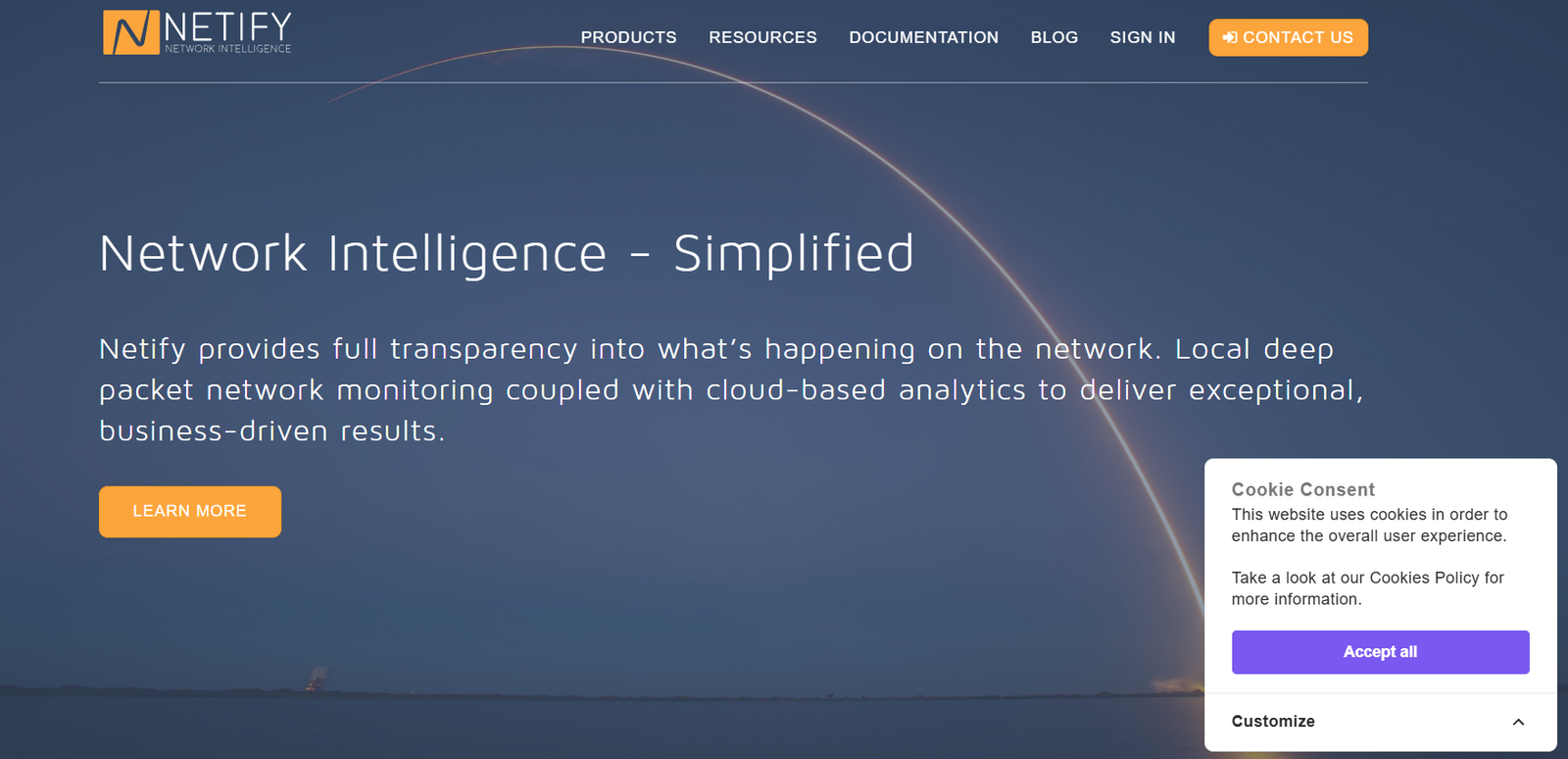
Netify.ai is an AI-powered DNS and network intelligence platform that provides real-time classification of internet traffic. It is designed to give IT departments, service providers, and cybersecurity teams full visibility into what’s happening on their networks, especially around DNS requests, domain lookups, and IP traffic.
Using machine learning, Netify.ai continuously updates and enriches its understanding of internet hosts and applications. This allows it to accurately identify websites, cloud apps, SaaS platforms, and potentially risky domains in real time.
Netify.ai operates as a cloud-based service and integrates easily into existing infrastructure via API or directly into firewalls, proxies, DNS resolvers, and other network tools. Its data feeds and lookup tools support security, content filtering, compliance, and analytics across small business, enterprise, and service provider environments.
Features
Netify.ai offers AI-powered classification for domains, IPs, and applications. The system uses advanced machine learning models to categorize traffic into thousands of well-defined categories, such as streaming media, social networking, gambling, adult content, and business tools.
The platform provides real-time DNS visibility, showing exactly which domains are being queried and resolved on a network. This allows IT teams to monitor usage patterns, identify anomalous behavior, and block or allow specific categories of traffic as needed.
With detailed threat intelligence, Netify.ai flags known malicious domains, command-and-control (C2) infrastructure, and potentially harmful applications. These alerts help organizations prevent data exfiltration, phishing, and other cyberattacks originating from DNS-level activity.
The system supports customizable content filtering by allowing administrators to set policies that block or allow specific domain categories. This makes it easy to enforce acceptable use policies in schools, businesses, and public networks.
Netify.ai also enables API integration for custom applications and reporting. Users can query the Netify database programmatically to retrieve classification data or enrich logs from SIEMs and threat hunting tools.
The platform includes a DNS lookup tool and domain explorer interface, where users can search for any domain or IP and instantly view its classification, traffic volume, historical behavior, and related metadata.
How It Works
Netify.ai works by analyzing DNS queries, IP flows, and other network signals to classify traffic. It begins with passive observation of network activity—collecting information about what domains and IPs are being accessed from a network.
This data is processed through Netify.ai’s AI engine, which uses a combination of signature detection, heuristic analysis, and machine learning models to classify each domain or IP in real time. The classification includes application type, risk level, content category, and associated metadata.
The classified data is then made available through the Netify dashboard or delivered via API to external systems. IT teams can use this data to enforce policies, generate reports, or enhance threat detection.
Because Netify.ai continuously updates its models and maintains a global threat intelligence network, its system can adapt to emerging threats and new applications without manual intervention. This makes it scalable and effective for both small networks and enterprise environments.
Use Cases
Netify.ai is used by network administrators and cybersecurity teams to monitor DNS traffic and identify unwanted or malicious activity in real time. It helps organizations gain full transparency over what users are accessing online and whether it aligns with internal policies.
Managed service providers (MSPs) integrate Netify.ai to offer enhanced security and compliance features to their clients. With deep classification and automated categorization, MSPs can provide reporting and filtering without deploying complex hardware.
In education settings, Netify.ai is used to enforce content filtering policies that restrict access to adult, gambling, or social media content during school hours.
For businesses, Netify.ai supports security teams by flagging unusual DNS patterns that may indicate malware infections, data leaks, or compromised endpoints.
Security operations centers (SOCs) use Netify.ai to enrich alerts and threat intelligence data with detailed application and domain context. This accelerates investigation and improves the accuracy of incident detection.
Software developers and analysts use Netify.ai’s API to build customized reporting dashboards or integrate traffic categorization into proprietary monitoring tools.
Pricing
Netify.ai does not publicly list pricing information on its website. The platform appears to offer flexible licensing based on the number of endpoints, volume of traffic, or API usage.
Potential users, including MSPs, enterprises, and software developers, are encouraged to contact the Netify.ai team directly to request a quote or schedule a demo tailored to their specific use case.
Depending on the implementation needs, Netify.ai may offer data feeds, dashboard access, cloud-hosted solutions, or on-premise integrations. Trial access or sandbox environments may also be available for evaluation purposes.
Strengths
Netify.ai excels in providing high-accuracy traffic classification without requiring deep packet inspection or invasive monitoring. Its reliance on AI and DNS data makes it lightweight, privacy-conscious, and fast to deploy.
The platform’s real-time classification engine is continuously updated and improves over time, thanks to machine learning. This ensures ongoing protection against new threats and evolving application behavior.
Netify.ai supports easy integration through REST APIs and standardized formats. This allows organizations to plug it into existing firewalls, SIEMs, or data analytics platforms with minimal development effort.
Another key strength is the breadth of categories and depth of metadata available for each domain. IT teams can understand not only the category of a website but also its application type, risk level, geolocation, and usage history.
Because Netify.ai focuses on DNS-layer intelligence, it is ideal for environments where privacy and encrypted traffic pose challenges for traditional monitoring methods.
Drawbacks
Netify.ai is a specialized platform, and while it excels at DNS and domain classification, it does not provide a full suite of network management tools like firewall configuration or endpoint protection.
The absence of publicly available pricing may make it difficult for smaller organizations to assess affordability upfront without a sales engagement.
The product is designed primarily for B2B use cases, which means individual users or very small businesses may find the platform more complex or feature-rich than necessary for basic needs.
As a data classification tool, Netify.ai requires integration into existing infrastructure to deliver its full value. Organizations without a mature IT setup may need support to get started.
Comparison with Other Tools
Compared to DNS-based filtering tools like Cisco Umbrella or Cloudflare Gateway, Netify.ai focuses more heavily on real-time AI classification and detailed metadata enrichment. This makes it especially valuable for teams looking to build custom analytics or enhance security operations with contextual DNS intelligence.
Unlike traditional threat intelligence feeds, Netify.ai provides real-time lookups and full application categorization, which goes beyond simple blacklists or IP reputation scoring.
Compared to endpoint detection and response (EDR) platforms, Netify.ai does not monitor local processes but instead provides a network-level view, which complements rather than replaces EDR solutions.
Its lightweight deployment model and powerful API access make it attractive for developers and MSPs seeking to build DNS-aware products or services without managing complex backends.
Customer Reviews and Testimonials
Netify.ai is widely used in managed IT and security environments, with customers praising its classification accuracy, ease of integration, and the depth of insights it provides from DNS data.
MSPs value the ability to offer enterprise-grade traffic categorization to small and medium clients without investing in expensive appliances or hardware.
Cybersecurity professionals highlight the platform’s usefulness in detecting suspicious domain activity and its ability to enrich SIEM alerts with domain context and risk scoring.
Although Netify.ai does not display individual customer testimonials on its website, its technology is integrated into several network security solutions and widely adopted in both commercial and government contexts.
Users have noted that Netify.ai helps reduce response times during incident investigations by providing immediate answers to key questions about domain or IP activity.
Conclusion
Netify.ai is a powerful AI-driven DNS and network intelligence platform that enables organizations to gain deep, real-time visibility into domain and IP activity on their networks. With its advanced classification engine, flexible APIs, and easy integration, Netify.ai helps IT and security teams enforce policy, monitor threats, and enhance network transparency without complexity.
Whether you’re an MSP, enterprise IT manager, or cybersecurity professional, Netify.ai offers a scalable and intelligent solution to the growing challenge of understanding and securing modern network traffic.
For organizations looking to transform raw DNS data into actionable insights, Netify.ai provides a reliable, intelligent, and adaptable platform that meets both security and operational needs.


