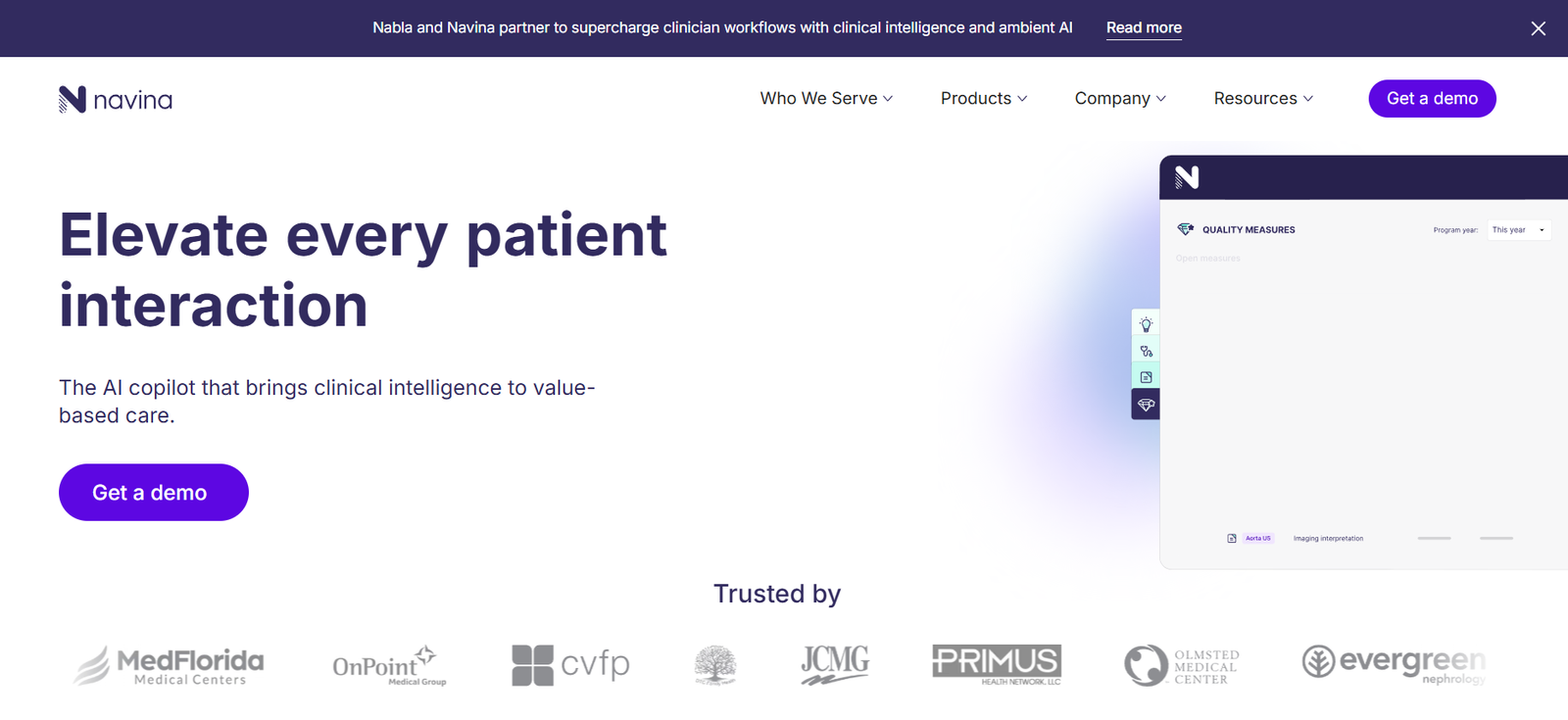
Navina is an AI-powered clinical intelligence platform built to support primary care physicians by turning scattered, unstructured patient data into a structured and insightful clinical summary. The platform’s core mission is to address physician overload caused by disorganized EHRs, fragmented data, and increasing administrative demands.
By using artificial intelligence and natural language processing (NLP), Navina pulls relevant information from multiple data sources—such as notes, labs, radiology, claims, and structured EHR data—and presents it in a visual interface that physicians can review in seconds.
This drastically improves efficiency during patient visits, supports diagnosis and treatment planning, and ensures that critical information is never overlooked.
Features
Navina delivers a robust suite of tools that help clinicians and care teams manage patients more effectively and efficiently:
AI-Powered Clinical Summaries: Presents a holistic, structured overview of each patient from messy, unstructured data.
Contextual Data Aggregation: Pulls in real-time data from EHRs, labs, consult notes, claims, and more.
Point-of-Care Decision Support: Surfaces urgent issues, care gaps, and risk factors during appointments.
HCC Coding and Risk Adjustment: Identifies missed HCC opportunities and documentation gaps to support accurate reimbursement.
Actionable Alerts: Flags abnormal lab results, overdue screenings, and potential diagnoses.
Visual Interface: Designed for quick comprehension with color-coded alerts, summaries, and timelines.
Seamless EHR Integration: Works with major systems like Epic and Athenahealth to embed into existing workflows.
HIPAA-Compliant and Secure: Enterprise-grade encryption and privacy controls.
Multidisciplinary Support: Useful for physicians, nurse practitioners, and care coordinators.
Customizable Views: Tailor insights based on individual workflow or specialty needs.
How It Works
Navina integrates directly with a clinic’s or health system’s EHR and data infrastructure. Once connected, it continuously ingests and analyzes structured and unstructured data sources, including:
Progress notes
Radiology and pathology reports
Lab results
Referral letters
Claims and eligibility data
The platform applies machine learning and NLP to extract meaningful clinical concepts, flag abnormalities, and match the data to the most relevant health risks or gaps. Physicians are presented with a visual patient profile before or during each visit, which includes:
Summarized conditions
Outstanding care gaps
Relevant labs and imaging
Risk scores
Suggestions for documentation (e.g., HCC codes)
This allows providers to walk into each visit with a complete clinical picture in minutes, not hours.
Use Cases
Navina is designed for use in a wide range of clinical and administrative settings, particularly in primary care and value-based care models:
Primary Care Visits: Give physicians an organized view of the patient’s health, history, and care gaps at the point of care.
HCC Risk Adjustment: Identify and close coding gaps in risk-based contracts such as Medicare Advantage.
Annual Wellness Visits: Ensure all relevant data and preventive care items are addressed.
Chronic Disease Management: Track lab trends, medication adherence, and comorbidities over time.
Population Health Programs: Highlight care gaps and risk scores across patient panels.
Multidisciplinary Team Support: Equip nurses, care coordinators, and health coaches with insights.
Pre-Visit Planning: Allow teams to prepare for visits with data-driven insights before the patient arrives.
Pricing
Navina does not publish pricing on its official website. It offers custom enterprise pricing based on organization size, number of providers, and level of integration required.
Pricing considerations typically include:
Number of clinicians or care team members using the platform
Scope of data integration (EHR systems, claims, third-party apps)
Volume of patients and visits
HCC risk adjustment module access
Onboarding and support services
Interested healthcare organizations can request a personalized demo and quote via the Navina contact page.
Strengths
Navina offers several significant advantages for healthcare organizations focused on clinical quality and efficiency:
Reduces cognitive load for physicians during visits
Improves diagnosis speed and documentation accuracy
Enhances visibility into care gaps and risk conditions
Streamlines HCC coding and revenue capture
Integrates cleanly with existing EHR systems
Designed with clinician input for optimal usability
Supports scalable value-based care initiatives
Improves both patient outcomes and provider satisfaction
Drawbacks
While powerful, Navina has a few limitations to keep in mind:
No publicly available pricing, making cost evaluation difficult for small practices
Primarily focused on primary care, less optimized for surgical or subspecialty workflows
Requires EHR integration, which may take time depending on the IT stack
Initial training and change management needed to fully adopt across teams
Limited direct-to-consumer visibility; platform is enterprise-focused
Comparison with Other Tools
Navina competes with other clinical intelligence and decision support tools such as:
Notable Health: Focuses more on automation and admin workflows, less on in-visit clinical decision support.
Pieces: Offers AI-driven decision support but is more hospital- and acute-care-oriented.
Suki and DAX (Nuance): Improve note-taking through voice AI but don’t organize complex patient data visually.
Health Catalyst: Offers analytics and care management tools, but not point-of-care summaries.
Navina’s strength lies in its point-of-care intelligence interface, built specifically for busy primary care providers navigating complex patients and care gaps in value-based environments.
Customer Reviews and Testimonials
Navina is deployed in several leading health systems and clinics across the U.S., particularly those operating under risk-based contracts.
Key feedback includes:
“Navina saves me 10-15 minutes per patient, every day.”
“I walk into visits confident I haven’t missed anything.”
“Our HCC coding accuracy went up within weeks of deployment.”
“It’s like a clinical co-pilot that reads everything I don’t have time to read.”
While third-party review platforms like G2 or Capterra do not yet list Navina, customer success stories on their website suggest strong provider adoption and satisfaction.
Conclusion
Navina is transforming the way primary care physicians interact with patient data by offering a powerful, AI-driven clinical intelligence platform. By turning fragmented, disorganized information into actionable insights, Navina helps providers make better decisions faster—while also supporting value-based care goals like HCC coding, care gap closure, and chronic disease management.
For healthcare organizations aiming to improve care quality, reduce provider burnout, and enhance operational efficiency, Navina offers a scalable, future-ready solution. It doesn’t replace the clinician—it augments their ability to deliver thoughtful, data-informed, and personalized care at every visit.