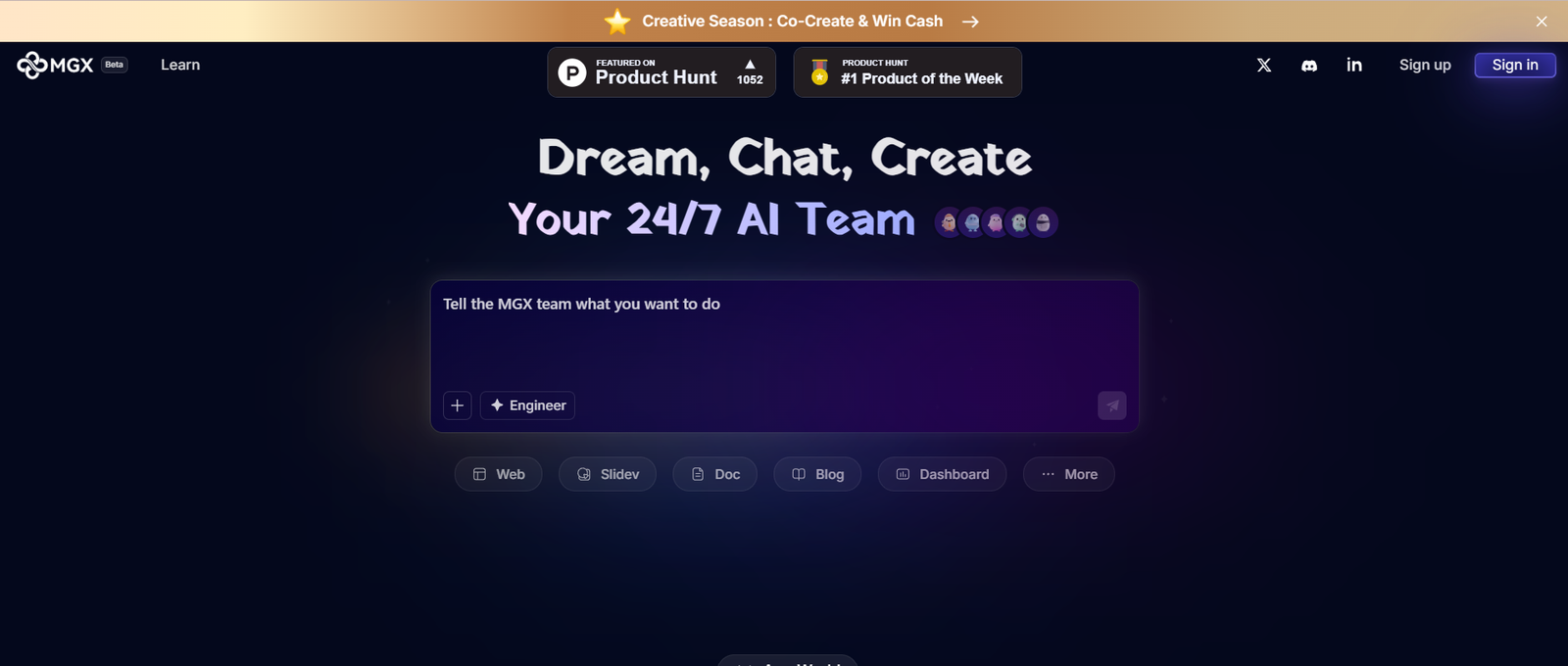
Magick (MGX) is an open-source, visual development platform for building and managing AI agents, LLM-powered tools, and intelligent workflows. It allows developers, researchers, and tinkerers to construct fully functioning AI agents without writing code, using a visual, node-based editor.
The platform combines the capabilities of natural language models, APIs, memory tools, and logic modules into a drag-and-drop environment, making it easy to build autonomous or semi-autonomous agents for tasks such as chat, search, creative generation, and decision-making.
By focusing on modularity, openness, and flexibility, Magick empowers users to experiment with agent architecture, iterate rapidly, and deploy functional AI-driven systems for real-world or experimental use.
Features
Magick offers a robust set of features that support the development and deployment of AI agents.
Its core component is a visual canvas where users can construct agent logic through interconnected nodes. Each node represents a function or module such as prompt generation, memory recall, API integration, or conditional logic.
The platform is LLM-agnostic, meaning users can plug in different models such as OpenAI’s GPT, Anthropic’s Claude, or open-source models like Mistral and LLaMA via API connectors.
It includes built-in support for memory systems, enabling agents to store and retrieve contextual information. This allows developers to create agents with continuity, personalization, and task history awareness.
Users can integrate external APIs, build tools, or connect services like Discord, Slack, or custom APIs to give agents real-world capabilities and connectivity.
Magick supports real-time monitoring and debugging of agent behavior, which is especially useful during development. Users can observe how data flows through the node system and fine-tune performance with instant feedback.
It includes authentication, event handling, scheduling, and state management features for creating agents that run in production environments.
The platform is entirely open-source and available for local deployment or self-hosting, making it a secure and customizable option for developers who want full control over their infrastructure.
How It Works
Magick is built around a visual scripting interface that allows users to connect nodes and build logic-based workflows.
Users begin by launching a project and opening the canvas, where they drag and drop nodes to define how the AI agent behaves. Nodes might include a system prompt, user input, LLM call, memory access, condition checks, and output.
Once the flow is established, the agent listens for incoming events such as user messages, API triggers, or system actions. It processes the input through the defined logic and returns a response or action.
Because each node represents a specific function, users can build highly complex behaviors by combining simple elements. For example, one part of the flow can retrieve a document from an external source, while another part generates a summary or responds in character.
Developers can test and debug the flow in real-time, inspecting variable values and output data at each stage of execution. This makes the development process more transparent and easier to troubleshoot.
The platform also includes a plugin system and SDK, enabling more advanced users to write their own modules or integrate third-party libraries.
Use Cases
Magick can be used in a wide variety of applications where AI agents or logic-based workflows are beneficial.
Developers use it to build autonomous chat agents for customer service, onboarding, or interactive entertainment experiences.
Research teams use Magick to prototype agent behavior for LLM experiments, testing how different prompt structures and memory systems affect output quality.
In the creative space, writers and designers use Magick to build interactive storytelling bots, character-driven assistants, or tools for generating narrative content.
Startups build internal productivity bots, knowledge assistants, and workflow automators that operate across systems using APIs, memory, and logic.
Educators and hobbyists use the platform as a learning tool to explore how AI agents work, simulate decision trees, or build educational chatbots.
Pricing
Magick (MGX) is fully open-source and free to use. The source code is available on GitHub, and users can clone and run it locally or on a private server.
There is no official pricing for hosted services, premium tiers, or enterprise licensing as of the current release. The platform is community-driven, and all core features are freely accessible.
For organizations or teams looking to deploy Magick in production environments, the flexibility of self-hosting allows for full customization without vendor lock-in or usage-based fees.
Commercial support or managed hosting may be offered in the future as the platform evolves, but at present, Magick remains an open, community-powered tool.
Strengths
Magick’s biggest strength is its visual, no-code interface for building complex AI logic. This lowers the barrier to entry for building AI agents and enables faster prototyping and experimentation.
The open-source nature gives developers full control over the environment, making it suitable for secure or highly customized deployments.
Its flexibility in supporting any LLM or external tool means it can be adapted to a wide range of tasks and industries.
The inclusion of memory systems and logic nodes allows for the development of truly interactive, context-aware agents, not just simple chat interfaces.
Magick also stands out for its developer experience, offering real-time debugging, visual state tracking, and a modular plugin system.
Drawbacks
As an emerging platform, Magick may not yet have the polish or extensive documentation found in commercial agent frameworks.
New users may face a learning curve in understanding how to structure flows effectively, especially without strong documentation or tutorials.
There is currently no native hosting or managed service, which means non-technical users may find setup and deployment challenging.
Community support is still growing, and while active, it may not yet provide instant answers to more complex implementation questions.
For production deployment at scale, additional engineering work may be needed to integrate authentication, error handling, and monitoring tools.
Comparison with Other Tools
Compared to agent platforms like LangChain or AutoGPT, Magick offers a visual interface rather than code-based scripting, which makes it more accessible to non-developers or cross-functional teams.
While LangChain provides extensive tool and model support in Python, Magick focuses on modular, real-time agent building in a no-code/low-code format.
Against tools like Flowise or Replit Ghostwriter, Magick gives users deeper control over agent logic and offers more complex memory and state handling out-of-the-box.
Unlike proprietary platforms like Cognosys or Character.AI, Magick does not restrict usage or model choice, making it more flexible for both experimentation and commercial use.
It’s an ideal middle ground for teams who want both freedom and structure—code-free design with developer extensibility.
Customer Reviews and Testimonials
Magick has received positive early feedback from developers and AI builders exploring agent architecture. Users appreciate the flexibility to build rich, contextual agents without extensive code or infrastructure setup.
Community discussions on GitHub and Discord reflect excitement about the modular design, memory support, and real-time feedback features. Early adopters report that Magick helps them iterate faster and better understand how agent behavior is constructed.
Some users have requested more tutorials and documentation to ease onboarding, while others have begun contributing to the codebase with new plugins and features.
The open development model and responsiveness of the core team have helped build trust and momentum within the AI development community.
Conclusion
Magick (MGX) is a powerful, open-source platform for building intelligent AI agents through a visual interface. Combining drag-and-drop logic, memory management, and LLM integration, it provides a flexible and intuitive environment for developers, researchers, and creatives to explore the future of AI-driven systems.
Its modular approach, real-time debugging, and open ecosystem make it a standout tool for those looking to move beyond simple chat interfaces and into more dynamic, autonomous agent design. Whether you’re building a customer assistant, a research tool, or a creative companion, Magick offers a modern and customizable foundation for your AI projects.