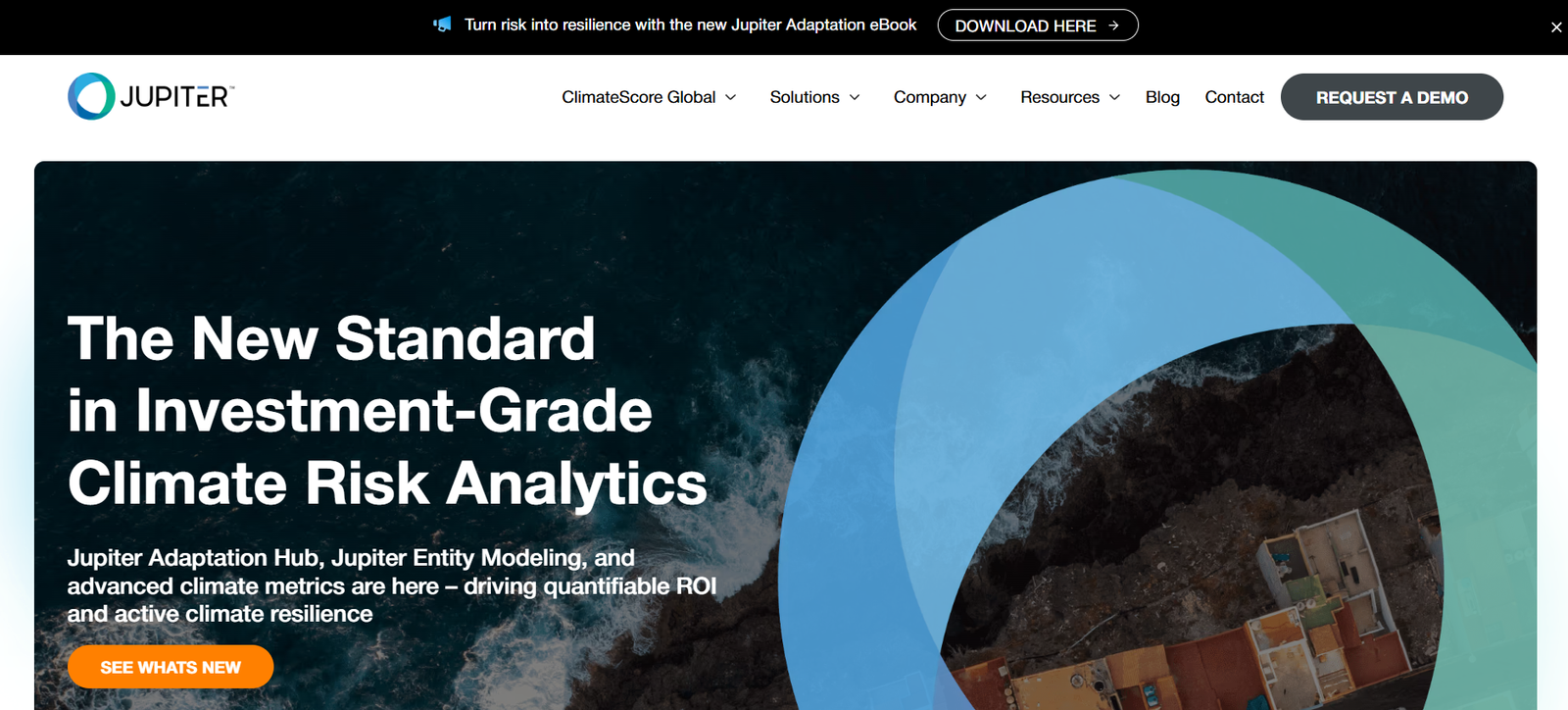
Jupiter Intelligence is a leading provider of physical climate risk analytics, delivering precise, science-based insights to help businesses, governments, and financial institutions assess, plan for, and mitigate the impacts of climate change. With a focus on physical risks like flooding, wildfires, extreme heat, and wind, Jupiter’s solutions support strategic climate adaptation and resilience planning at asset, portfolio, and infrastructure levels.
Built on advanced climate science, engineering models, and AI, Jupiter’s cloud-based platform delivers real-time and future-looking risk data tailored to specific geolocations. These insights enable decision-makers to quantify climate exposure, comply with climate reporting regulations, and protect long-term investments from climate-related threats.
Jupiter Intelligence works with Fortune 500 companies, insurers, utilities, governments, and asset managers seeking reliable and actionable climate intelligence to inform sustainable growth and resilience.
Features:
Climate Risk Modeling
Jupiter offers hyperlocal modeling of physical climate hazards, including flood, fire, heat, drought, hail, wind, and air quality degradation.Future Scenario Forecasting
Uses peer-reviewed climate models and emissions scenarios (e.g., IPCC RCPs and SSPs) to project risk through 2100.Asset-Level Risk Assessment
Provides precise risk analysis for individual assets, including infrastructure, real estate, and industrial facilities.Portfolio Risk Aggregation
Enables organizations to assess risk across entire portfolios, helping financial and real estate clients manage systemic exposure.ClimateScore™ Intelligence
Jupiter’s proprietary ClimateScore™ product provides risk scores for physical assets under current and future climate conditions.Regulatory Compliance Support
Supports TCFD, CSRD, and SEC climate-related financial disclosures with transparent methodologies and auditable data.Geospatial Data Integration
Combines Earth observation data, climate simulations, and hydrological models with advanced AI/ML analytics.APIs and Platform Access
Delivers insights via APIs or through the ClimateScore™ Portal for integration into enterprise systems and workflows.Custom Climate Resilience Planning
Jupiter’s analytics support scenario planning, infrastructure design, and risk mitigation strategies tailored to each client’s geography and risk profile.
How It Works:
Data Collection and Integration
Jupiter aggregates satellite data, weather station records, topography, land use data, and climate projections into its analytics engine.Climate Modeling and Simulation
High-resolution simulations model climate hazards across multiple time horizons under different global warming scenarios.Asset Mapping and Analysis
Users upload asset locations or portfolio data; Jupiter assigns risk metrics to each based on local conditions and climate projections.Risk Scoring and Reporting
Each asset or region is assigned a ClimateScore™ and accompanied by detailed reports on probability, severity, and projected changes.Visualization and Dashboarding
Results are delivered through interactive dashboards or can be exported via APIs or reports for use in planning and reporting.Ongoing Monitoring and Updates
Jupiter continuously updates its models with the latest data and can provide dynamic risk tracking over time.
Use Cases:
Real Estate Investment
Jupiter helps developers, REITs, and investors evaluate climate exposure for property portfolios and incorporate resilience into asset planning.Banking and Insurance
Supports underwriting and risk assessment for insurers and lenders, enabling better financial modeling and premium pricing.Government and Public Sector
Assists cities, utilities, and transportation authorities in understanding infrastructure vulnerability and planning adaptive strategies.Energy and Utilities
Identifies threats to power grids, generation assets, and transmission infrastructure from heat, storms, and wildfires.Manufacturing and Logistics
Assesses operational risk from supply chain disruptions and asset downtime due to extreme weather.Climate Reporting and ESG
Provides the data backbone for TCFD, SEC, and other climate disclosure frameworks, supporting sustainability and compliance.
Pricing:
Jupiter Intelligence does not provide standardized public pricing due to the customized nature of its solutions. Pricing typically depends on:
Number and Size of Assets
Risk assessments are scaled to portfolios, facilities, or asset classes.Hazards Analyzed
The breadth of climate risks modeled (e.g., flood, fire, heat, wind) affects pricing tiers.Access Method
API access, dashboard use, or custom reporting may each carry different costs.Geographical Scope
Global coverage is available, but pricing may vary based on region-specific modeling complexity and data availability.Service Level and Support
Custom consulting or integration services may be priced separately.
Organizations interested in pricing can request a demo or consultation here:
https://www.jupiterintel.com/contact
Strengths:
High-Resolution Climate Risk Modeling: Hyperlocal insights down to the building or street level.
Scientific Rigor: Uses peer-reviewed, science-based methodologies aligned with global climate scenarios.
Comprehensive Hazard Coverage: Models multiple physical climate risks across geographies and timeframes.
Trusted by Leading Institutions: Jupiter works with governments, top corporations, and financial institutions worldwide.
Portfolio and Asset-Level Support: Helps both individual asset owners and portfolio managers.
Regulatory Alignment: Built to support climate disclosures under TCFD, SEC, and EU regulations.
Interactive Dashboards and API: Enables both visual and programmatic access to climate data.
Drawbacks:
No Free Tier or Public Tools: Designed for enterprise users; inaccessible to small businesses or individuals.
Pricing Transparency: Lack of upfront pricing can be a barrier to early-stage or smaller organizations.
Enterprise Integration Required: API usage or deep analytics may require technical resources.
Focused on Physical Risks Only: Does not provide deep coverage of transition risks like regulatory or market changes.
Limited Public Documentation: Technical documentation and model transparency are mostly available through client engagement.
Comparison with Other Tools:
Sust Global: Offers similar asset-level climate risk data with a strong focus on geospatial integration. Jupiter differentiates with broader hazard modeling and the ClimateScore™ system.
Cervest: Also provides asset-level risk analysis. Jupiter offers deeper hazard modeling and long-term projections up to 2100.
Climate Alpha: Focuses more on predictive real estate value under climate change; Jupiter provides detailed risk modeling for multiple sectors.
The Climate Service (S&P Global): Offers robust risk assessment tools with regulatory alignment. Jupiter provides more customizable hazard analysis and scientific depth.
Customer Reviews and Testimonials:
While Jupiter Intelligence does not publish individual reviews on its site, its client base and media features indicate broad adoption and satisfaction.
Key partnerships and endorsements include:
Collaborations with U.S. Cities: Jupiter has supported city governments in climate adaptation planning, including flood and heat stress modeling.
Utilities and Infrastructure Firms: Work with Jupiter to assess risk to energy assets and transportation systems.
Coverage in Major Media: Featured in outlets like The Wall Street Journal, Forbes, and Bloomberg as a leader in climate risk modeling.
A quote from their website:
“Our clients rely on Jupiter’s risk intelligence to guide multi-million-dollar infrastructure and investment decisions in a changing climate.”
More information on clients and case studies is available at:
https://www.jupiterintel.com/resources
Conclusion:
Jupiter Intelligence is a top-tier provider of climate risk analytics, offering scientifically grounded, location-specific insights to help businesses and governments navigate the growing challenges of climate change. Its asset-level modeling, hazard coverage, and compliance-ready outputs make it a trusted partner for climate resilience planning and disclosure reporting.
Whether you’re managing a real estate portfolio, designing infrastructure, or meeting ESG requirements, Jupiter delivers the advanced analytics needed to quantify physical climate risk and build for a more resilient future.