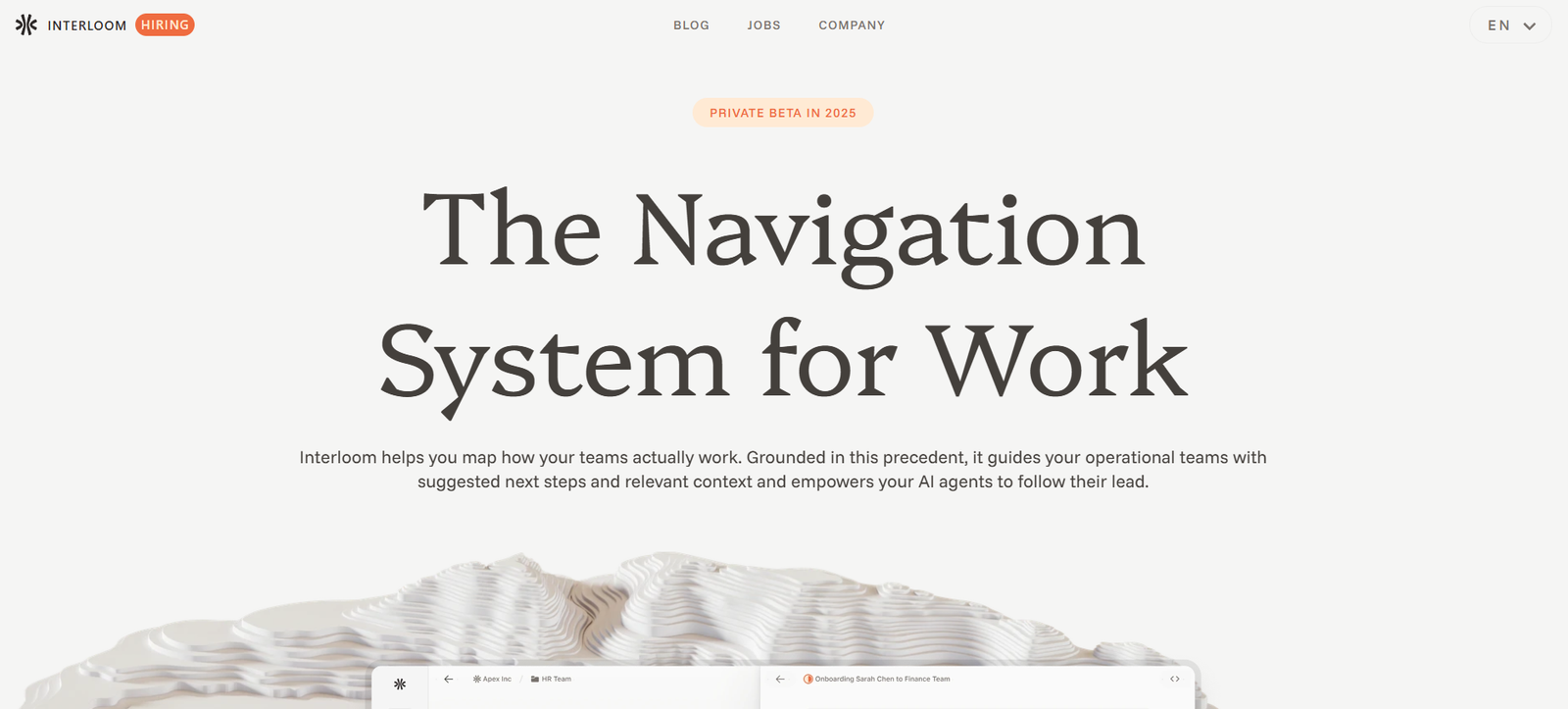
Interloom is an AI-powered platform designed to help teams and organizations turn unstructured information into a dynamic, centralized knowledge base. It simplifies the process of organizing, searching, and using internal knowledge by connecting scattered data across apps and workflows. With a focus on structured thinking, Interloom empowers teams to transform notes, ideas, documents, and resources into actionable workflows and reusable knowledge.
The platform is built for teams that deal with fast-moving projects and complex communication across functions. By linking information intelligently and automating knowledge flows, Interloom ensures that critical insights don’t get lost in disconnected tools or siloed conversations.
Features
Interloom offers a robust set of features to organize team knowledge and improve operational efficiency.
Its core feature is the AI-powered knowledge graph, which automatically links related pieces of information together, providing context and traceability. Whether you’re writing a note, updating a project plan, or reviewing feedback, Interloom connects content to relevant entities like teams, projects, and tasks.
The Loomboard is a dynamic workspace that allows users to create, edit, and link information cards in a visual, board-style interface. Teams can use this to manage everything from meeting notes and product specs to decision logs and action plans.
Context-aware search helps users find answers quickly, even when they’re buried deep within multiple threads or documents. The platform indexes everything and uses semantic AI to deliver relevant results, including related insights that may not be explicitly mentioned.
Users can build and automate knowledge workflows, which guide teams through repeatable processes like onboarding, product launches, or incident response. This ensures consistency and reduces redundant work across the organization.
Interloom supports real-time collaboration, allowing multiple users to contribute, tag, and link content simultaneously. All changes are tracked, making it easy to review decision history and context.
The platform also integrates with popular tools like Slack and Notion, enabling information to flow between systems and reducing the need for app switching.
How It Works
Interloom transforms how organizations handle information by acting as a centralized, intelligent workspace.
Users begin by creating “looms”—modular information cards that can contain notes, documents, links, or embedded media. These looms are categorized by context such as projects, departments, or workflows.
The platform uses AI to analyze content and automatically build a knowledge graph. Related looms are linked together, helping users see the full picture and identify gaps in knowledge or execution.
The Loomboard acts as a control center where users can group related cards visually. It functions like a digital whiteboard or kanban system, but with AI-enhanced organization and suggestions.
When teams need to execute recurring tasks or processes, they can use workflow templates that pre-define the steps, responsible parties, and necessary resources. This reduces cognitive load and boosts team efficiency.
All content is indexed and searchable with Interloom’s semantic search engine. Users can enter natural language queries and receive contextual results along with suggested follow-ups or related resources.
Use Cases
Interloom supports a wide range of use cases across different industries and departments.
Product teams use Interloom to manage product development cycles, from discovery and feature planning to release documentation and feedback tracking. The knowledge graph connects all stages of development, ensuring continuity.
Operations teams rely on Interloom to document and execute standard operating procedures. By turning SOPs into interactive workflows, teams ensure consistent execution and easy knowledge transfer.
In marketing, Interloom helps teams coordinate campaign planning, messaging strategy, and content creation. It links insights from customer research to project briefs and creative assets.
Customer support teams use Interloom to centralize support documentation, track resolution workflows, and improve knowledge sharing between teams.
For HR and People Ops, Interloom is useful for onboarding processes, policy documentation, and managing employee feedback cycles.
Founders and leadership teams benefit from Interloom by using it as a digital memory hub for decisions, priorities, investor communications, and strategic planning.
Pricing
As of now, Interloom does not display public pricing tiers on its website. The platform appears to follow a custom or request-based pricing model. This approach allows the team to tailor pricing to the specific needs and size of each organization.
Prospective users are encouraged to request access or schedule a demo directly via the website to learn more about available features and pricing. This suggests that Interloom is currently working with early access users or offering the platform in a private beta.
To inquire about access and pricing, visit interloom.com and fill out the request form.
Strengths
Interloom stands out for its unique approach to knowledge management, focusing not just on storing information but on structuring and connecting it intelligently. The knowledge graph and semantic linking allow teams to break out of traditional folder structures and surface insights they didn’t even know they had.
Its AI-driven automation of workflows and content relationships eliminates manual tagging and organizing, saving teams hours of administrative effort.
The Loomboard interface is intuitive and flexible, making it easy to visualize complex projects and content relationships without needing training or configuration.
Interloom’s real-time collaboration and seamless search functionality further strengthen its usability across cross-functional teams.
By integrating with existing tools like Slack, Interloom makes adoption smoother and ensures continuity across platforms.
Drawbacks
Interloom is a relatively new platform, and as such, it may lack some of the advanced customization options or integrations offered by more mature knowledge management tools.
The absence of public pricing may make it harder for teams to evaluate the platform upfront or compare it with alternatives during the research phase.
Since the platform is likely still in early-access or controlled release, potential users might experience wait times or limited onboarding resources compared to mainstream SaaS products.
Because Interloom relies heavily on AI-generated suggestions and relationships, users must trust its contextual accuracy, which could vary based on content quality or team usage patterns.
Comparison with Other Tools
Compared to platforms like Notion, Coda, or Confluence, Interloom takes a fundamentally different approach by emphasizing structured knowledge relationships over hierarchical organization. Rather than relying on folders and pages, Interloom builds a graph of connected insights.
Unlike project management tools such as Asana or Trello, Interloom is designed to serve as a dynamic knowledge base first, with workflows layered on top. This makes it more suitable for teams that need both documentation and process automation in one place.
AI-powered knowledge tools like Mem and Dashworks also offer semantic search and knowledge graphs, but Interloom goes a step further by allowing users to build end-to-end workflows from linked information.
Interloom’s strongest differentiator is its blend of collaborative documentation, semantic AI, and visual knowledge mapping—all in a single platform.
Customer Reviews and Testimonials
As of now, Interloom does not publish customer reviews or testimonials directly on its website. This is common for platforms in early access or beta stages.
However, the product messaging and design suggest that Interloom is working closely with early adopters and likely gathering direct feedback to improve the platform before wider release.
Interested users are encouraged to follow Interloom’s LinkedIn page or sign up on the site to receive updates and be part of the early user community.
Conclusion
Interloom is a promising AI-powered platform designed to help teams organize knowledge, automate workflows, and foster structured thinking. By combining dynamic workspaces, semantic AI, and visual knowledge mapping, it offers a fresh and intelligent alternative to traditional documentation and project tools.
While still in early-access mode, Interloom has the potential to become a go-to platform for teams looking to reduce information overload and increase operational clarity. Its emphasis on AI-driven connections and reusable workflows makes it especially valuable for fast-paced, cross-functional environments.
For organizations ready to move beyond scattered notes and fragmented tools, Interloom presents a unified, structured approach to team knowledge and productivity.