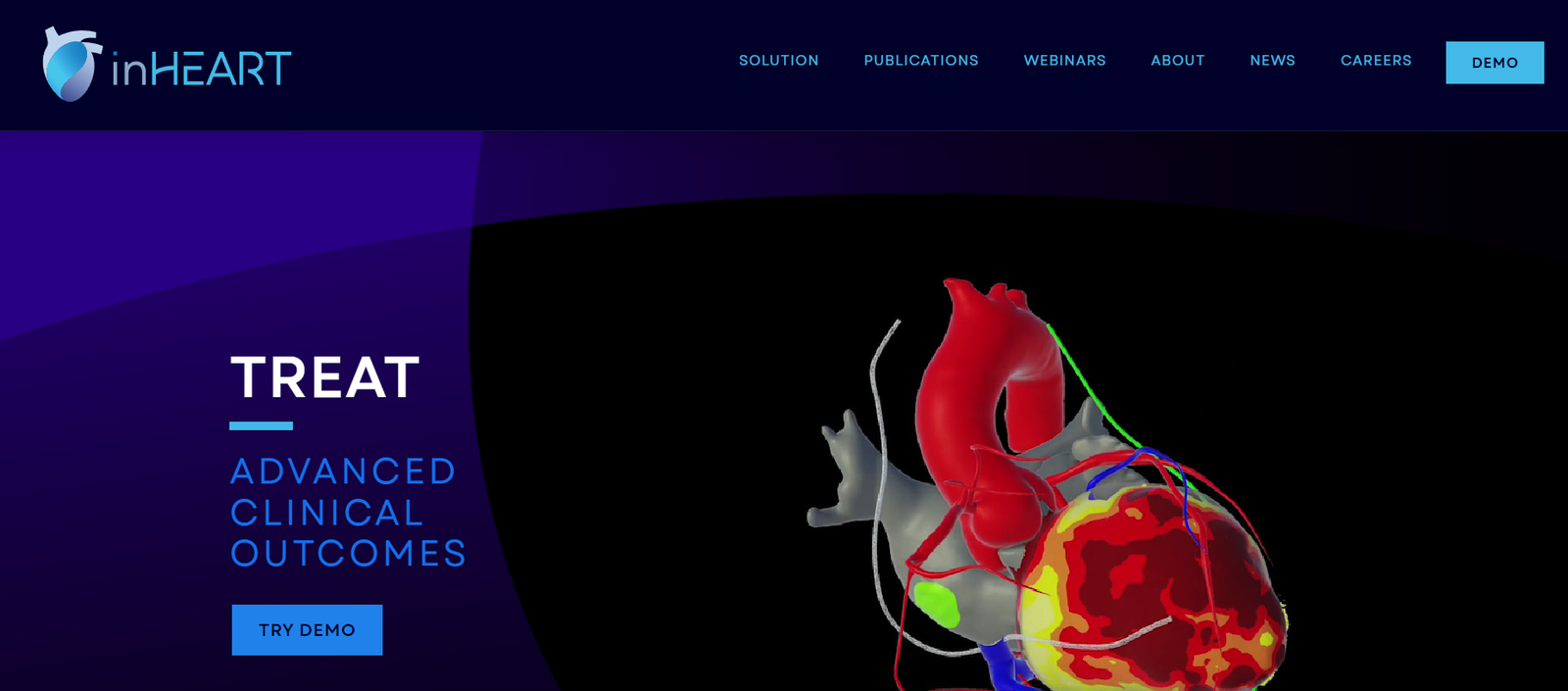
inHEART is an AI-driven healthcare platform that provides a digital twin of the heart to support personalized treatment of cardiac arrhythmias. Designed for use by cardiac electrophysiologists, inHEART transforms standard cardiac imaging data into accurate 3D models of a patient’s heart anatomy and electrical properties.
This digital twin allows clinicians to visualize scar tissue, healthy myocardium, and complex anatomical structures in detail—helping them plan and guide catheter ablation procedures with greater precision. The technology improves procedural outcomes, reduces risks, and shortens ablation time, making it a valuable tool in the management of complex arrhythmias like ventricular tachycardia (VT) and atrial fibrillation (AFib).
Features
inHEART provides an advanced suite of features that combine AI, imaging, and simulation:
3D Digital Heart Twin: Converts CT or MRI scans into a personalized 3D model of the patient’s heart.
AI Image Processing: Automatically detects and highlights scar tissue, healthy tissue, and complex anatomical landmarks.
Electrophysiological Mapping: Integrates electrical data with anatomical structures to guide treatment.
Simulation Tools: Enables virtual testing of ablation strategies before entering the lab.
Cloud-Based Platform: Accessible on demand from any location, supporting remote planning and team collaboration.
DICOM Compatibility: Seamlessly integrates with standard imaging formats used in hospitals.
Interoperability: Compatible with major electro-anatomical mapping (EAM) systems.
HIPAA & GDPR Compliance: Designed with full data security and privacy in mind.
Clinical Dashboard: Provides intuitive views and customizable overlays for treatment planning.
How It Works
inHEART begins with routine cardiac imaging—either a CT scan or MRI. These images are uploaded to inHEART’s secure, cloud-based platform.
Artificial intelligence algorithms automatically segment and analyze the images, detecting and distinguishing between scarred myocardium, healthy tissue, blood pools, and anatomical landmarks such as the pulmonary veins and aortic root.
The platform then reconstructs a detailed, interactive 3D digital twin of the heart. Electrophysiologists can rotate, zoom, and slice through this model to plan ablation lines, simulate potential outcomes, and better understand the target area before the procedure.
During the actual ablation, the inHEART model can be integrated with existing mapping systems to provide real-time anatomical guidance, improving the accuracy and safety of the intervention.
Use Cases
inHEART is designed for a range of clinical applications related to cardiac electrophysiology:
Ventricular Tachycardia (VT): Helps identify scar-related reentry circuits and optimize VT ablation strategies.
Atrial Fibrillation (AFib): Visualizes pulmonary veins and adjacent structures for better isolation planning.
Complex Arrhythmia Cases: Enhances navigation in patients with congenital abnormalities or prior interventions.
Pre-Procedure Planning: Supports detailed review and simulation before entering the EP lab.
Training and Education: Provides a visual and interactive learning tool for EP fellows and medical students.
Post-Ablation Assessment: Evaluates ablation outcomes and informs repeat procedures.
Pricing
inHEART does not publish fixed pricing on its website. The platform is typically offered through custom enterprise agreements with hospitals, academic medical centers, and electrophysiology clinics.
Pricing depends on several factors:
Number of cases or licenses per month
Type of imaging integration (CT/MRI)
Volume of users or sites
Support and training packages
Integration with hospital IT and mapping systems
Healthcare providers interested in adopting inHEART can request a demo or quote via the inHEART contact page.
Strengths
inHEART stands out in the digital health and cardiac AI space for several reasons:
Clinically Proven Technology: Used in top EP labs across Europe and North America.
Highly Accurate 3D Modeling: Offers detailed visualization not available in standard imaging.
Reduces Procedure Time and Risk: Improves pre-procedure planning and reduces time in the EP lab.
Supports Better Outcomes: Contributes to higher success rates and fewer repeat ablations.
Cloud-Based and Scalable: Facilitates remote planning and collaboration.
Integrates with Existing Systems: Compatible with standard EAM systems and imaging protocols.
Strong Research Backing: Featured in peer-reviewed publications and clinical studies.
Drawbacks
Despite its innovations, inHEART has a few limitations:
Requires High-Quality Imaging: Effectiveness depends on the quality of input CT/MRI scans.
Not Yet Widely Deployed: Still expanding availability across global markets.
Cost Considerations: Custom pricing may not be accessible for smaller clinics.
Training Required: Users must understand how to interpret and navigate digital twins effectively.
Limited Public Reviews: Adoption is growing, but user testimonials are mostly institutional.
Comparison with Other Tools
inHEART belongs to a niche but growing category of digital tools that use AI and 3D modeling to support cardiology. Comparable technologies include:
Adagio Medical: Focuses on cryoablation and mapping systems but lacks inHEART’s pre-procedural digital twin capabilities.
Carto 3 by Biosense Webster: Provides real-time mapping during ablation but not full pre-procedural 3D digital twin planning.
HeartFlow: Focuses on coronary flow modeling rather than electrophysiology.
Vektor Medical: Offers non-invasive mapping but does not use pre-imaging to create digital twins.
inHEART’s unique value lies in combining AI image processing with 3D anatomical simulation, offering true pre-procedural planning that enhances ablation accuracy and efficiency.
Customer Reviews and Testimonials
While inHEART does not yet list consumer-style reviews on platforms like G2 or Capterra, it has received strong endorsements from physicians and healthcare systems.
Quotes from electrophysiologists featured on the website emphasize key benefits:
“inHEART allows me to visualize scar and anatomy better than ever before.”
“It shortens my procedure time and improves confidence in complex cases.”
“The digital twin is like having a map to guide every step of the ablation.”
The technology is actively used in clinical trials and peer-reviewed research, further supporting its credibility and clinical impact.
Conclusion
inHEART is transforming cardiac electrophysiology by delivering a clinically accurate, AI-powered digital twin of the heart. Its ability to turn standard imaging into interactive 3D models provides physicians with a new level of precision in treating complex arrhythmias.
With applications in ventricular tachycardia, atrial fibrillation, and beyond, inHEART reduces guesswork, improves safety, and enhances patient outcomes. For hospitals and EP labs looking to modernize their approach to ablation planning, inHEART is a forward-looking, evidence-based solution that bridges imaging, AI, and real-time simulation.