Informatica, now part of Salesforce, is an enterprise data management cloud whose CLAIRE AI agents help integrate, clean, catalogue and govern data for analytics and AI agents.
Facts checked: November 2026 · Sources: Informatica’s official site and app listings
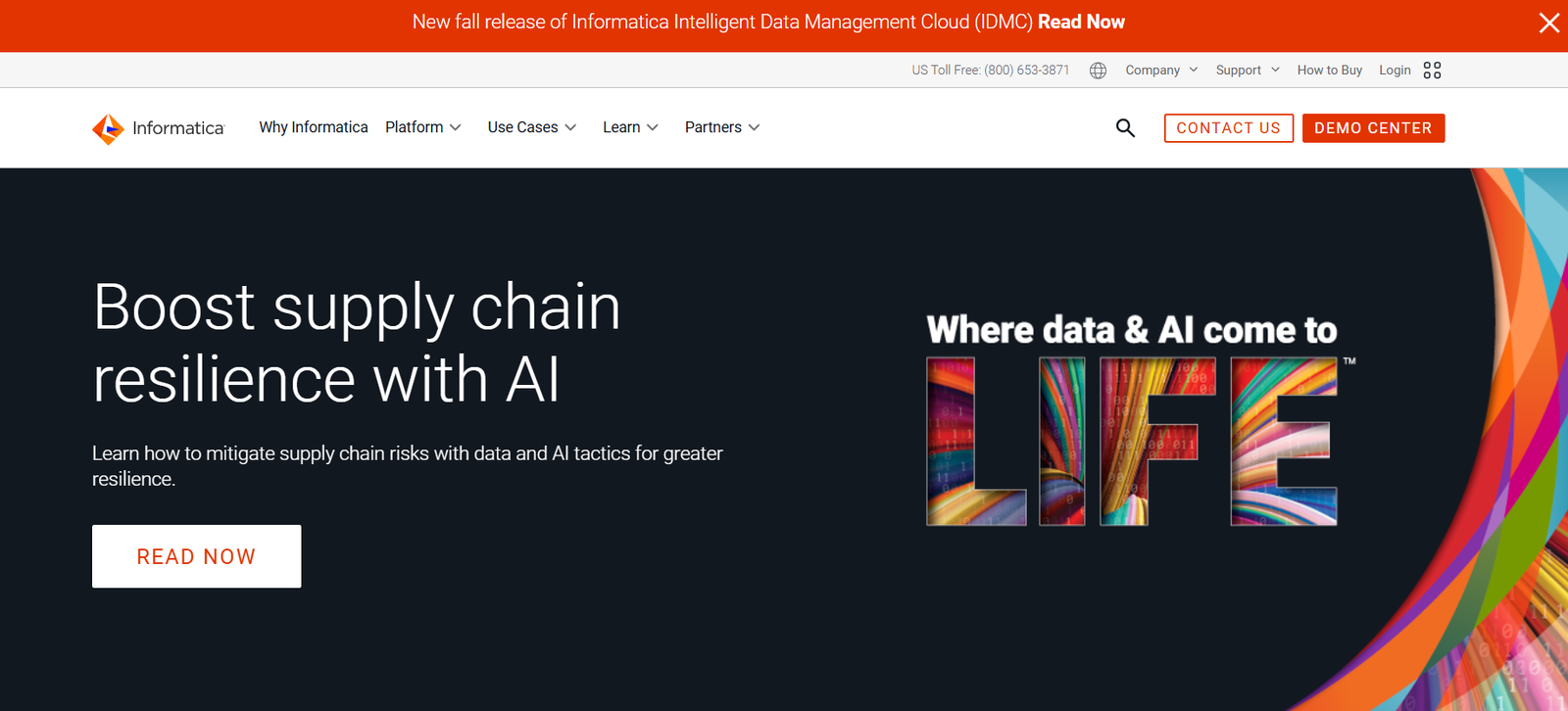
Informatica provides data integration, data quality, master data management, cataloguing, governance and privacy through its Intelligent Data Management Cloud. Its CLAIRE AI engine and agents automate data tasks. Salesforce completed its roughly $8 billion acquisition of Informatica on 18 November 2025, combining CLAIRE with Salesforce’s Einstein, Data Cloud and Agentforce. In 2026 CLAIRE agents added support for Google’s A2A protocol.
Large enterprises preparing data for analytics and AI
CLAIRE AI engine and data management agents
Salesforce (acquisition completed Nov 2025)
Enterprise, consumption-based; contact sales
Is Informatica right for you?
- need trusted, governed data for AI agents
- run master data management
- integrate many cloud data sources
- are a small business with simple data needs
Key features
CLAIRE AI agents
Automate data discovery, quality and integration tasks.
Data integration
Connect cloud and on-prem sources.
Data catalog
Find and understand enterprise data.
Governance and privacy
Policies for trusted data use.
A2A support
CLAIRE agents work with agents on other platforms.
Pros and cons
- Industry leader in data management
- Deep AI automation
- Now integrated with Salesforce
- Complex and costly
- Overkill for small teams
How to get started
- Visit informatica.com and request a demo.
- Start with a free trial of Cloud Data Integration if offered.
- Connect data sources and use CLAIRE to profile data.
Informatica alternatives
⇄ Compare Informatica side by side
Informatica: frequently asked questions
Who owns Informatica?
Salesforce completed its acquisition of Informatica on 18 November 2025.
What is CLAIRE?
Informatica’s AI engine and agents that automate data management tasks.
How much does Informatica cost?
Pricing is enterprise and consumption-based; contact sales for a quote.
More about Informatica
Informatica is a leading enterprise cloud data management platform that helps organizations connect, integrate, govern, and manage their data across hybrid and multi-cloud environments. Known for its deep experience in data integration, Informatica now provides an AI-powered Intelligent Data Management Cloud (IDMC) that supports a wide range of data-driven use cases—from analytics and data quality to privacy, governance, and master data management.
Built for enterprises that operate in complex IT landscapes, Informatica makes it easier to deliver trusted, business-ready data at scale. It enables businesses to accelerate digital transformation by turning fragmented and siloed data into strategic assets that drive smarter decisions, automation, and compliance.
Features
Intelligent Data Management Cloud (IDMC)
A unified, AI-powered platform that supports end-to-end data management across clouds, applications, and on-premises systems.
Cloud Data Integration
Connects and integrates structured and unstructured data across sources like AWS, Azure, Snowflake, Google Cloud, Salesforce, and more.
Data Quality & Observability
Monitors data pipelines for consistency, accuracy, and freshness, helping teams maintain high-quality, reliable data across all systems.
Master Data Management (MDM)
Creates a single, trusted view of customer, product, supplier, or employee data by eliminating duplication and ensuring consistency.
Data Catalog & Discovery
Automatically scans and indexes data assets across environments, providing searchable metadata and lineage for better governance.
Data Governance & Privacy
Supports compliance with data protection regulations (GDPR, CCPA, HIPAA) through role-based access, policy enforcement, and automated workflows.
AI-Powered Automation
CLAIRE, Informatica’s embedded AI engine, helps automate data discovery, lineage mapping, transformation, and classification.
Application Integration
Orchestrates workflows across SaaS and on-prem applications, enabling real-time data syncing and API-based connectivity.
Data Marketplace
Allows organizations to securely share curated datasets across business units or external partners through a governed data exchange.
How It Works
Informatica connects to various data sources—cloud databases, enterprise apps, APIs, and on-prem systems—using prebuilt connectors and integration tools. Once connected, it ingests and integrates the data, applying cleansing, transformation, masking, and enrichment where needed.
Using the CLAIRE AI engine, Informatica automatically discovers metadata, suggests mappings, flags quality issues, and tracks data lineage. Governance teams can define access controls, policies, and workflows to enforce privacy and regulatory standards.
Everything is managed through the IDMC console, where business and technical users can collaborate through no-code and low-code tools to build, deploy, and monitor data pipelines, catalogs, and governance frameworks.
Use Cases
Cloud Data Warehouse Integration
Helps organizations move data from legacy systems into modern platforms like Snowflake, BigQuery, or Redshift with clean, trusted data.
Customer 360 and MDM
Delivers a unified view of customers across marketing, sales, and service by consolidating data into a single, reliable profile.
Data Privacy and Compliance
Automates data classification, access controls, and audit logging to help meet GDPR, HIPAA, and CCPA requirements.
Data Observability and Trust
Ensures data used in dashboards and AI models is accurate and timely through monitoring and alerting.
Application Integration
Connects cloud apps like Salesforce, Workday, and ServiceNow to create automated business workflows and real-time data sync.
Data Democratization
Enables business users to discover, access, and share data through a governed, self-service data marketplace.
Pricing
Informatica follows a custom pricing model based on the services used, deployment type (cloud, hybrid, or on-prem), data volume, and support level. Key pricing factors include:
Number of data sources and targets
Volume of data processed or stored
Tools and modules used (e.g., Data Integration, Governance, MDM)
Enterprise or developer-level support
Informatica offers free trials for some products, as well as usage-based pricing for its cloud-native services. Businesses can contact Informatica or request a demo to explore personalized plans.
Strengths
Comprehensive Data Management
Supports the full spectrum of enterprise data needs, from integration and quality to governance and analytics.
Cloud-Native Architecture
Fully cloud-native and scalable across all major cloud providers, supporting multi-cloud and hybrid environments.
AI-Driven Automation
CLAIRE automates repetitive tasks and boosts productivity with intelligent recommendations and anomaly detection.
Robust Ecosystem
Integrates with thousands of systems and platforms, including SAP, Oracle, AWS, Azure, Snowflake, and Salesforce.
Proven Enterprise Reliability
Used by Fortune 500 companies globally, Informatica is known for reliability, scalability, and support.
Drawbacks
Complex for Small Teams
Due to its enterprise-grade capabilities, smaller companies may find the platform overwhelming or too resource-intensive.
Learning Curve
Some tools require training and onboarding to fully leverage the breadth of features and configurations.
Custom Pricing
Lack of transparent pricing makes early-stage budgeting more difficult without direct engagement with sales.
Comparison with Other Tools
Compared to platforms like Talend, Fivetran, or Matillion, Informatica offers broader capabilities beyond just integration. While those tools focus on ETL/ELT pipelines, Informatica provides end-to-end data management, including governance, MDM, quality, and AI-powered metadata intelligence.
Against full platforms like Collibra or Alation for data governance and cataloging, Informatica provides a more tightly integrated experience within the same platform, backed by strong automation.
It’s best suited for organizations that need a unified platform to manage the full data lifecycle, rather than point solutions for individual needs.
Customer Reviews and Testimonials
Customers consistently highlight Informatica’s robust feature set, scalability, and depth of integrations. Enterprises value how it handles complex data environments and supports diverse business units and compliance needs.
IT teams report strong support from the company, including onboarding assistance, documentation, and ongoing updates. The automation provided by the CLAIRE engine is often cited as a key productivity booster.
Some users note that initial setup and customization can be time-consuming, but most agree that the long-term benefits outweigh the ramp-up effort.
Conclusion
Informatica delivers one of the most comprehensive cloud-native data management platforms available today. With powerful integration, governance, and AI-driven automation tools, it enables enterprises to manage data securely, efficiently, and at scale—no matter where that data resides.
From driving analytics to enforcing compliance, Informatica helps organizations turn data into a strategic advantage, supporting both operational efficiency and innovation.