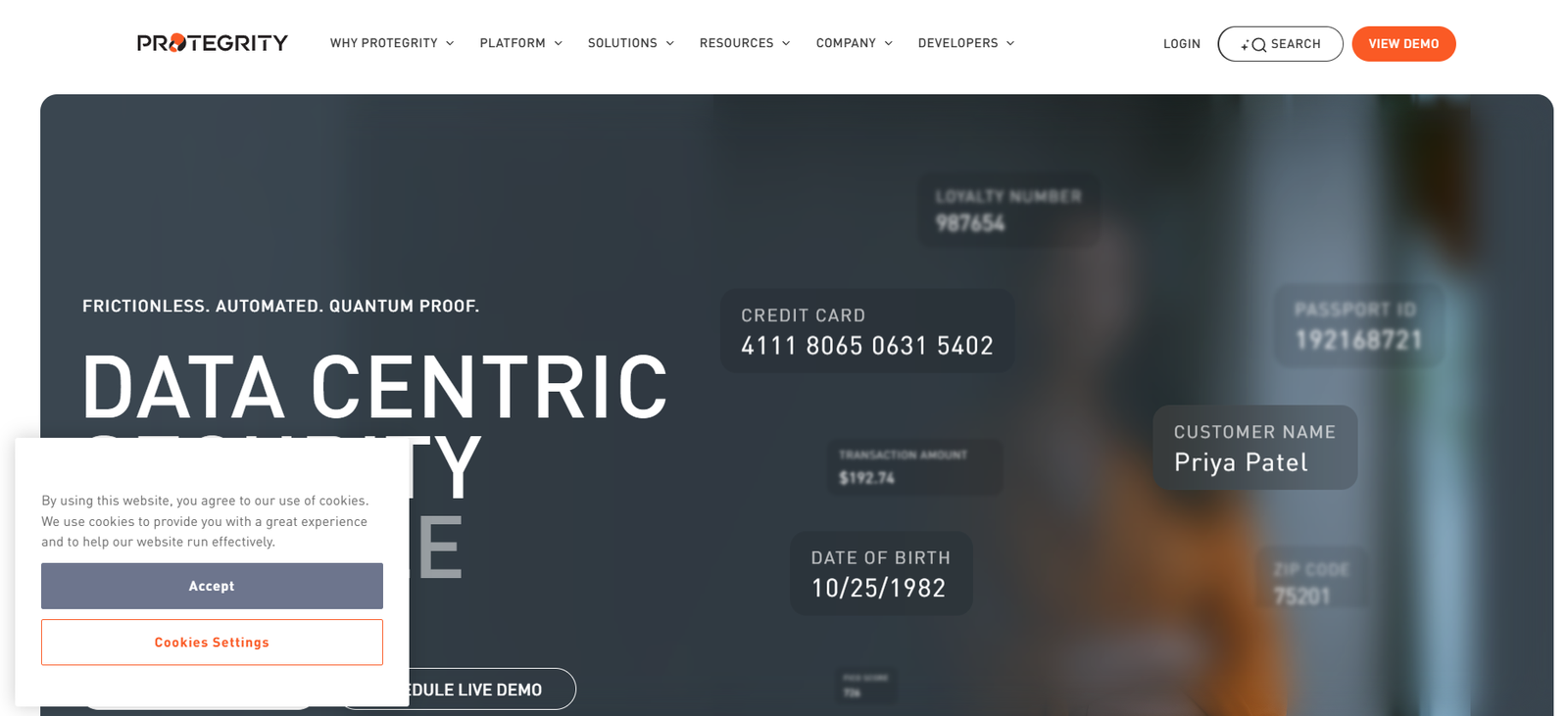
Protegrity is an enterprise data security platform that protects sensitive data before it reaches AI models and agents, using tokenization, encryption, PII detection and policy controls.
Facts checked: November 2026 · Sources: Protegrity’s official site and app listings
Protegrity protects data at the field level so companies can use sensitive information in analytics and AI safely. In 2026 it launched AI Team Edition for secure inferencing and, in November, a unified policy engine controlling how people, AI agents and applications access data and models. Its PII detection model recognises 69 types of sensitive information.
Banks, insurers, retailers and large enterprises using AI on sensitive data
PII detection, semantic guardrails, agent and inference controls, synthetic data
Developer (free), Team and Enterprise
Enterprise sales; free Developer Edition
Is Protegrity right for you?
- must keep customer data private in AI projects
- work under strict regulations
- run AI agents on internal data
- are an individual or small business
Protegrity pricing
| Plan | Price | What you get |
|---|---|---|
| AI Developer Edition | Free | Python package for notebooks and pipelines |
| AI Team Edition | Contact sales | Secure inferencing for teams |
| AI Enterprise Edition | Contact sales | Organisation-wide policies |
Key features
PII detection
Finds 69 types of sensitive data in text.
Tokenization and encryption
Protects data while keeping it usable.
Agent and inference controls
Governs what AI agents and models can see.
Synthetic data
Privacy-safe data for testing and training.
Pros and cons
- Strong data-centric protection
- Built for AI workflows
- Free developer option
- Enterprise pricing not public
- Complex to deploy
How to get started
- Try the free AI Developer Edition from protegrity.com.
- Add PII detection to a test pipeline.
- Contact sales for Team or Enterprise.
Protegrity alternatives
⇄ Compare Protegrity side by side
Protegrity: frequently asked questions
What does Protegrity do?
It protects sensitive data with tokenization, encryption and policy controls so it can be used safely in analytics and AI.
Is Protegrity free?
There is a free AI Developer Edition; Team and Enterprise editions are sold through sales.
How does Protegrity help with AI?
It detects and protects sensitive data before it reaches AI models and controls what agents can access.
More about Protegrity
Protegrity is an enterprise data security platform designed to protect sensitive information across cloud, hybrid, and on-premises environments. The company focuses on enabling secure data usage by applying powerful protection methods like tokenization and encryption, helping businesses comply with global regulations while keeping data accessible for analytics and innovation.
Founded in the early 2000s and headquartered in Salt Lake City, Utah, Protegrity has built a reputation for helping some of the world’s largest companies safeguard personally identifiable information, health data, and financial records. Its platform is built for scalability, compliance, and integration into modern data ecosystems, giving businesses the freedom to operate securely in complex digital environments.
Features
Protegrity offers a rich set of features focused on securing sensitive data at the field level while preserving its usability for operations like machine learning, reporting, and analytics. One of the platform’s key capabilities is fine-grained tokenization, which replaces sensitive values such as names, social security numbers, or payment data with secure, format-preserving tokens. These tokens retain the structure of the original data, allowing it to be processed and analyzed without exposure to real values.
Another core capability is enterprise encryption. Protegrity enables organizations to encrypt data using strong algorithms while maintaining centralized control over key management and decryption policies. The encryption engine is built to handle large-scale deployments, ensuring that even high-volume transactional data remains protected.
Protegrity’s centralized policy management interface gives security teams full control over how data is protected, accessed, and shared across different departments and geographies. It supports multiple data protection methods and allows rules to be applied consistently across databases, cloud storage, and analytics platforms.
The platform also provides integration with cloud-native services from major providers such as AWS, Microsoft Azure, and Google Cloud. This allows businesses to extend their data protection strategies across hybrid environments, ensuring consistent security even as data moves between systems.
How It Works
Protegrity’s platform secures data by embedding protection into the data itself, rather than depending on securing the perimeter. When sensitive information is ingested into a system, Protegrity applies tokenization or encryption based on pre-defined policies. These policies determine what data to protect, how to protect it, and who can access it.
Each data element is protected in a way that balances security with usability. For example, a tokenized credit card number can still be used in queries or for analytics, while remaining useless to anyone who intercepts it. Only authorized users or applications with the right permissions and decryption keys can retrieve the original values.
Protegrity’s architecture supports deployment across cloud platforms, on-premise systems, and hybrid environments. It integrates with a wide range of technologies, including relational databases, data lakes, SaaS applications, and big data frameworks. The platform uses APIs, SDKs, and native connectors to seamlessly embed into enterprise ecosystems without disrupting existing workflows.
All protection activities are logged and monitored through a central dashboard, which also provides reporting tools to support audits and compliance efforts. Protegrity enforces consistent policies across systems, helping organizations minimize security gaps and reduce the complexity of managing privacy rules in multiple regions.
Use Cases
Protegrity is widely adopted in industries that handle regulated or sensitive data, including healthcare, financial services, retail, and government. One of the most common use cases is protecting personally identifiable information across transactional systems and analytics platforms. This includes names, addresses, social security numbers, and account information that must be secured to comply with laws like GDPR, HIPAA, and PCI DSS.
In healthcare, Protegrity is used to protect patient records while still allowing providers and researchers to extract insights from data. It enables advanced analytics and AI-driven diagnostics without compromising patient privacy.
Financial institutions use Protegrity to secure account data, payment information, and internal records. This ensures both regulatory compliance and defense against threats like data breaches and insider risk.
Retailers and e-commerce platforms also benefit from Protegrity’s ability to protect customer information while using that data for targeted marketing and customer experience optimization.
Additionally, global organizations operating in multiple jurisdictions use Protegrity to manage localized data privacy policies, ensuring they remain compliant with laws in every region while maintaining a unified approach to data security.
Pricing
Protegrity does not publish fixed pricing on its website, as its solutions are tailored to the unique requirements of each enterprise. Pricing depends on several factors, including the size of the organization, the volume of data to be protected, the number of environments involved, and the depth of integration required.
Organizations interested in deploying Protegrity can contact the company directly to schedule a consultation and receive a custom quote. The platform is typically positioned as an enterprise-level solution, so pricing reflects the level of customization, support, and scalability that large businesses require.
Protegrity also offers proof-of-concept support for businesses evaluating its capabilities, helping them assess how the solution would integrate into their environment before committing to a full deployment.
Strengths
One of Protegrity’s greatest strengths is its data-centric security model. Rather than focusing on network or device security alone, Protegrity protects the data itself at the source, ensuring it remains secure even when stored in the cloud, shared with partners, or used in analytics.
Its support for format-preserving tokenization is particularly valuable. This allows organizations to continue running reports and models on protected data without compromising compliance or risking exposure. Few solutions offer this level of flexibility while maintaining such high standards for data protection.
The platform’s integration capabilities also stand out. With native connectors for cloud platforms, databases, and enterprise applications, Protegrity is built to fit into diverse IT ecosystems without causing disruption. This flexibility makes it a strong option for global businesses undergoing digital transformation.
Another strength is its centralized policy control. Security and compliance teams can define and enforce consistent rules across departments and regions, simplifying management while strengthening data governance.
Protegrity also offers strong support for regulatory compliance, providing tools and logs to support audits, investigations, and data subject access requests under laws like GDPR and CCPA.
Drawbacks
While Protegrity is a powerful enterprise solution, it may not be ideal for smaller businesses or organizations with simpler data protection needs. Its feature set and architecture are designed for large-scale environments, which may be more than necessary for companies with basic encryption or compliance requirements.
The platform’s flexibility and customization also come with a learning curve. Organizations may need time to properly configure policies, integrate with legacy systems, and train staff on the platform’s usage. This means initial deployment can require more planning and resources than some out-of-the-box security tools.
Another consideration is cost. While Protegrity offers a high level of data security, its pricing model reflects its enterprise focus. Companies should be prepared to evaluate the total cost of ownership in relation to the business value of securing sensitive data across multiple environments.
Comparison with Other Tools
Compared to traditional encryption tools, Protegrity provides more nuanced and application-friendly data protection. While many solutions encrypt data in a way that makes it unreadable to all systems, Protegrity allows data to be protected while still usable for legitimate business purposes. This makes it well-suited for analytics-driven organizations that don’t want to sacrifice data utility for compliance.
When compared to other enterprise data protection platforms like Thales CipherTrust or IBM Guardium, Protegrity offers more flexibility in tokenization methods and better support for privacy-preserving analytics. Its ability to provide persistent protection across hybrid architectures also makes it a stronger choice for organizations operating in both on-premise and cloud environments.
Protegrity’s open API framework and modular deployment options give it an edge for enterprises that want to build custom solutions or integrate with existing infrastructure without locking into a rigid framework.
Customer Reviews and Testimonials
Protegrity is trusted by some of the world’s largest enterprises and has consistently earned strong reviews from customers in healthcare, financial services, and global retail. Customers often highlight the platform’s ability to secure sensitive data while still enabling analytics, helping them get business value from data without violating privacy regulations.
IT and security teams appreciate the centralized policy control, which reduces complexity and improves visibility into how data is protected across the organization. Many users also cite Protegrity’s responsive support team and professional services as key enablers during initial deployment and ongoing operations.
Case studies from major banks and healthcare providers show how Protegrity helps reduce the risk of data exposure, meet compliance goals, and accelerate cloud adoption while maintaining strict data privacy controls.
Conclusion
Protegrity is a comprehensive and adaptable platform that helps large organizations protect sensitive data at the source. Its data-centric approach, advanced tokenization, and enterprise integration capabilities make it a reliable solution for companies operating in regulated, data-driven environments.
As data continues to flow freely across systems, platforms, and borders, securing that data while keeping it usable has become more important than ever. Protegrity delivers the tools businesses need to protect customer trust, maintain compliance, and unlock data value without compromising privacy.