iNaturalist is a free, AI-powered platform and mobile app that helps people identify plants and animals by uploading photos. It connects everyday nature lovers with a global community of scientists, naturalists, and fellow users who help identify and catalog species from around the world. Launched as a joint initiative between the California Academy of Sciences and the National Geographic Society, iNaturalist aims to promote biodiversity awareness and support scientific research through citizen science.
The platform blends artificial intelligence with community verification, allowing users to upload pictures of wildlife and receive instant identification suggestions. Observations made through iNaturalist contribute to a massive global database of biodiversity, which is used by researchers, conservationists, and institutions for tracking species distribution, environmental changes, and conservation efforts.
Whether you are a beginner, a hobbyist, or a trained ecologist, iNaturalist makes it easy to engage with nature, learn more about the environment, and contribute meaningfully to scientific knowledge.
Features
Photo-Based Species Identification
Users can upload a photo of any plant, animal, or fungus, and iNaturalist’s AI system will suggest the most likely species. The app uses computer vision trained on millions of confirmed observations.
Crowdsourced Verification
Each observation is shared with the iNaturalist community, where experts and knowledgeable users can suggest, confirm, or refine species identifications.
Observation Map
Users can explore a global interactive map of all observations, allowing for detailed geographical exploration of biodiversity across continents and habitats.
Project Creation
Users and organizations can create and manage projects, which group related observations for events like bioblitzes, research initiatives, or conservation efforts.
Species and Observation Stats
iNaturalist provides data on species richness, user contributions, and biodiversity trends in real time, making it useful for ecological monitoring.
Offline Observation Support
The mobile app allows users to make and save observations offline, syncing them later when an internet connection is available.
Data Sharing with Global Biodiversity Databases
Verified data from iNaturalist are shared with the Global Biodiversity Information Facility (GBIF), supporting international research and biodiversity studies.
Taxonomic Database
iNaturalist maintains a structured taxonomy, integrating scientific names and common names for better user understanding and classification.
Multilingual Support
The platform is available in multiple languages, making it accessible to users around the globe and encouraging broader participation.
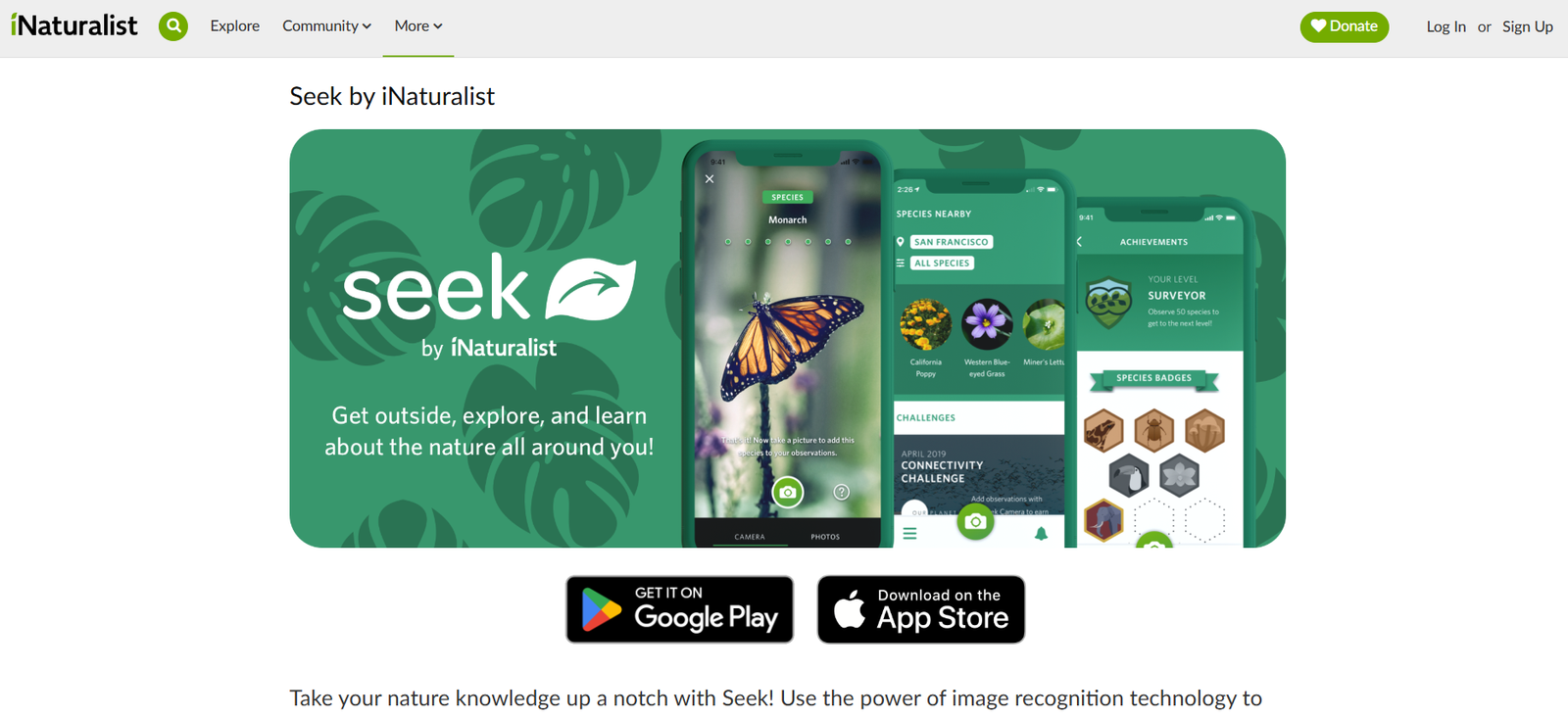
Integration with Seek by iNaturalist
Seek is a child-friendly app powered by iNaturalist’s data that encourages learning about local species without needing an account or uploading data.
How It Works
iNaturalist functions through a combination of artificial intelligence, community engagement, and scientific data validation.
When a user encounters an interesting plant or animal, they can open the iNaturalist app or website and upload a photo of the organism. The app’s AI then processes the image using a deep learning model trained on millions of previously identified observations. It provides several suggestions, ranked by confidence level, for the species or taxonomic group the organism likely belongs to.
After the initial AI identification, the observation is shared with the iNaturalist community. Other users can confirm or suggest alternate identifications. Once multiple users agree on a species ID, the observation is marked as “Research Grade,” which means it has met scientific quality standards and is automatically shared with global biodiversity databases like GBIF.
This dual-validation approach—AI plus community—ensures both speed and accuracy. Users can also interact with the community by asking questions, commenting on observations, and participating in species identification challenges and bioblitz events.
The platform is also educational, with tools to view species guides, explore biodiversity hotspots, and understand ecological relationships between organisms.
Use Cases
Citizen Science
Nature enthusiasts, students, and volunteers contribute to global biodiversity data simply by uploading observations of local species. This democratizes scientific participation.
Education and Learning
Teachers and educators use iNaturalist to engage students in hands-on biology lessons, species hunts, and ecological awareness activities.
Biodiversity Monitoring
Researchers and conservationists use iNaturalist data to monitor the presence and distribution of species over time, especially in regions vulnerable to habitat loss or climate change.
Urban Ecology
Urban dwellers use the app to learn about local trees, insects, and birds, fostering greater environmental awareness and urban conservation efforts.
Ecotourism and Exploration
Travelers and hikers use iNaturalist to identify unfamiliar species in new areas and document their discoveries.
Field Research
Scientists use iNaturalist to log field observations, access geotagged species data, and verify findings through community input.
Conservation Planning
Data from iNaturalist supports conservation organizations in identifying key habitats, tracking invasive species, and assessing the impact of environmental policy.
Pricing
iNaturalist is entirely free to use. There are no subscription tiers, payment plans, or hidden features. All services—including AI-based identification, community support, and data sharing—are accessible at no cost.
The platform is supported by donations, grants, and partnerships with institutions like the California Academy of Sciences and the National Geographic Society. This ensures that iNaturalist remains open, ad-free, and freely accessible to everyone.
There is also no cost for educational institutions, NGOs, or research organizations to use the platform or create projects.
Strengths
Free and Open Access
iNaturalist is fully accessible to anyone without any paywall, making it inclusive and widely used.
Strong AI Capabilities
The computer vision system offers fast, accurate species suggestions that improve over time with more observations.
Community Verification
The expert and amateur naturalist community adds a human layer of accuracy, especially for complex or rare species.
Global Biodiversity Contribution
All research-grade data contribute to GBIF, making each observation potentially valuable to global science.
User-Friendly Interface
Both the mobile app and website are intuitive, making nature identification and sharing enjoyable even for non-technical users.
Educational and Engaging
The app is a great tool for learning, especially for children, educators, and amateur biologists.
Multilingual and Global Reach
Its broad language support and international user base make it useful for global biodiversity documentation.
Drawbacks
Accuracy Depends on Photo Quality
Blurry or incomplete images may lead to incorrect AI suggestions or prevent species confirmation.
Requires Internet for Full Functionality
Although offline observations are supported, identification and community features require a stable internet connection.
Limited for Microscopic Species
The platform is less effective for microscopic organisms or species that require lab-based analysis for accurate ID.
Not a Field Guide Replacement
While powerful, iNaturalist does not replace a full field guide or expert consultation for highly detailed taxonomy or ecological data.
Dependent on Community
For less common species, identification can take longer or remain unverified due to lack of experts in certain regions.
Comparison with Other Tools
Compared to other nature identification apps like PlantSnap, PictureThis, or Google Lens, iNaturalist stands out for its combination of AI and community-based verification. Where other apps rely solely on machine learning, iNaturalist enhances its accuracy by integrating feedback from human users and experts.
Unlike Seek, which is designed for private, educational use and does not share data, iNaturalist contributes to real scientific research by linking with biodiversity databases like GBIF. Compared to PlantNet, which is plant-specific, iNaturalist supports identification for all taxa—animals, fungi, insects, and plants alike.
In addition, iNaturalist’s project-based ecosystem and integration with conservation tools make it more suitable for research and policy use than purely commercial apps.
Customer Reviews and Testimonials
iNaturalist is widely praised across educational institutions, environmental groups, and casual users alike. On platforms such as Product Hunt and app stores, it consistently receives high ratings for its ease of use, educational value, and positive community.
Educators commend it for bringing biology lessons to life. Hikers and travelers appreciate the quick, AI-powered species ID. Researchers value the quality and structure of its contributed data. Many users describe it as “addictive,” “life-changing,” and “a window into the natural world.”
Users also frequently highlight the sense of community and the satisfaction of contributing to real science. The app is recognized not only as a learning tool but also as a gateway to environmental stewardship.
Conclusion
iNaturalist is more than just a nature app—it’s a global citizen science platform that connects people to the environment and to one another through the power of observation, artificial intelligence, and open collaboration. It empowers individuals to learn about the natural world, document their encounters, and contribute meaningfully to biodiversity science.
Its free, intuitive interface combined with cutting-edge AI and community engagement make it a standout platform for users of all backgrounds. Whether you’re walking in your neighborhood, exploring a remote forest, or conducting field research, iNaturalist transforms every nature sighting into an opportunity for learning and impact.