IBM Research is the research and innovation division of IBM, dedicated to advancing scientific discovery and developing technologies that shape the future of computing, artificial intelligence, quantum systems, and climate science. With over 3,000 scientists and researchers worldwide, IBM Research collaborates across disciplines and industries to solve some of the world’s most pressing problems through cutting-edge technologies.
Founded in 1945, IBM Research has a long legacy of innovation, including Nobel Prize-winning discoveries and breakthroughs in semiconductors, data storage, and artificial intelligence. Today, it leads pioneering work in generative AI, foundation models, quantum computing, sustainability, and hybrid cloud technologies.
IBM Research operates globally, with labs across the U.S., Europe, Asia, Africa, and South America, making it one of the most influential industrial research organizations in the world.
Features:
Foundation Models and Generative AI
IBM Research is a leader in developing trustworthy, enterprise-grade foundation models and generative AI, including multilingual models optimized for scientific, financial, and healthcare domains.Watsonx AI Platform
Supports the IBM Watsonx ecosystem by contributing research into large language models, governance tools, and model efficiency.Quantum Computing Innovation
IBM Research is building one of the most advanced quantum computing programs globally, with the IBM Quantum System One and the Quantum Development Roadmap extending to over 100,000 qubits by 2033.AI for Climate and Sustainability
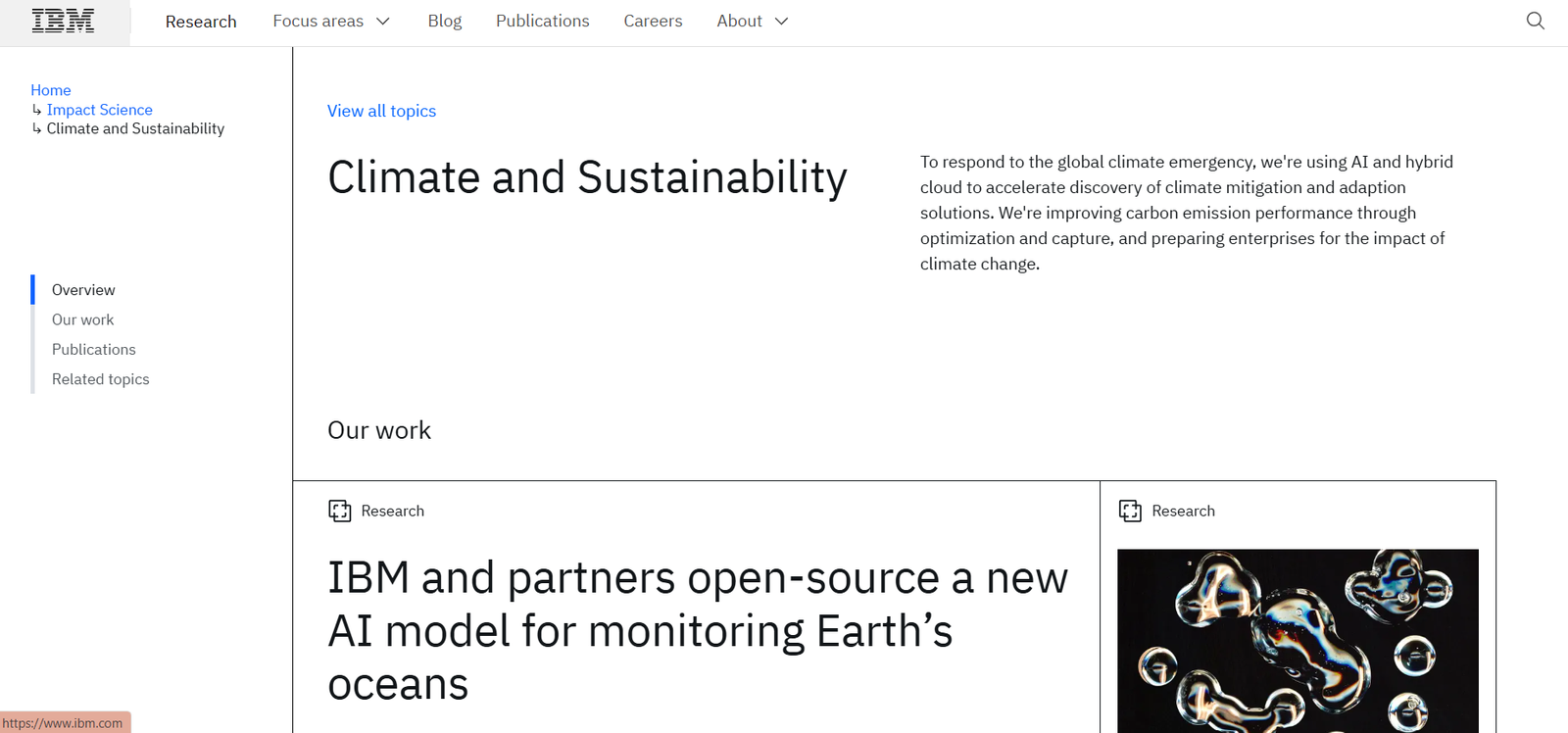
Through initiatives like AI for Climate and the Green Horizons project, IBM Research uses AI and geospatial data to model and mitigate the effects of climate change.Semiconductors and Materials Science
Advances in 2nm chip technology, neuromorphic computing, and sustainable semiconductor design are part of IBM Research’s hardware innovation pipeline.Hybrid Cloud and Security Research
Focus on scalable computing, confidential computing, and data privacy tools for secure enterprise applications in hybrid cloud environments.Neurosymbolic AI
Combines deep learning with symbolic reasoning to create more interpretable and robust AI systems, suitable for regulated industries.Open-Source Collaboration
IBM Research contributes to open-source projects, including AI governance tools, model efficiency frameworks, and quantum SDKs (like Qiskit).Industry Collaboration and Scientific Publications
Partners with universities, governments, and enterprises to publish peer-reviewed research and contribute to standards and ethical AI development.
How It Works:
Multidisciplinary Research Labs
IBM Research teams work across AI, quantum, semiconductors, cloud, and materials science in dedicated labs located around the world.Fundamental and Applied Research
Projects focus on both foundational science and near-term technological innovation, often transitioning into IBM products or open ecosystems.Technology Incubation and Transfer
Research outcomes feed directly into IBM’s commercial offerings, such as Watsonx, IBM Cloud, and IBM Quantum, ensuring industry relevance.Open and Ethical AI Development
Emphasis is placed on explainability, fairness, bias mitigation, and model governance, particularly in enterprise and scientific AI applications.Client Co-Innovation Programs
IBM Research collaborates with enterprises on applied research through IBM Research Accelerated Discovery and Discovery Science platforms.Scientific Publications and Patents
Research output is often published in top journals and conferences and contributes to IBM’s strong intellectual property portfolio.
Use Cases:
Healthcare and Drug Discovery
IBM Research accelerates drug discovery using foundation models for molecular simulation, protein folding, and biomedical data analysis.Climate Risk Modeling
Develops AI models for predicting extreme weather events, tracking emissions, and optimizing climate resilience strategies.Financial Services AI
Provides domain-specific models for financial institutions to improve forecasting, fraud detection, and risk management.Quantum Application Development
Enables scientists and developers to build quantum algorithms for chemistry, optimization, and cryptography.Manufacturing and Supply Chain Optimization
Uses AI and hybrid cloud technologies to improve product quality, demand forecasting, and resilience in global supply chains.Natural Language Processing in Regulated Industries
Provides interpretable NLP models for legal, healthcare, and governmental use cases.
Pricing:
IBM Research itself is not a commercial product and does not have a published pricing model. However, its technologies and research feed into IBM products and platforms that are available commercially.
Commercial Offerings Related to IBM Research Include:
Watsonx – IBM’s AI and data platform incorporating models and tools developed by IBM Research.
IBM Quantum – Access to quantum systems through cloud subscriptions or partner programs.
IBM Cloud for Sustainability – Includes climate analytics and AI services developed in part by IBM Research.
Strengths:
Legacy of Innovation: Over 75 years of pioneering research, including Nobel Prizes and major computing milestones.
Scientific and Industrial Credibility: Strong presence in both academia and enterprise, bridging research and real-world application.
Multidisciplinary Scope: Covers AI, quantum computing, climate science, semiconductors, cybersecurity, and more.
Open Science Leadership: Regular contributions to open-source tools and peer-reviewed research.
Global Research Network: Operates labs and collaborations in North America, Europe, Asia, Africa, and South America.
AI with Ethics and Governance: Emphasizes responsible AI development through fairness, transparency, and accountability.
Drawbacks:
Not Directly Product-Focused: As a research arm, IBM Research doesn’t offer standalone tools for public use—products are commercialized via IBM’s enterprise platforms.
Enterprise-Centric Output: Most innovations are built with large-scale commercial or scientific applications in mind, not general consumer use.
High Barrier to Entry: Custom collaborations and use of IBM Research tools (e.g., quantum systems) often require technical expertise and enterprise-scale budgets.
Limited Public Access to Some Research: Some innovations remain proprietary or require licensing through IBM commercial products.
Comparison with Other Tools and Institutes:
Microsoft Research: Similar in scale and focus, but IBM Research has a stronger presence in quantum computing and semiconductor R&D.
Google DeepMind: Focuses more heavily on AI for scientific discovery and general intelligence, whereas IBM Research integrates AI into enterprise and scientific workflows.
OpenAI: Specializes in general-purpose AI models. IBM Research focuses on trustworthy, domain-specific AI for regulated industries.
MIT CSAIL: Academic institution focused on open research; IBM Research operates at the intersection of academia and enterprise with a strong commercialization pipeline.
Customer Reviews and Testimonials:
While IBM Research is not a consumer-facing product and does not publish reviews in a traditional sense, its influence and success are reflected in:
Collaborations with Fortune 500 companies
Including work with Pfizer, Moderna, ExxonMobil, and the U.S. government on AI, quantum, and climate modeling.Scientific Recognition
Dozens of scientific publications and accolades in AI, quantum, and materials science, published in journals like Nature and Science.Enterprise Innovation
Contributions to IBM Watsonx, IBM Quantum, and AI governance frameworks adopted by major enterprises globally.
Conclusion:
IBM Research stands at the forefront of technological advancement, developing AI, quantum, climate, and semiconductor innovations that power tomorrow’s breakthroughs. With a legacy of scientific excellence and a commitment to ethical, scalable technology, IBM Research plays a pivotal role in shaping how industries and governments tackle the challenges of the future.
Whether through advanced quantum computing systems, domain-specific AI models, or sustainability research, IBM Research transforms complex science into solutions that matter—globally and at scale.