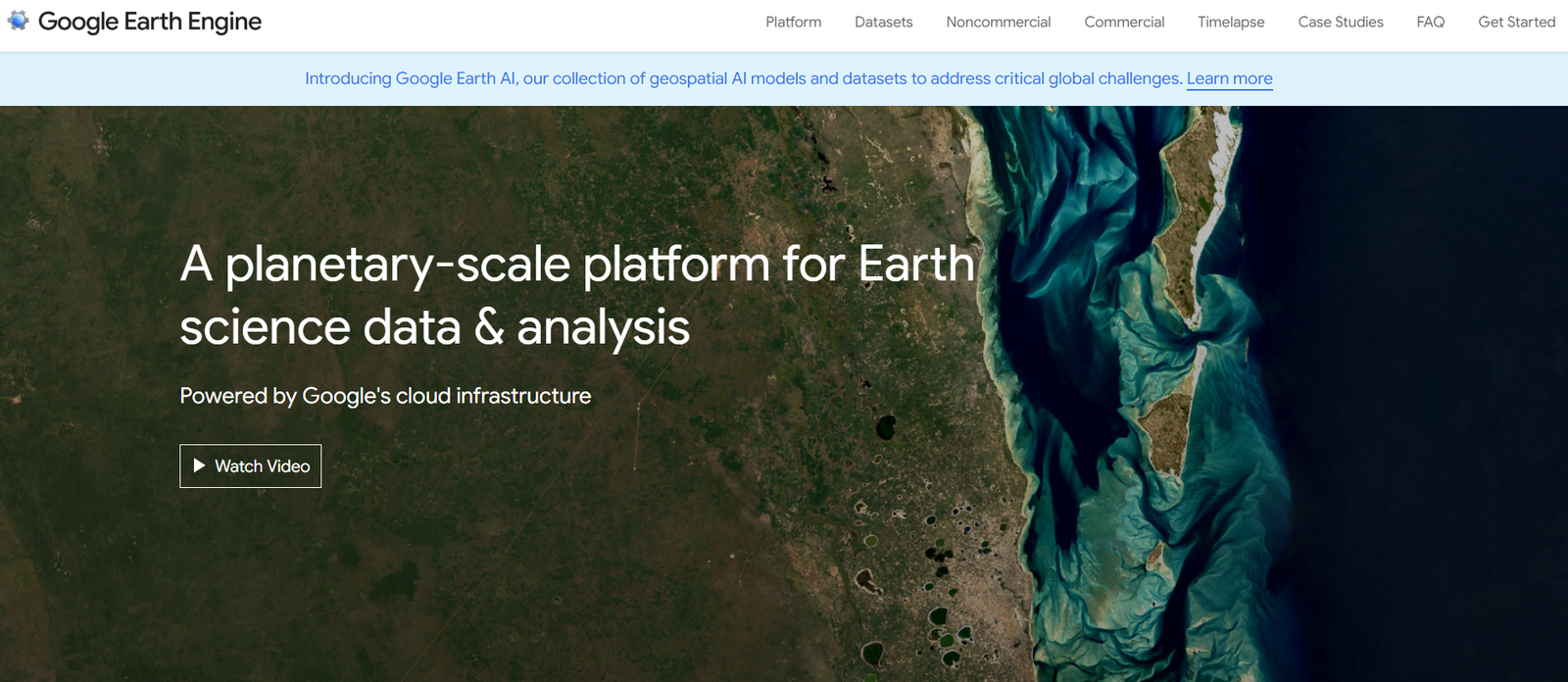
Google Earth Engine is a powerful cloud-based platform developed by Google that allows users to analyze and visualize vast amounts of geospatial data. Launched in 2010, it serves scientists, researchers, and policymakers by providing access to a massive public data archive and computational capabilities for monitoring the Earth’s surface.
What makes Google Earth Engine unique is its ability to process satellite imagery and geospatial datasets at global scale using Google’s cloud infrastructure. Instead of requiring high-performance local computers, users can perform complex computations directly on Google’s servers. The platform is widely used in environmental monitoring, climate research, natural disaster response, and land-use planning.
Google Earth Engine is not a traditional AI tool, but it can integrate with machine learning models and AI frameworks to enhance geospatial analysis, making it highly relevant for AI-driven environmental applications.
Features
Google Earth Engine comes packed with features designed to simplify the handling and analysis of satellite imagery and geospatial data.
One of the core features is its massive public data catalog, which includes petabytes of satellite imagery from NASA, ESA, USGS, MODIS, Landsat, Sentinel, and other sources. These datasets are updated regularly and are accessible for analysis within the platform.
Another feature is its JavaScript and Python APIs, allowing users to write custom scripts to analyze data. This enables automation of repetitive tasks and the creation of custom workflows. The JavaScript-based Code Editor offers an in-browser scripting environment that allows users to write, test, and run code without installing any software.
Google Earth Engine also supports scalable cloud computing, which means that users can analyze large-scale datasets without needing high-end local machines. The platform can perform pixel-level calculations over large geographic areas with high speed and precision.
The tool integrates with Google Cloud AI services, enabling machine learning workflows such as land classification, change detection, and pattern recognition using training datasets and labeled imagery.
In addition, Google Earth Engine offers data visualization tools such as time-lapse animations, map overlays, and charts to make the analysis more intuitive and accessible.
How It Works
Google Earth Engine works by combining a massive cloud-based repository of satellite imagery and geospatial datasets with high-performance computing resources.
Users begin by selecting datasets relevant to their study area. This could be multi-year satellite imagery of a forest, rainfall data for a specific region, or land-use maps. Using JavaScript or Python code, users then write algorithms to analyze or manipulate these datasets.
Once the code is executed, Earth Engine processes the request on Google’s cloud servers. The results can be viewed as maps, graphs, or downloadable datasets. For example, a user could calculate vegetation loss in a region over the past 20 years, and Earth Engine would perform the calculation using multi-temporal satellite images and return the results in minutes.
For machine learning tasks, users can train classifiers such as decision trees, support vector machines, or integrate TensorFlow models. The platform supports both supervised and unsupervised classification techniques, enabling advanced environmental modeling.
Use Cases
Google Earth Engine is used across a wide range of industries and disciplines.
In environmental monitoring, it helps track deforestation, desertification, glacier retreat, and biodiversity loss. Governments and conservation organizations use it to develop strategies based on accurate, timely data.
In agriculture, Earth Engine supports precision farming by enabling analysis of crop health, yield prediction, and irrigation planning using NDVI and other vegetation indices.
For disaster response, Earth Engine is used to assess flood extent, wildfire damage, and earthquake impacts. Rapid access to satellite data allows emergency responders to allocate resources more effectively.
In urban planning, municipalities use it for land-use classification, infrastructure mapping, and tracking urban sprawl. It’s also employed by academic institutions for research in climatology, geography, and sustainability.
Climate scientists use Earth Engine to model global temperature trends, precipitation patterns, and greenhouse gas impacts by analyzing multi-decadal datasets from global satellite systems.
Pricing
Google Earth Engine is free for non-commercial and research use. Academic institutions, researchers, and nonprofits can access the platform at no cost by submitting a simple application through the official website.
For commercial use, Earth Engine is available via Google Cloud’s commercial licensing. Pricing for commercial use is not publicly listed on the website and is customized based on the user’s needs and usage level. Interested organizations must contact Google’s sales team to request access and receive a quote.
The commercial version offers access to the same data and computational capabilities but includes service-level agreements (SLAs), enhanced support, and enterprise integration options.
Strengths
One of the greatest strengths of Google Earth Engine is its ability to process and analyze global-scale geospatial data in the cloud, eliminating the need for local infrastructure. This makes it accessible to users around the world, regardless of their computing power.
Its integration with Google’s extensive satellite imagery archive and data sources ensures that users have access to timely and accurate information for analysis. The support for both JavaScript and Python scripting languages makes it flexible for a wide range of users, from researchers to developers.
Another major advantage is the ability to integrate with machine learning libraries and AI frameworks, which enhances its capability for advanced data classification and modeling. The platform is also well-documented, with a large user community and numerous open-source projects available for learning and collaboration.
Drawbacks
Despite its powerful capabilities, Google Earth Engine does have some limitations. The platform has a steep learning curve for new users who are not familiar with coding or geospatial data structures. While the interface is browser-based and convenient, users must be comfortable writing scripts in JavaScript or Python to fully utilize the platform.
Another drawback is that commercial pricing is not transparent and may be cost-prohibitive for smaller startups or businesses. Additionally, while the platform offers massive data storage and compute power, there are some usage limits for free users, such as quota restrictions on computation time and data export volumes.
Also, the lack of native mobile app support and limited offline functionality may pose challenges in field-based operations.
Comparison with Other Tools
Compared to commercial platforms like ESRI ArcGIS, Google Earth Engine stands out for its free access (for non-commercial use) and global cloud computing capabilities. While ArcGIS offers powerful desktop tools and enterprise solutions, it typically requires expensive licenses and local installation.
Another comparable tool is Sentinel Hub, which allows access to Copernicus satellite data with a similar focus on analysis and visualization. However, Sentinel Hub is more focused on specific European datasets, whereas Earth Engine has a broader global dataset range and integrates with Google’s ecosystem.
Tools like QGIS are also widely used for geospatial analysis but are primarily desktop-based and do not offer cloud computing. Google Earth Engine excels in handling big data workflows and real-time processing without needing a powerful local machine.
Customer Reviews and Testimonials
Google Earth Engine has received widespread acclaim from academic institutions, NGOs, and government agencies. Researchers appreciate its scalability and access to historical data. It has been featured in numerous peer-reviewed studies and environmental reports as a reliable platform for satellite-based analysis.
Organizations such as Global Forest Watch, World Resources Institute, and UN Environment Programme have publicly endorsed and integrated Earth Engine into their projects. User testimonials often highlight its speed, ease of collaboration, and global data availability.
Although not featured on review sites like G2 or Capterra due to its non-commercial nature, community discussions on forums like Stack Overflow and GitHub reflect strong user engagement and support.
Conclusion
Google Earth Engine is a transformative platform for geospatial analysis, offering unparalleled access to satellite imagery and global datasets combined with powerful cloud computing capabilities. Its applications span a wide range of industries, from environmental science and agriculture to urban planning and disaster management.
Though it requires some coding knowledge, the platform provides an efficient and scalable solution for complex Earth observation tasks. With its free tier for research and nonprofit use, and enterprise support for commercial applications, Earth Engine serves as a vital tool in addressing global challenges related to climate change, sustainability, and land management.