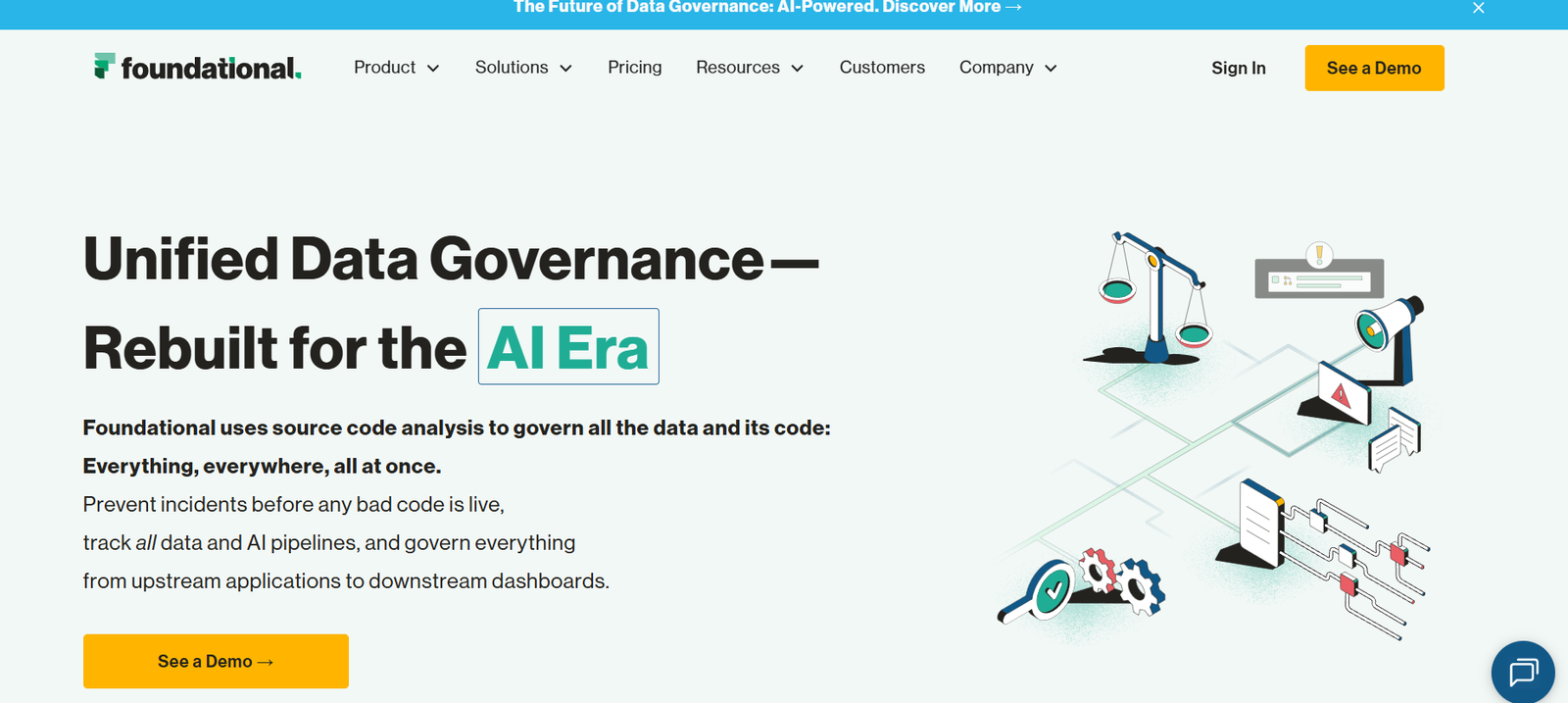
Foundational AI is a cutting-edge AI infrastructure company that enables enterprises to build, deploy, and manage autonomous AI agents at scale. Designed for complex business environments, Foundational provides a robust backend system that powers mission-critical workflows through intelligent, autonomous agents that can operate securely within enterprise systems.
Unlike standard LLM wrappers or lightweight automation tools, Foundational takes a systems-level approach to AI deployment. Its platform is tailored for companies seeking to go beyond chatbots or copilots and instead run entire departments or operations autonomously, backed by scalable agentic architectures.
The platform is built for security, extensibility, and enterprise readiness, allowing organizations to deploy AI agents that can read documents, operate software systems, take real-world actions, and continuously learn. Foundational’s agents integrate directly into enterprise APIs, CRMs, ERPs, and other internal systems — driving end-to-end automation in domains like finance, customer support, HR, and logistics.
Features
1. Autonomous AI Agents
At the core of Foundational AI’s platform is a highly flexible agent runtime that supports multi-step reasoning, memory, planning, and decision-making. These agents are not just task executors — they’re capable of long-horizon goal planning and collaboration with other agents or systems.
2. Secure and Auditable Runtime
Foundational is built with enterprise-grade security and compliance in mind. All agent actions are logged and auditable, providing full transparency into decision-making processes. It includes role-based access controls and integrates with enterprise identity providers.
3. Agent Composition and Orchestration
The platform supports modular agent composition — meaning businesses can construct complex workflows by combining multiple specialized agents. It also supports hierarchical and multi-agent systems where agents delegate or coordinate with others.
4. Data-Aware Agents
Foundational’s agents are not limited to static prompts. They are “data-aware” and can natively access structured and unstructured internal data sources. This allows for deeper business context, personalization, and accurate decision-making.
5. Integration with Enterprise Systems
Agents built on Foundational can securely interact with APIs, databases, SaaS tools, and internal systems such as Salesforce, Workday, SAP, or custom tools. This is enabled by a robust integration layer that includes connectors, authentication management, and API call governance.
6. Observability and Monitoring
All agent actions can be monitored in real time via dashboards and logs. The platform also offers observability tools for debugging, agent behavior analysis, and performance optimization.
7. Fine-Grained Governance and Controls
Foundational gives enterprises granular control over what agents are allowed to do, what data they can access, and what systems they can interface with. This makes it suitable for use in regulated industries such as finance, healthcare, and defense.
8. Developer-Friendly SDKs and APIs
The platform offers extensive APIs and SDKs for developers to define agent behaviors, integrations, and custom policies. Support is available for Python and other enterprise-standard environments.
9. Memory and Long-Term Context
Agents on Foundational can store and retrieve long-term memory, enabling continuous learning and context retention across tasks, sessions, or even departments.
How It Works
Foundational AI operates as an infrastructure layer that enables developers and enterprises to deploy AI agents across their organizations. The process generally involves the following steps:
Define Agent Scope and Roles
Organizations first define what the agent should do — such as manage invoices, process HR onboarding, respond to customer support tickets, or monitor compliance logs.Integrate Data and Systems
Using Foundational’s connectors, developers connect agents to internal data sources (databases, documents, APIs) and enterprise systems (e.g., Salesforce, ServiceNow, Notion).Configure Agent Behavior
Using Foundational’s SDKs or interface, developers define agent behavior including objectives, rules, policies, and access permissions. Agents can be composed of multiple sub-agents for complex tasks.Deploy Agents in Production
Once configured, agents are deployed into live environments, where they can interact with users, other agents, and enterprise systems securely.Monitor and Iterate
The platform provides real-time observability, allowing teams to monitor agent performance, analyze logs, identify errors, and iterate on behavior as needed.
The entire system is designed for iterative development — agents can learn and improve over time, with safety and oversight features built in.
Use Cases
1. Enterprise Workflow Automation
Automate repetitive back-office processes such as procurement, expense processing, HR onboarding, or customer support triage.
2. AI Customer Service Agents
Deploy agents that autonomously respond to customer inquiries across email, chat, or helpdesk platforms — with full access to knowledge bases and CRMs.
3. Financial Operations
Use agents to handle invoice processing, reconciliation, audit trail generation, and report automation by connecting to ERP and accounting systems.
4. Compliance and Security Monitoring
Set up AI agents to continuously scan logs, documents, or communication channels to flag compliance issues or detect anomalies in real time.
5. Internal IT Support
Build internal-facing agents to handle IT support tickets, manage system permissions, and triage internal employee requests autonomously.
6. Legal and Document Review
Automate contract review, clause extraction, and regulatory document analysis with agents that understand legal context and access relevant documents securely.
Pricing
As of the time of writing, Foundational AI does not publicly list its pricing on the official website. This is typical for enterprise infrastructure platforms that offer highly customizable deployments depending on the scale, use case, and compliance requirements of each client.
However, Foundational operates under an enterprise licensing model. Interested companies are encouraged to request a demo or contact the sales team directly through the official website at https://www.foundational.io/ to receive tailored pricing and deployment information based on their organizational needs.
Strengths
1. Built for Enterprise Scale
Unlike consumer-grade AI tools, Foundational is built specifically for enterprise environments with scalability, observability, and governance in mind.
2. Deep Integration Capabilities
The platform’s ability to interface directly with internal systems and APIs gives it a significant advantage in automating real business workflows.
3. Secure and Auditable
Foundational prioritizes security, making it suitable for sensitive environments such as healthcare, finance, and government.
4. Composable Agent Architecture
Support for multi-agent collaboration and agent hierarchies enables more sophisticated workflows compared to simpler chatbot platforms.
5. Developer-Focused
With SDKs, APIs, and extensive configuration options, Foundational appeals to technical teams looking to embed agents deeply into their workflows.
Drawbacks
1. No Public Pricing
The lack of transparent pricing makes it harder for startups or small teams to evaluate feasibility without direct contact.
2. Requires Technical Expertise
Foundational is built for technical teams — it may not be suitable for non-technical users looking for no-code AI automation.
3. Limited Public Resources
Due to its enterprise focus, there’s limited publicly available documentation or community support compared to open-source or developer-first tools.
Comparison with Other Tools
vs. LangChain
LangChain is a popular framework for building LLM-based apps, but it lacks built-in enterprise integrations, security controls, and observability. Foundational offers a more complete platform for production-grade deployments.
vs. Cognosys AI
While Cognosys focuses on agentic workflows and memory, Foundational takes a deeper approach to infrastructure, with better support for enterprise data pipelines and governance.
vs. OpenAI Assistants API
OpenAI’s Assistants API enables basic agent workflows but lacks the composability, observability, and enterprise integrations of Foundational. Foundational is better suited for production-scale internal tools.
vs. Adept or Inflection AI
These focus more on end-user experiences with AI agents. Foundational instead provides backend agent infrastructure for businesses to build their own experiences securely and scalably.
Customer Reviews and Testimonials
As a relatively new but enterprise-focused company, Foundational does not yet have a large volume of public customer testimonials or third-party reviews. However, based on available investor and industry commentary, the platform has already seen adoption in regulated sectors and Fortune 500 companies.
Notably, Foundational has received support from respected AI and infrastructure investors, indicating strong confidence in the team’s vision and execution. The company’s founders come from leading AI and software infrastructure backgrounds, which adds credibility to the platform’s engineering depth.
Conclusion
Foundational AI represents a significant evolution in enterprise AI adoption by providing the infrastructure needed to scale autonomous agents securely and reliably. Its focus on composable, data-aware agents — combined with robust integrations and governance — positions it as a foundational layer for organizations serious about automation.
While it may not cater to small teams or casual users, Foundational offers immense value to enterprises looking to deploy AI agents that go beyond chat — agents that can take actions, reason, and integrate deeply with internal systems.