
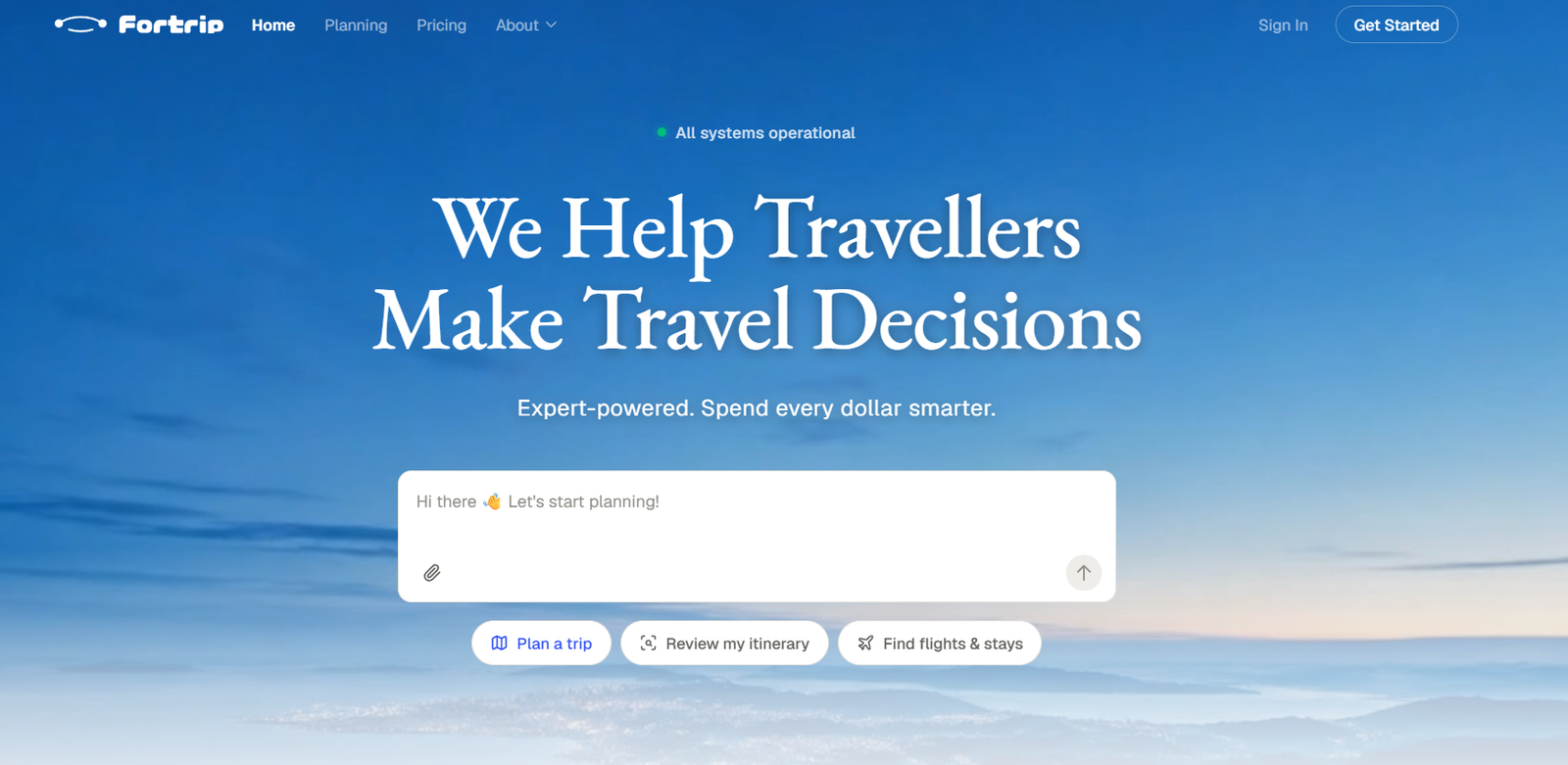
Fortrip is an AI-powered travel planning platform designed to help travelers build more realistic, personalized, and practical trips.
Instead of simply generating a list of attractions, Fortrip focuses on the decisions that make an itinerary actually work. It considers factors such as travel dates, budget, pace, transportation, hotel location, traveler preferences, route sequence, physical intensity, seasonal conditions, and available time.
The platform is particularly useful for multi-city and more complicated trips where travelers need to coordinate several destinations, hotels, flights, trains, buses, ferries, attractions, and other decisions.
Fortrip currently brings together several specialized travel-planning tools. Its AI Trip Planner creates complete itineraries from a rough brief. The Itinerary Validator reviews an existing plan and identifies problems. The Transport Optimizer compares different ways of moving between destinations. Stay-related tools can also help compare accommodation options and how they fit into the wider trip.
One of Fortrip’s main differences is its emphasis on reasoning. Recommendations are designed to include explanations about why a particular neighborhood, hotel, route, activity, or sequence fits the traveler.
Fortrip is developed by FortripAI, Inc. and is designed for travelers who want more than generic destination suggestions from a general-purpose chatbot.
Features
AI Trip Planner
Fortrip can turn a rough travel idea into a structured day-by-day itinerary.
Users can begin with basic information such as destination, dates, trip length, budget, interests, and travel style.
Personalized Itineraries
The platform adapts recommendations according to the information provided by the traveler.
Factors can include:
Budget
Travel dates
Interests
Travel pace
Traveler type
Food preferences
Accommodation preferences
Transportation preferences
Physical intensity
Accessibility requirements
Reasoned Recommendations
Fortrip attempts to explain why a recommendation fits the trip rather than simply presenting a list.
This can help travelers understand the trade-offs behind different choices.
Itinerary Validator
Users who already have a travel plan can submit it for analysis.
The Validator reviews the itinerary and identifies potential weaknesses before the traveler books or begins the trip.
Multi-Dimensional Validation
The Validator can examine issues such as:
Overloaded days
Inefficient routing
Travel pace
Hotel location and value
Seasonal suitability
Attraction closures
Budget allocation
Transportation gaps
Connection times
Day distribution
Traveler preferences
Overall feasibility
Existing Itinerary Review
Travelers do not need to create their itinerary with Fortrip.
They can bring a plan created manually, by another AI service, or by someone else and ask Fortrip to review it.
Transport Optimizer
Fortrip can compare transportation options between destinations.
Supported comparisons can include:
Flights
Trains
Buses
Ferries
Door-to-Door Transport Analysis
The platform attempts to consider more than the advertised ticket price or travel time.
It can examine factors such as transfers, baggage, route sequence, connection risk, and the effect of transportation on the rest of the itinerary.
Multi-City Route Optimization
Fortrip is particularly suited to trips involving several cities.
It can help determine a practical sequence for visiting destinations rather than treating every city as a separate trip.
Realistic Connection Times
The Transport Optimizer considers whether connections are practical rather than assuming every theoretically possible transfer will work comfortably.
Cost and Time Trade-Offs
The cheapest transportation option is not automatically treated as the best option.
Fortrip can compare price against travel time, comfort, transfers, and the effect on the wider trip.
Stay Optimizer
Fortrip provides accommodation-oriented optimization alongside itinerary and transport planning.
It can help compare hotels and determine how accommodation choices fit the overall route.
Live Hotel Pricing
The current platform states that it can search and quote live hotel pricing within the planning workflow.
Large Accommodation Search
Fortrip currently states that its hotel search covers approximately two million properties.
Hotel Location Analysis
The platform can consider whether a well-reviewed hotel is actually located conveniently for the activities included in the itinerary.
Multi-Hotel Planning
Fortrip can evaluate whether using different hotels during a trip could improve location, price, or route efficiency.
Date Optimization
Changing the order of destinations or shifting particular nights can change hotel and transportation costs.
Fortrip can help compare these alternatives.
Restaurant Recommendations
The Trip Planner can include dining recommendations as part of the wider itinerary.
Rather than treating restaurants as isolated suggestions, they can be selected according to location, timing, preferences, and the day’s route.
Local Experience Recommendations
Fortrip can recommend attractions and local experiences according to the traveler’s interests.
Responsible Travel Recommendations
Fortrip may highlight small local shops, restaurants, cafés, stalls, attractions, and community-rooted businesses that fit the destination and itinerary.
Real-World Constraint Checking
The platform attempts to account for practical issues that generic itinerary generators may overlook.
These can include:
Opening hours
Season
Weather considerations
Transport schedules
Travel time
Route logic
Physical intensity
Entry requirements
Connection risks
Ask Before Assuming
When an important decision can significantly affect the trip, Fortrip may ask the traveler to choose between alternatives instead of silently making an assumption.
Living Itinerary
The itinerary can evolve alongside the AI conversation.
When the traveler changes a preference or decision, the plan can be adjusted accordingly.
Travel Risk Checks
Fortrip can flag potential problems related to route, timing, season, transportation, and other practical factors.
Where possible, it also suggests a solution rather than only identifying the problem.
AI Travel Chat
Users can continue asking questions and refining their trip conversationally.
The same conversation can connect itinerary planning, validation, transportation, and accommodation decisions.
How It Works
Step 1: Start with a Travel Idea
Tell Fortrip where you want to go.
You can begin with only a rough idea rather than a complete itinerary.
Step 2: Add Basic Details
Provide information such as:
Travel dates
Number of days
Budget
Number of travelers
Interests
Travel style
Preferred pace
Step 3: Answer Important Questions
Fortrip may ask follow-up questions when a decision could materially affect the trip.
Step 4: Generate the Itinerary
The AI creates a day-by-day plan based on the information provided.
Step 5: Review the Reasoning
Check why particular destinations, neighborhoods, attractions, hotels, or activities were recommended.
Step 6: Validate the Plan
Use the Itinerary Validator to identify unrealistic days, routing problems, timing issues, or other weaknesses.
Step 7: Optimize Transportation
Compare flights, trains, buses, and ferries between destinations.
Step 8: Compare Stays
Review hotel options and consider their price, location, dates, and relationship to the wider itinerary.
Step 9: Refine the Trip
Ask Fortrip to change destinations, activities, pace, hotels, transport, or other details.
Step 10: Verify Before Booking
Check important live details such as schedules, prices, visa requirements, attraction opening hours, and booking conditions before making final purchases.
Use Cases
Multi-City Trips
Fortrip can help determine the best sequence for several destinations and coordinate transportation and accommodation.
International Vacations
Travelers can combine destination research, itinerary planning, hotels, transport, and practical considerations.
Complex Itineraries
Trips involving many decisions, fixed bookings, different transportation modes, or competing priorities are particularly suitable.
Existing Itinerary Review
Travelers can check a manually created or AI-generated itinerary before booking.
Transport Planning
Users can compare flights, trains, buses, and ferries according to the wider trip rather than only ticket price.
Hotel Optimization
Travelers can compare accommodation according to price, location, dates, and itinerary convenience.
Budget Travel
Fortrip can help evaluate where changing dates, transport, route order, or accommodation may reduce overall costs.
Solo Travel
Recommendations can be adjusted according to the requirements of solo travelers.
Family Trips
Travel pace, transport, hotel location, and activity intensity can be adapted for families.
Travel with Older Adults
Travelers can incorporate slower pacing, accessibility, transportation convenience, and physical intensity into the plan.
Food-Focused Travel
Users can build itineraries around restaurants, markets, neighborhoods, and local food experiences.
Responsible Tourism
Travelers can discover smaller local and community-rooted businesses that fit their itinerary.
Pricing
Fortrip currently allows travelers to try its planning functionality for free.
The Itinerary Validator is explicitly described by Fortrip as completely free and can currently be used without signing up for the initial validation check.
However, a clear standardized public pricing table for broader premium usage or future subscription plans is not prominently available on the official website at present.
For this reason, specific paid subscription prices should not be published unless they are displayed in the user’s live Fortrip account or checkout interface.
Pricing details are not clearly mentioned on the official website for all services.
Travelers should also remember that hotel, transportation, attraction, and other third-party travel costs are separate from any fee charged for using Fortrip itself.
Privacy
Fortrip is operated by FortripAI, Inc.
The company states that it may collect information required to personalize and manage travel planning, including account information, travel dates, destinations, budgets, preferences, itinerary information, accommodation preferences, transportation preferences, dietary requirements, accessibility requirements, and booking information.
The platform may also process conversation history with its AI assistant.
Fortrip’s privacy policy states that AI service providers may process chat messages and travel queries to generate recommendations.
Users planning sensitive trips should therefore review the current privacy policy before entering passport information, visa details, payment information, medical accessibility information, or other sensitive personal data.
Strengths
Travel-Specific AI
Fortrip is designed specifically around travel decisions rather than being a general chatbot with a travel prompt.
Itinerary Validation
The ability to review an existing plan is a significant advantage over tools focused only on generating new itineraries.
Realistic Planning
The platform considers pace, sequence, transportation, hotel location, dates, and other real-world constraints.
Multi-City Optimization
Fortrip is particularly useful when several destinations need to work together as one coherent trip.
Transport Comparison
Flights, trains, buses, and ferries can be evaluated within the context of the complete itinerary.
Reasoned Recommendations
The platform attempts to explain why an option is suitable.
Hotel and Transport Integration
Accommodation and transportation can be considered alongside itinerary planning rather than as entirely separate searches.
Free Itinerary Validator
Travelers can currently analyze an existing itinerary without paying for the validation tool.
Iterative Planning
Users can modify the plan conversationally as their preferences change.
Drawbacks
Fortrip does not currently provide a clearly visible comprehensive public pricing table for all functionality.
Travel prices, schedules, attraction hours, visa requirements, weather conditions, and availability can change after an itinerary is generated.
AI recommendations should therefore be verified before making non-refundable bookings.
The platform may process substantial amounts of personal travel information, including preferences and itinerary details. Privacy-conscious users should review what information they provide.
A highly specialized travel agent may still be preferable for complicated visa situations, luxury concierge travel, medical accessibility requirements, unusual destinations, or trips requiring extensive human coordination.
AI can reduce planning errors but cannot guarantee that every recommendation, connection, opening time, fare, or entry requirement will remain accurate.
Comparison with Other Platforms
Fortrip competes broadly with AI trip planners, travel-booking websites, itinerary generators, and general-purpose AI assistants.
Many AI itinerary tools are optimized around generating a visually appealing day-by-day plan from a destination and a few preferences.
Fortrip places greater emphasis on whether that plan will actually work.
Its Itinerary Validator can critique an existing plan, while its Transport Optimizer examines how travelers should move between destinations. Stay-related optimization adds accommodation decisions to the same planning process.
Compared with general-purpose AI assistants, Fortrip is built specifically around travel constraints and itinerary reasoning.
Compared with conventional online travel agencies, its primary value is planning and decision support rather than simply presenting bookable inventory.
This makes Fortrip particularly relevant for travelers who have many possible options and need help deciding how those options fit together.
Customer Reviews and Testimonials
Fortrip publishes traveler testimonials on its official website.
The featured feedback highlights areas such as adapting trips for older parents, visa and weather guidance, accessibility-conscious planning, budget-based itineraries, and explanations for attraction recommendations.
These testimonials are selected and presented by Fortrip itself and should therefore be treated as company-published customer feedback rather than a comprehensive independent review sample.
A substantial body of independently verified customer reviews from major software-review platforms is not clearly established on the official website at this time.
Conclusion
Fortrip is an AI travel planning and decision-support platform designed to make itineraries more realistic rather than simply more detailed.
Its AI Trip Planner can turn a rough idea into a personalized day-by-day itinerary, while the Itinerary Validator checks existing plans for problems involving pace, routing, accommodation, timing, transport, budget, season, and overall feasibility.
The Transport Optimizer extends this approach to flights, trains, buses, and ferries, while stay-related tools help travelers evaluate hotels in the context of the complete trip.
Fortrip is particularly well suited to multi-city and complex travel, where changing the order of destinations, transportation method, hotel location, or travel dates can significantly affect cost and convenience.
Its main limitations are the absence of a clearly published comprehensive pricing structure and the general need to verify changing travel information before making bookings.
For travelers who want an AI system that does more than generate a generic sightseeing checklist, Fortrip provides a more analytical approach to planning, validating, and optimizing a trip.


