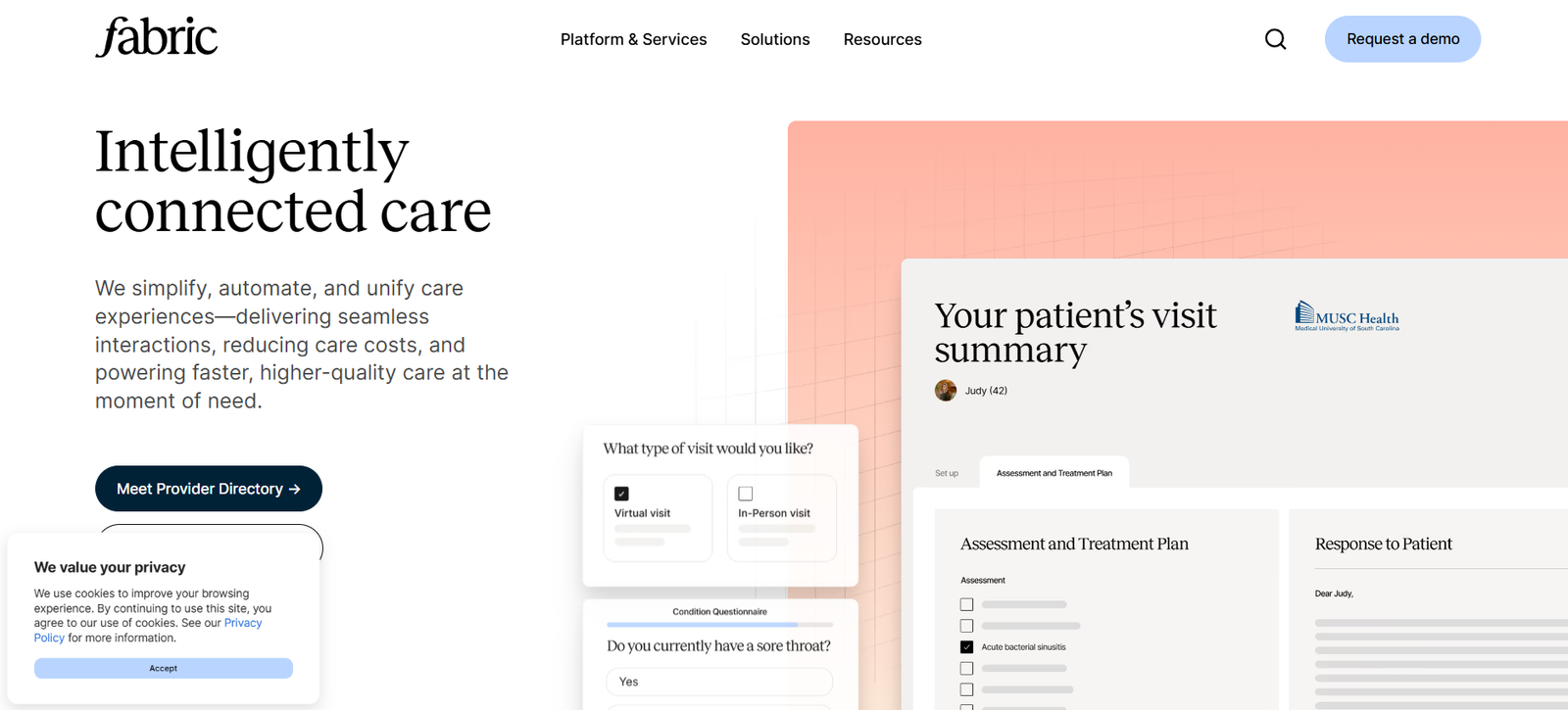
Fabric Health is a mission-driven healthcare navigation company that delivers personalized support to families while they do their laundry. By placing trained health navigators in laundromats across urban neighborhoods, Fabric Health meets people where they are—helping them access Medicaid benefits, find primary care, manage chronic conditions, and take charge of their family’s health.
Founded to improve health equity and reduce barriers to care, Fabric Health focuses on underserved communities that often struggle with accessing traditional healthcare systems. By operating in familiar, trusted neighborhood spaces, the organization creates a convenient and stigma-free environment for preventive health conversations.
Fabric Health works in partnership with Medicaid managed care plans, health systems, and social service organizations to connect people with the care and coverage they need—all without requiring them to go out of their way.
Features
Fabric Health’s primary feature is its on-site health navigation services at laundromats. While community members wait for their laundry, trained navigators provide free, confidential assistance with a range of healthcare-related tasks.
Services include Medicaid renewal and enrollment, appointment scheduling, primary care referrals, transportation coordination, care plan navigation, and assistance with benefits like SNAP or WIC.
Navigators use tablets and mobile tools to securely help customers navigate health plan portals, submit documentation, find providers, or understand eligibility for local services.
The program also provides health education and outreach, offering trusted, culturally sensitive guidance in the form of conversations—not just flyers. This human-centered design ensures meaningful engagement with the community.
Fabric Health also conducts outreach campaigns via SMS and community events to raise awareness, support re-enrollment during redetermination periods, and encourage preventive screenings and vaccinations.
How It Works
Fabric Health sets up service points inside local laundromats in cities where the company operates. These service points are staffed by trained health navigators who are available during peak laundry hours.
When a customer enters the laundromat, a navigator greets them and offers help with health-related issues. If the person agrees, the navigator begins by asking about their current coverage, health needs, and any challenges they are facing accessing care.
Using mobile tools and secure platforms, the navigator assists with tasks such as checking Medicaid status, completing redetermination forms, or scheduling a doctor’s appointment. In some cases, navigators help address broader social needs by connecting users to food assistance or housing programs.
Customers do not need to bring any special documentation, and support is provided in the customer’s preferred language whenever possible. All services are free, confidential, and provided on the spot, requiring no prior appointment or sign-up.
The interaction typically lasts between 10 to 20 minutes—just enough time to finish a laundry load—and is designed to be convenient and friendly, not bureaucratic.
Use Cases
Fabric Health is particularly effective for Medicaid redetermination, helping individuals and families maintain continuous coverage during critical eligibility periods. This is especially important in communities where digital literacy or document access may be limited.
Parents use Fabric Health to find pediatric care, catch up on missed well-child visits, or get help managing care for children with chronic conditions like asthma or diabetes.
Elderly community members benefit from help navigating Medicare-Medicaid dual eligibility, understanding prescription coverage, or arranging transportation to appointments.
Health plans partner with Fabric Health to increase member engagement, reduce unnecessary emergency visits, and close care gaps—especially among hard-to-reach populations.
Social service providers collaborate with Fabric Health to extend their reach and enroll more families in food, housing, and utility assistance programs—all while those families wait for their laundry to finish.
Pricing
Fabric Health does not charge individuals or families for its services. All health navigation support is provided free of charge at the point of use.
The organization operates through partnerships with managed care organizations (MCOs), Medicaid plans, hospitals, and public agencies. These partners fund the services as part of their community engagement, outreach, or member retention strategies.
Organizations interested in collaborating with Fabric Health are encouraged to reach out for a customized engagement plan or pilot program. The pricing for partners varies based on geography, number of service points, and scope of services.
Strengths
A major strength of Fabric Health is its unique, hyper-local delivery model. By embedding services in laundromats, it reduces traditional barriers to care such as transportation, scheduling, and stigma.
The human-centered approach creates trust and rapport, especially in communities that may be skeptical of institutional healthcare systems. Navigators are often hired from within the community, adding cultural competence and relatability.
Fabric Health’s focus on Medicaid access and care continuity fills a critical gap at a time when many people risk losing coverage due to procedural issues or lack of support.
The flexibility of the model also allows partners to reach populations that are often digitally disconnected or left out of conventional outreach strategies.
Its proven impact in high-density cities like Philadelphia and Pittsburgh has demonstrated how a small interaction at a laundromat can lead to better health outcomes and long-term system savings.
Drawbacks
One limitation of Fabric Health is that its physical model is location-bound, requiring laundromat partnerships and navigator availability. This makes it harder to scale rapidly compared to purely digital health tools.
Service hours may be limited to peak laundry times, meaning customers outside those windows may miss out on access unless additional hours are added.
While the platform offers great in-person assistance, there is no current mobile app or self-service platform, which could be a missed opportunity for scaling digital engagement.
Fabric Health is also focused primarily on navigation and support, not on providing clinical care or telehealth. Users still need to be referred out for diagnosis or treatment.
Comparison with Other Tools
Fabric Health is unique in the healthcare space, combining community-based engagement with health navigation services. It differs from digital health apps and symptom checkers by offering face-to-face interaction and real-world support.
Compared to organizations like Unite Us or FindHelp, which offer digital directories for social services, Fabric Health focuses on in-person support and direct enrollment assistance at trusted community locations.
Unlike traditional community health worker programs, Fabric Health’s model is situated in everyday spaces like laundromats rather than clinics or nonprofit offices, improving accessibility.
While telehealth companies focus on virtual consultations, Fabric Health plays a critical role before patients even get to the point of care, ensuring they have coverage, knowledge, and a care plan in place.
Customer Reviews and Testimonials
Fabric Health highlights powerful stories from families who have regained Medicaid coverage, scheduled long-overdue appointments, or secured primary care—all while doing laundry.
Customers frequently mention how surprised and grateful they were to receive such helpful services in a non-medical setting. The friendly, judgment-free approach of navigators is consistently praised.
Health plans working with Fabric Health report improvements in member retention, engagement rates, and redetermination success. Community partners commend the program for its cultural sensitivity, real-world impact, and ability to build trust.
Fabric Health has also received recognition in public health and innovation circles for its equity-focused model and measurable results in increasing access to care.
Conclusion
Fabric Health is reimagining healthcare access by meeting families where they are—specifically, in the laundromat. Through on-site navigation, Medicaid support, and personalized care connections, the platform addresses critical gaps in coverage and access, particularly for underserved communities.
Its human-first, low-barrier approach offers a scalable, compassionate solution to improving public health and system efficiency. For health plans, providers, and public agencies, Fabric Health offers a proven model to reach vulnerable populations with dignity and trust.