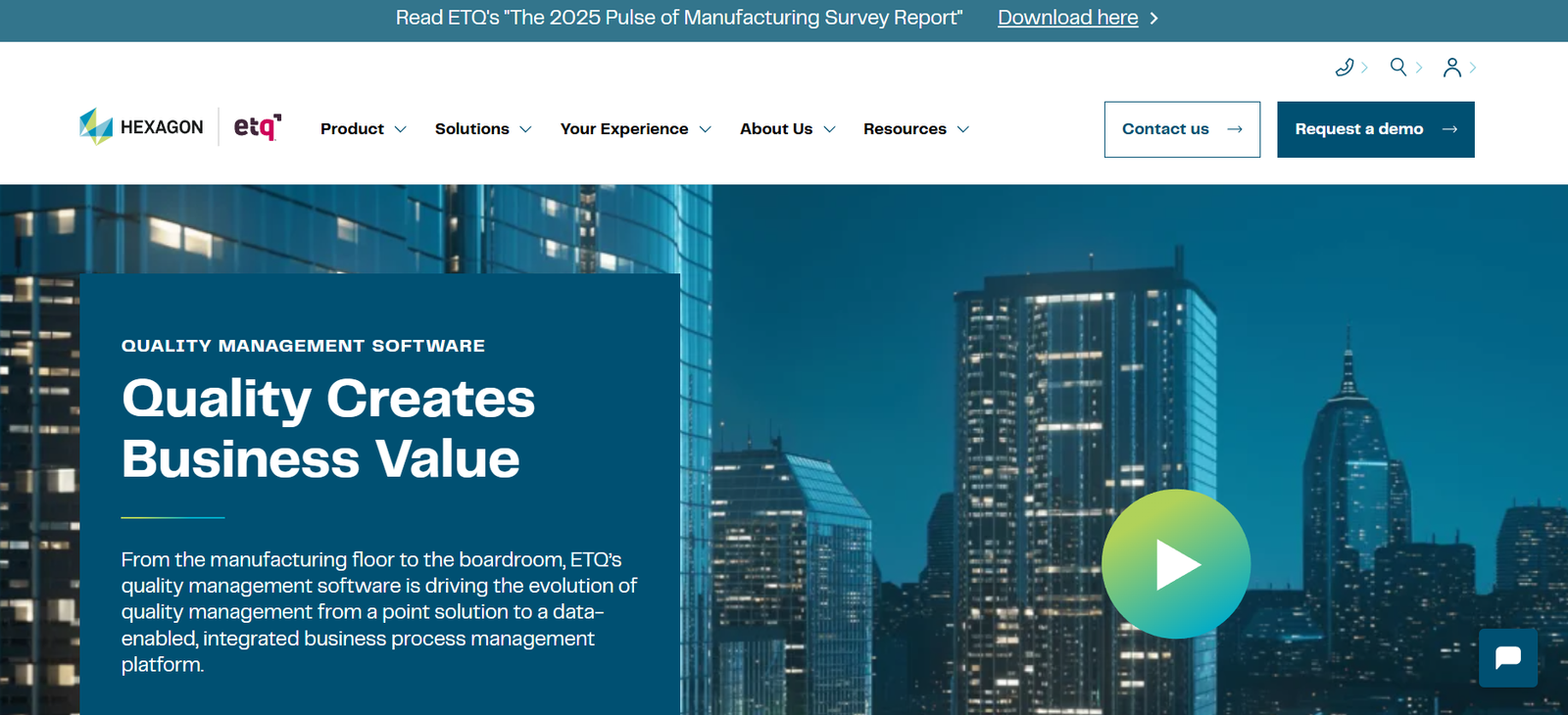
ETQ is a leading provider of quality, EHS (Environmental Health and Safety), and compliance management software, serving companies in highly regulated industries. Its flagship platform, ETQ Reliance, is a flexible and modular Quality Management System (QMS) designed to help organizations automate critical processes such as document control, CAPA (Corrective and Preventive Action), audits, risk management, supplier quality, and more. By digitizing and integrating quality and compliance workflows, ETQ helps organizations reduce risk, improve operational efficiency, and ensure consistent product and process quality.
Features
ETQ Reliance is built on a no-code, cloud-native platform, enabling organizations to adapt quality and compliance workflows to their unique operational needs. Key features include:
Document Control: Automates document creation, approval, revision, and distribution across teams.
CAPA Management: Tracks corrective and preventive actions with root cause analysis and follow-up verification.
Audit Management: Plans, executes, and tracks internal and external audits with customizable workflows.
Risk Management: Identifies, assesses, and mitigates operational, quality, and supplier risks.
Training Management: Ensures employees are trained on relevant processes, policies, and regulatory changes.
Supplier Quality Management: Monitors and evaluates supplier performance and compliance.
Change Management: Manages change requests and impact assessments for controlled process changes.
Analytics and Dashboards: Real-time data insights for KPIs, compliance status, and operational performance.
These features are highly configurable, allowing businesses to build a tailored QMS aligned with industry standards like ISO 9001, FDA 21 CFR Part 11, and IATF 16949.
How It Works
ETQ Reliance is deployed as a cloud-based software-as-a-service (SaaS) platform. Organizations start by selecting pre-built applications based on their industry and compliance needs. Each module includes workflows and best practices that can be modified using the platform’s no-code editor. Users can configure rules, forms, data fields, and automation triggers to align with internal policies. Employees access the platform via a secure login and interact with modules based on their roles and responsibilities. Real-time dashboards display tasks, approvals, non-conformances, and key quality indicators. All data is logged and audit-ready, ensuring traceability and regulatory compliance.
Use Cases
ETQ is used by organizations in manufacturing, life sciences, food and beverage, energy, aerospace, and automotive sectors. A pharmaceutical company may use ETQ to meet FDA compliance by digitizing SOPs, audits, and CAPA workflows. An automotive supplier may rely on ETQ to comply with IATF 16949 standards and manage change controls. A food manufacturer uses ETQ to track supplier certifications, manage non-conformances, and ensure traceability. Environmental, Health, and Safety (EHS) teams use ETQ to manage incident reporting, corrective actions, and employee training. ETQ is also ideal for enterprise-level organizations that need to scale quality operations globally.
Pricing
ETQ follows a customized pricing model based on company size, number of users, modules required, and deployment scope. Pricing is not published publicly on the official website. Prospective customers can request a tailored demo and quote from ETQ’s sales team. The company offers flexible subscription plans with options for implementation services, training, and ongoing customer support. ETQ is designed to scale with your business, and packages are available for both mid-sized firms and large enterprises. Deployment options include public cloud (SaaS), private cloud, and on-premises, depending on the organization’s IT infrastructure and regulatory requirements.
Strengths
ETQ’s core strength lies in its configurability and scalability. Unlike rigid, one-size-fits-all systems, ETQ Reliance allows businesses to customize workflows and data models to fit their exact needs—without coding. The platform supports more than 40 pre-built applications, providing end-to-end quality, EHS, and compliance coverage. Its user-friendly interface and modular design reduce onboarding time and support continuous improvement. ETQ’s strong focus on regulated industries ensures alignment with global standards and requirements. The ability to manage suppliers, risk, training, and audits in one unified system offers significant operational advantages.
Drawbacks
One limitation of ETQ is that its robust feature set and flexibility may require a significant time investment during the implementation phase. Organizations with limited internal resources or without prior QMS experience may need additional support to fully leverage the platform. The lack of publicly available pricing can also make early budgeting difficult. While the no-code environment offers high configurability, it still requires a clear understanding of quality processes to implement effectively. ETQ is more suitable for medium to large enterprises than small businesses due to its scale and enterprise-level functionality.
Comparison with Other Tools
Compared to other QMS platforms such as MasterControl, TrackWise, or Greenlight Guru, ETQ Reliance stands out for its balance of configurability, industry-specific templates, and modular architecture. MasterControl is widely used in life sciences and offers robust compliance features but may be more rigid in terms of configuration. TrackWise by Sparta Systems is also highly scalable but often requires heavy IT support for implementation and customization. Greenlight Guru focuses on medical devices and is excellent for smaller teams but lacks ETQ’s broader industry coverage and functional depth. ETQ is ideal for organizations needing a flexible, enterprise-grade QMS that can evolve with changing regulatory landscapes.
Customer Reviews and Testimonials
ETQ is well-reviewed by quality managers, compliance officers, and operational leaders across industries. Clients report reduced audit preparation time, improved issue tracking, and faster corrective action cycles. Case studies show organizations reducing quality incidents, improving supplier performance, and enhancing employee training compliance after implementing ETQ. Users praise the platform’s configurability, ease of integration, and responsive support. Many enterprise customers note ETQ’s role in helping them standardize quality operations across multiple global sites, improving visibility and collaboration across departments.
Conclusion
ETQ Reliance is a robust, configurable Quality Management System designed to help organizations manage quality, safety, and compliance with confidence. From document control and CAPA to risk management and supplier oversight, ETQ centralizes critical processes on a scalable, no-code platform. Built for industries with strict regulatory demands, ETQ enables organizations to improve operational performance, reduce compliance risk, and drive continuous improvement. For businesses seeking a flexible and enterprise-grade QMS, ETQ offers the tools, templates, and technology needed to achieve and maintain a culture of quality.