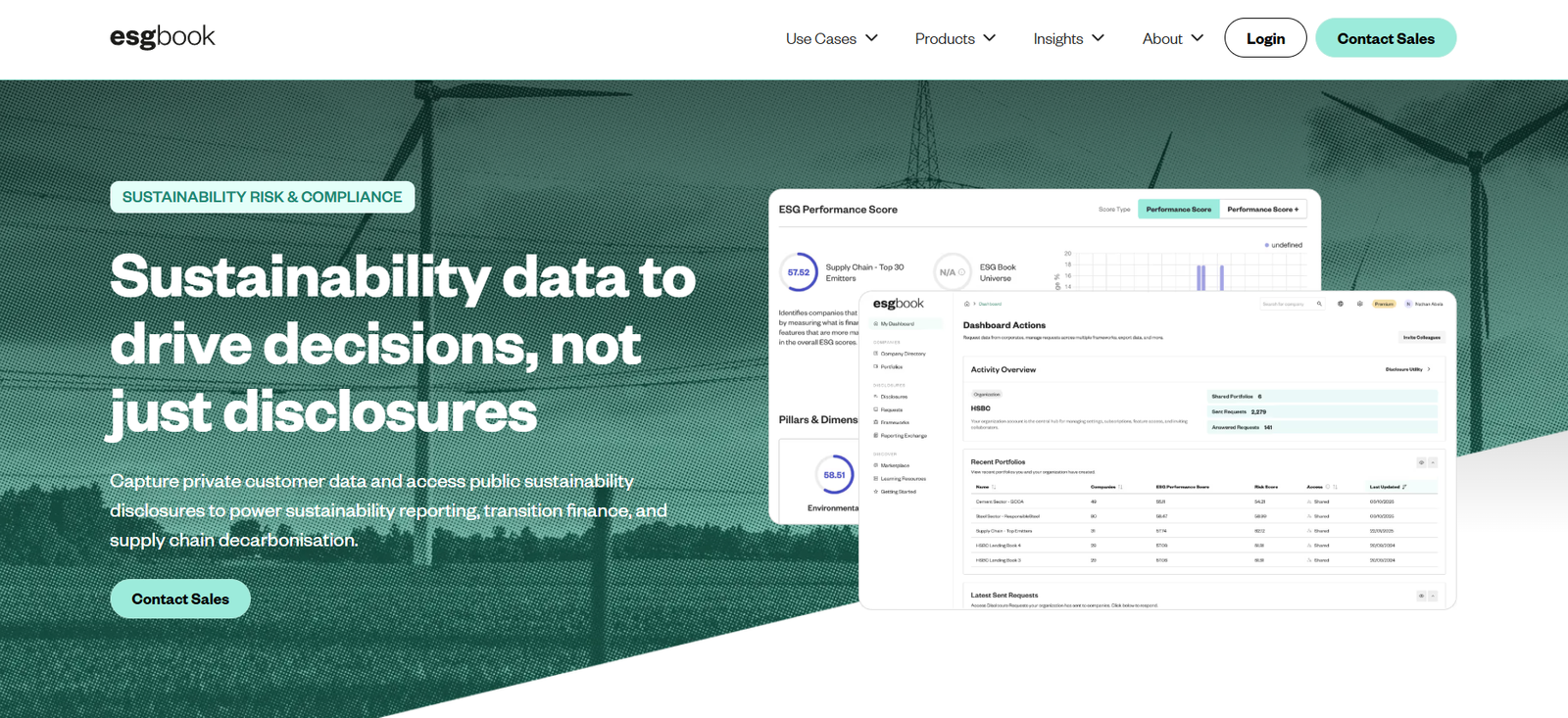
ESG Book is a global platform that offers real-time environmental, social, and governance (ESG) data, analytics, and disclosure tools for companies, financial institutions, and investors. Designed to enhance transparency and standardization in ESG reporting, ESG Book allows organizations to access, report, and manage sustainability data in a consistent and comparable way.
Developed by Arabesque, a leading sustainability-focused financial technology company, ESG Book enables businesses to meet evolving regulatory requirements, align with global frameworks, and communicate ESG performance with stakeholders. The platform aims to democratize ESG data by making it more accessible, timely, and transparent.
Used by banks, asset managers, corporations, and governments worldwide, ESG Book offers a unified solution for ESG data reporting, benchmarking, and decision-making in today’s sustainability-driven business environment.
Features
ESG Book offers a wide range of tools and services designed to meet the needs of various stakeholders in the ESG ecosystem.
One of the platform’s core features is its real-time ESG data dashboard, which provides access to sustainability information on thousands of companies globally. Users can view ESG metrics, historical trends, and performance comparisons in a clean, interactive interface.
The platform supports company self-disclosure, allowing organizations to publish their ESG data directly into ESG Book. This ensures data accuracy and helps companies control their ESG narrative while meeting regulatory or voluntary disclosure standards.
ESG Book includes AI-powered data aggregation and analytics, which collect ESG information from a wide range of public sources, regulatory filings, and proprietary channels. The use of artificial intelligence ensures data is continuously updated and quality-checked.
Users can access ESG scores and ratings across key themes such as climate risk, diversity, governance, supply chain sustainability, and more. These scores are aligned with major global frameworks, including the SDGs, TCFD, GRI, SASB, and SFDR.
The platform also offers a benchmarking tool, which enables users to compare ESG performance across peers, industries, or portfolios. This is especially useful for institutional investors and asset managers.
ESG Book is equipped with regulatory compliance support tools, helping financial institutions manage ESG data requirements under EU regulations like SFDR and taxonomy-related disclosures.
APIs and data integration options are available for seamless connectivity with internal systems, dashboards, or third-party analytics platforms.
How It Works
ESG Book works by aggregating ESG-related data from multiple sources, both public and self-disclosed. The platform processes this data using AI and advanced data modeling to ensure standardization, accuracy, and comparability.
Companies can create accounts and disclose their ESG metrics directly on the platform. This self-disclosure model ensures transparency and allows organizations to control how their data is presented.
Once the data is collected and verified, ESG Book makes it available through its cloud-based dashboard and APIs. Users can search for companies, view detailed ESG profiles, track trends, generate benchmark reports, and download datasets for internal analysis.
For financial institutions, ESG Book offers tools to manage regulatory reporting, evaluate ESG risk exposure, and integrate sustainability factors into investment decision-making.
The platform also connects with external ESG rating systems, helping users map and reconcile different ESG frameworks into a unified reporting strategy.
Use Cases
ESG Book is widely used across financial services, corporate sustainability, investment analysis, and government sectors.
Asset managers use ESG Book to assess the sustainability performance of companies in their portfolios, conduct peer benchmarking, and support ESG-focused investment strategies.
Banks and lenders leverage the platform to evaluate ESG risks in credit assessments, support green financing initiatives, and ensure compliance with ESG disclosure regulations.
Corporates use ESG Book to disclose ESG data, engage with stakeholders, and align their operations with global sustainability frameworks such as GRI, SASB, or the UN SDGs.
Consulting firms and ESG analysts use the platform to perform due diligence, trend analysis, and ESG risk assessments for clients and partners.
Governments and regulators benefit from ESG Book’s data transparency and analytics tools to monitor corporate sustainability practices and develop policy frameworks.
Pricing
ESG Book does not publicly list pricing on its website. Its services are tailored to meet the unique needs of corporates, financial institutions, and ESG data consumers.
Pricing likely depends on factors such as:
Number of users or teams
Level of data access (basic, advanced, historical)
API integration requirements
Type of license (corporate disclosure, investor access, or both)
Custom support and regulatory compliance services
Interested users can contact ESG Book directly through their website to request a demo and receive customized pricing information based on their organization’s goals and requirements.
Strengths
One of ESG Book’s key strengths is its commitment to transparency and real-time access. Unlike traditional ESG data providers that operate on delayed reporting cycles, ESG Book offers continuous updates and real-time analytics.
The ability for companies to self-disclose adds credibility and ensures that the data reflects actual performance rather than estimates or outdated filings.
Another major advantage is the platform’s alignment with global regulatory and reporting standards. ESG Book supports TCFD, GRI, SASB, SFDR, and other frameworks, making it a valuable compliance tool.
Its AI-powered data collection and benchmarking tools make it easy for investors and analysts to identify ESG leaders and laggards across different sectors.
The open-access philosophy also differentiates ESG Book in a market often dominated by expensive, closed ESG rating systems.
Drawbacks
A potential drawback of ESG Book is its lack of public pricing, which can make it difficult for smaller companies or new users to evaluate cost-effectiveness before initiating a sales conversation.
The platform is highly comprehensive, which may require training for non-experts or smaller teams unfamiliar with ESG frameworks and analytics.
While ESG Book supports data integration via API, more technical users may require support for advanced integration into proprietary systems, which could add to onboarding time.
Another consideration is that ESG Book may still rely on external data sources for companies that do not participate in self-disclosure, which could affect the granularity or timeliness of some data points.
Comparison with Other Tools
When compared with ESG data providers like MSCI ESG Manager, Sustainalytics, or Refinitiv ESG, ESG Book stands out for its real-time data, open access model, and company self-disclosure capabilities.
MSCI and Sustainalytics often operate as closed systems, where ESG ratings are based on proprietary models and are not always transparent. ESG Book, on the other hand, emphasizes standardization, data ownership, and transparency.
Compared to Arabesque S-Ray (developed by the same parent company), ESG Book expands functionality by integrating more user-facing tools for benchmarking, compliance, and disclosure management.
Other platforms like Worldfavor or EcoVadis focus more on supply chain sustainability, whereas ESG Book provides a more holistic view across industries, asset classes, and ESG themes.
Customer Reviews and Testimonials
ESG Book is trusted by leading financial institutions, asset managers, corporations, and governments globally.
While formal reviews are not listed on third-party sites like G2 or Capterra, the company’s clients include major firms such as Deutsche Bank, Allianz, HSBC, and other global players, which speaks to the platform’s credibility and industry relevance.
According to feedback featured on ESG Book’s website and public interviews, users value the platform’s real-time updates, custom benchmarking tools, and alignment with regulatory frameworks.
The self-disclosure model has also received praise from corporate users who seek more control over their ESG narrative and want to build trust with investors and regulators.
Conclusion
ESG Book is a powerful and forward-thinking platform that brings transparency, speed, and standardization to the world of ESG data and disclosures. With tools that support real-time analytics, regulatory compliance, and self-disclosure, ESG Book enables financial institutions, corporations, and governments to manage sustainability data more effectively.
Its open and transparent approach helps solve some of the longstanding challenges in ESG reporting, including data inconsistency and lack of comparability.
For organizations seeking to improve ESG performance, enhance stakeholder trust, or comply with evolving regulations, ESG Book offers a comprehensive and scalable solution.