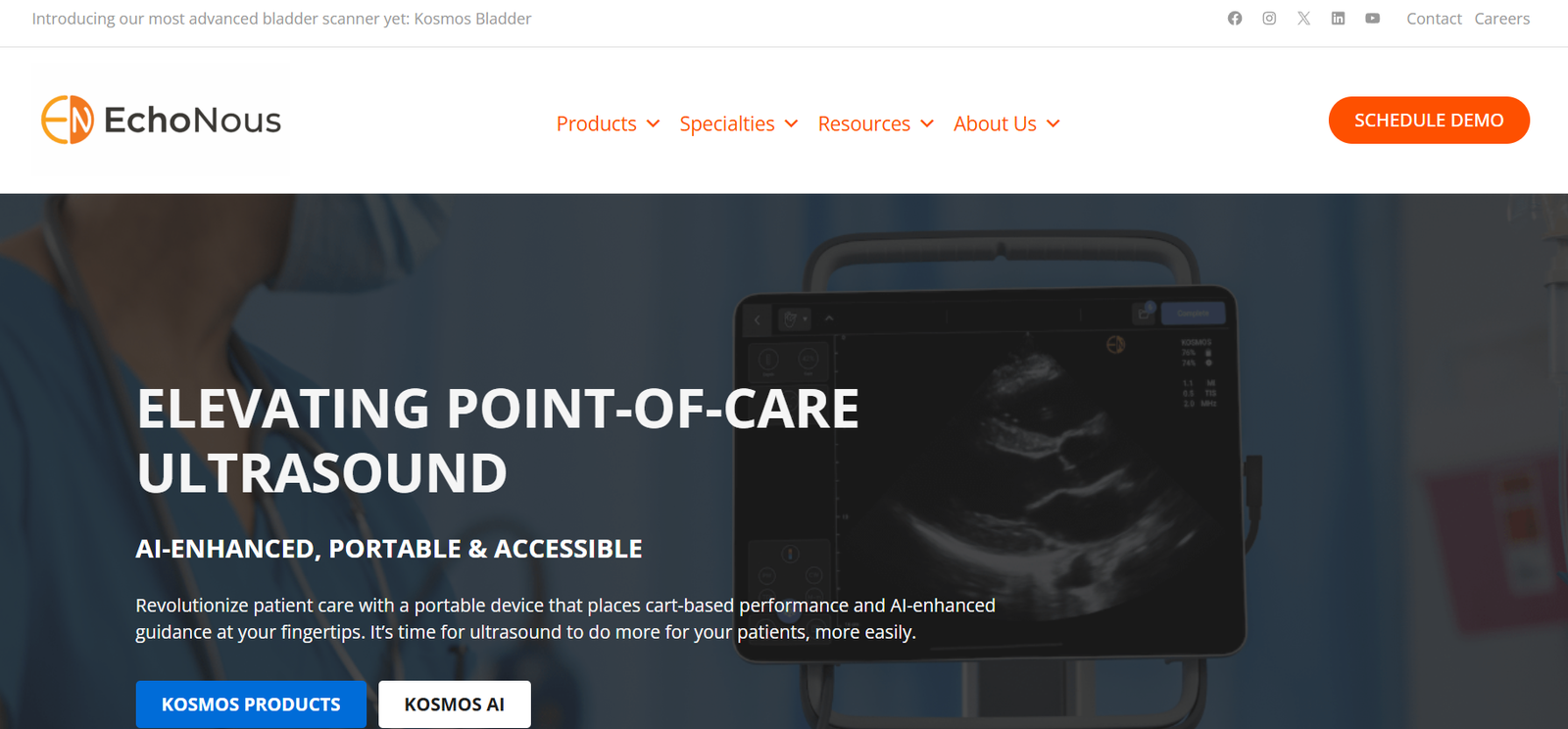
EchoNous is a medical technology company focused on revolutionizing ultrasound imaging by combining portability with artificial intelligence. Its flagship product, Kosmos, is an AI-powered handheld ultrasound system designed to bring high-quality diagnostic imaging directly to the point of care. With a strong focus on emergency medicine, critical care, and internal medicine, EchoNous aims to democratize access to ultrasound by making it faster, smarter, and more accessible.
Unlike traditional ultrasound machines, which are bulky and require significant training, Kosmos offers real-time imaging with AI-guided features in a compact, portable form. It is designed for clinicians who need immediate insights at the bedside, in remote settings, or during emergency response situations.
Features
Kosmos is the core product in the EchoNous ecosystem. It is a handheld, FDA-cleared ultrasound device that connects to a tablet and offers imaging capabilities on par with full-sized hospital-grade ultrasound systems. The device supports three imaging modes: B-mode, color Doppler, and pulsed wave Doppler.
One of its most notable features is AI guidance, which helps users position the probe correctly and interpret the images. This makes the device particularly useful for non-expert users or those working in fast-paced environments. The AI continuously analyzes the scan in real-time, offering auto labeling of anatomy and suggesting adjustments for optimal imaging.
Kosmos is designed to scan multiple organ systems and supports cardiac, lung, abdominal, and vascular imaging. It includes continuous wave Doppler for cardiac function, a capability not commonly found in handheld devices.
Another unique feature is Kosmos Bridge, which enables remote collaboration between clinicians. With this feature, multiple users can view live ultrasound images simultaneously, making it ideal for telemedicine, education, or remote supervision.
The device is built with durability and infection control in mind, featuring a sealed, disinfectant-safe body and wireless connectivity. It can be integrated into hospital IT systems and supports secure storage of DICOM images for compliance and review.
How It Works
Kosmos is composed of a lightweight probe and a tablet-based interface. To use the system, a clinician connects the probe to the tablet via USB or a secure wireless connection. Once connected, the Kosmos app launches automatically and guides the user through the scanning process.
The built-in AI assists with probe placement and anatomy recognition, providing visual cues and real-time feedback. For cardiac imaging, the system offers advanced features such as ejection fraction estimation and valve flow visualization using continuous wave Doppler.
The scans can be saved and uploaded to a cloud-based platform or integrated directly into the hospital’s electronic medical record system. Kosmos Bridge allows the user to share a live feed of the scan with other clinicians or specialists in real-time, even from remote locations.
Kosmos is designed for point-of-care use, meaning it can be used at the patient’s bedside, in the emergency room, or in field settings. Its portability and battery life make it suitable for both routine care and emergency diagnostics.
Use Cases
EchoNous Kosmos is used widely in point-of-care ultrasound (POCUS) applications. In emergency departments, clinicians use it for rapid diagnosis of cardiac function, lung conditions, or abdominal trauma. Its AI guidance is especially helpful in time-sensitive scenarios where fast decisions are critical.
In critical care units, Kosmos supports hemodynamic monitoring by providing quick cardiac assessments, helping to guide fluid management and medication adjustments. Its Doppler capabilities allow intensivists to evaluate heart function without moving the patient.
General practitioners and internists use Kosmos in outpatient settings to support diagnosis and monitor chronic conditions. The system’s portability and intuitive interface make it ideal for primary care practices that want to incorporate ultrasound into their workflow without requiring full radiology support.
The device is also increasingly used in remote or rural healthcare, where access to imaging infrastructure is limited. With Kosmos Bridge, clinicians in rural locations can consult with specialists in real time, improving patient outcomes without requiring patient transport.
In medical education, Kosmos serves as a training tool for teaching ultrasound imaging, anatomy, and procedural guidance. Its AI features help students learn proper techniques and build confidence in ultrasound interpretation.
Pricing
EchoNous does not publish specific pricing on its website. However, the Kosmos system is positioned as a more affordable alternative to full-sized ultrasound machines, while offering many of the same features.
Pricing may vary depending on the configuration, number of probes, software features, and support packages chosen. Typically, Kosmos is offered under a one-time purchase model, with optional annual software subscriptions for AI features, remote collaboration, and cloud storage.
Hospitals, clinics, and educational institutions are encouraged to contact EchoNous directly for customized pricing based on their specific needs and volume requirements.
Strengths
One of the key strengths of EchoNous is its combination of portability and clinical-grade imaging. Kosmos delivers advanced features like continuous wave Doppler and cardiac assessments in a device small enough to carry in a pocket.
Its AI guidance system significantly reduces the learning curve, making it accessible to clinicians who are not ultrasound experts. This democratizes access to high-quality imaging across multiple care settings.
EchoNous has also built a strong platform for remote collaboration, which is critical in today’s telehealth landscape. The Kosmos Bridge feature enhances teamwork and knowledge sharing among clinicians, especially in rural or educational environments.
The device’s regulatory clearance by the FDA and its ability to scan multiple organs make it a comprehensive solution for point-of-care diagnostics. Its ability to store and transfer DICOM files supports integration with existing hospital IT systems.
Drawbacks
One limitation of EchoNous Kosmos is its reliance on external tablets for display and operation. While this allows for flexibility, it may introduce compatibility issues or require additional hardware investment.
Another drawback is that some advanced features, such as remote collaboration or AI analytics, may require ongoing subscription fees. This could impact budgeting for smaller clinics or educational programs.
As a newer player in the ultrasound market, EchoNous may not have the same brand recognition or long-term track record as larger medical imaging companies. However, its technology and performance have been positively reviewed by early adopters.
Lastly, although the device is designed to be intuitive, there is still a need for basic ultrasound training, particularly for users without prior imaging experience.
Comparison with Other Tools
EchoNous Kosmos competes with other handheld ultrasound systems such as Butterfly iQ+ and Philips Lumify. Compared to Butterfly iQ+, which uses a single probe with a chip-based transducer, Kosmos offers dedicated probes for higher resolution and better performance in specific applications.
Unlike Philips Lumify, which also requires a smart device and offers high-quality imaging, Kosmos distinguishes itself with AI-guided scanning and Doppler features, making it a better fit for cardiac and vascular use.
Butterfly iQ+ is more well-known for its ease of use and single-probe versatility, but EchoNous provides superior Doppler capabilities and advanced cardiac functionality that many emergency and critical care clinicians find essential.
In terms of software, EchoNous stands out for its remote collaboration tools and continuous updates to AI features. While pricing is not publicly listed for any of these systems, Kosmos is positioned competitively with similar devices in its class.
Customer Reviews and Testimonials
EchoNous has received positive reviews from clinicians, especially those in emergency and critical care settings. Users often highlight the image quality, portability, and AI assistance as key benefits that improve their workflow and confidence in diagnosis.
In published case studies, hospitals have reported faster diagnosis and reduced time to treatment in acute cases thanks to the quick deployment of Kosmos at the bedside. Medical educators have also praised the device for making ultrasound training more accessible and engaging.
Although full customer testimonials are limited on the website, EchoNous has been featured in healthcare publications and conference presentations, where its impact on point-of-care imaging is frequently recognized.
Conclusion
EchoNous is redefining the ultrasound landscape with Kosmos, an AI-powered handheld ultrasound solution that brings hospital-grade imaging to the point of care. Designed for ease of use, clinical accuracy, and real-time decision-making, Kosmos is an ideal tool for emergency physicians, intensivists, primary care providers, and educators alike.
With features such as continuous wave Doppler, AI-guided scanning, and remote collaboration, EchoNous is not just competing with legacy systems but setting a new standard for what portable ultrasound can achieve.
For healthcare providers looking to expand their diagnostic capabilities with smart, portable, and high-performance ultrasound, EchoNous offers a powerful and forward-thinking solution. To learn more or request a demo, visit the official website at https://echonous.com.