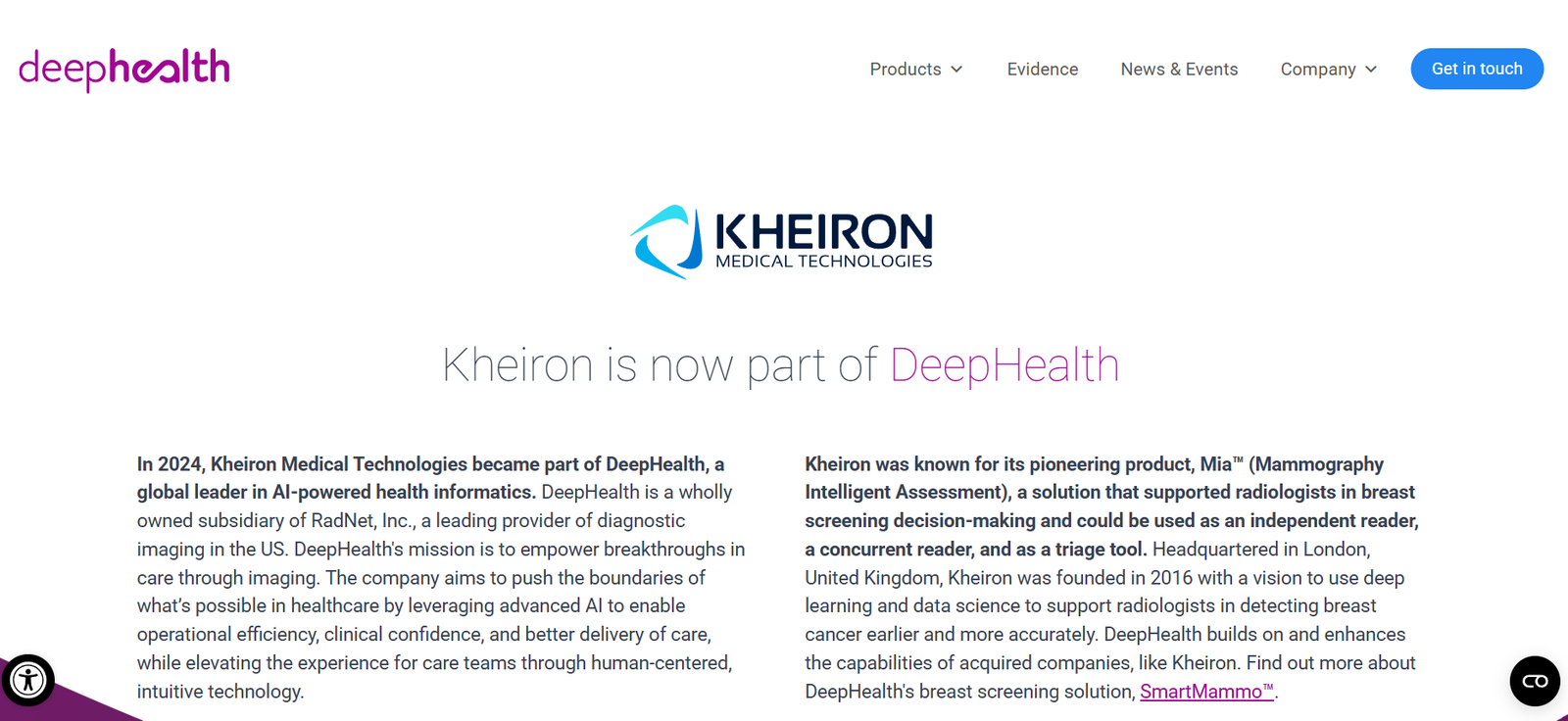
DeepHealth is a medical technology company focused on improving the accuracy and efficiency of breast cancer detection using artificial intelligence. As a subsidiary of RadNet, one of the largest providers of outpatient imaging in the United States, DeepHealth combines state-of-the-art machine learning with clinical expertise to support radiologists in interpreting mammograms more effectively.
The company’s core mission is to leverage AI to detect breast cancer earlier and with greater precision, ultimately improving patient outcomes. DeepHealth’s solutions integrate seamlessly with existing imaging infrastructure, helping providers scale diagnostic capabilities and reduce radiologist burnout. The platform is FDA-cleared and supports 2D and 3D mammography (digital breast tomosynthesis), making it suitable for a wide range of clinical environments.
Features
DeepHealth’s flagship offering is an AI-enabled breast imaging platform that analyzes mammograms in real-time, identifying suspicious areas that may indicate malignancies. The system uses deep learning algorithms trained on diverse datasets to detect abnormalities across a range of breast densities and imaging types.
The platform provides decision support for radiologists by highlighting regions of interest on the mammogram, enabling them to focus their attention where it’s most needed. It also offers case triage functionality, helping prioritize high-risk cases for immediate review.
DeepHealth supports full-field digital mammography and digital breast tomosynthesis (DBT), with high compatibility across major imaging systems. Its AI is designed to work alongside radiologists—not replace them—offering a second set of eyes that helps reduce missed cancers and false positives.
Additionally, DeepHealth integrates with PACS and RIS systems to streamline workflow and minimize disruption to existing clinical operations. The system is built to comply with HIPAA standards, ensuring patient privacy and data security.
How It Works
DeepHealth’s AI software is integrated into the radiology workflow through PACS or cloud-based systems. When a mammogram is taken, the image is analyzed by the AI engine in real time.
The deep learning model identifies regions of interest and flags them on the image viewer for the radiologist to review. The system also assigns a likelihood score to each area, helping the radiologist assess the probability of malignancy.
Radiologists then review the AI-enhanced images alongside their own interpretation. The goal is to provide additional information and confidence, particularly in complex cases or dense breast tissue where cancers are harder to spot.
The AI platform is continuously updated based on new imaging data and feedback, helping to improve diagnostic performance over time. DeepHealth also provides tools for case comparison and audit support, enabling clinicians to track diagnostic outcomes and identify performance improvement areas.
Use Cases
DeepHealth is used in breast imaging centers and radiology departments to enhance cancer detection and optimize workflow. Radiologists benefit from the AI’s ability to identify subtle patterns and support confident decision-making.
In screening programs, DeepHealth helps increase throughput by automating triage and highlighting potentially abnormal cases for priority review. This is particularly valuable in high-volume centers facing radiologist shortages.
Health systems and outpatient imaging providers use DeepHealth to standardize breast cancer screening quality across multiple locations, ensuring consistency and reducing diagnostic variability.
DeepHealth is also employed in clinical research settings, where AI-assisted imaging supports data analysis and validation of new cancer screening protocols.
In future applications, the platform may expand to support risk prediction models and personalized screening pathways based on AI-driven insights.
Pricing
DeepHealth does not publicly list pricing on its website. The company offers custom pricing models based on the size of the organization, number of imaging studies, and integration requirements.
Healthcare providers interested in deploying DeepHealth’s platform can request a demo and consultation to receive a tailored pricing proposal. Pricing structures typically depend on enterprise-level agreements, including volume discounts and multi-site deployments.
As part of RadNet, DeepHealth may also be available through bundled services or strategic partnerships with imaging providers and hospital networks.
Strengths
A key strength of DeepHealth is its clinical-grade AI, which has been trained and validated on large and diverse datasets to ensure robustness across populations and breast densities.
The platform’s FDA clearance for both 2D and 3D mammography sets it apart from other imaging tools that are limited in scope or still under regulatory review.
Its seamless integration with PACS and radiology systems allows for easy adoption without disrupting current workflows, making implementation faster and more efficient.
The system supports radiologist productivity and decision-making, helping reduce diagnostic errors, improve cancer detection rates, and lower recall rates.
As part of RadNet, DeepHealth benefits from access to an extensive imaging network, clinical expertise, and real-world testing environments, accelerating innovation and trust in its solutions.
Drawbacks
One limitation of DeepHealth is that it currently focuses exclusively on breast imaging, whereas some AI imaging companies offer multi-specialty tools for chest, brain, and abdominal scans.
The system’s effectiveness is still dependent on high-quality input images and radiologist interpretation, meaning it cannot function as a standalone diagnostic solution.
Like many AI tools in radiology, trust and adoption may vary among clinicians, especially those unfamiliar or skeptical of machine learning technologies.
The platform’s pricing and availability are not transparent, which may be a barrier for smaller imaging centers or global markets looking for affordable AI solutions.
While FDA-cleared, insurance reimbursement for AI-assisted reads remains limited, meaning financial ROI may depend on efficiency gains rather than direct revenue streams.
Comparison with Other Tools
DeepHealth competes with other AI imaging companies such as iCAD, Lunit INSIGHT, Therapixel, and ScreenPoint Medical.
Compared to iCAD’s ProFound AI, which also offers breast cancer detection tools, DeepHealth emphasizes workflow integration and real-time prioritization, making it highly adaptable for radiology teams.
Lunit and Therapixel provide AI for mammography with strong international presence, but DeepHealth’s close integration with RadNet’s imaging infrastructure gives it a significant advantage in the U.S. healthcare system.
ScreenPoint Medical’s Transpara also supports mammography analysis, but DeepHealth differentiates itself with its FDA clearance for both 2D and 3D images, offering broader modality support.
DeepHealth’s focus on augmenting—not replacing—radiologist expertise, along with its scalable platform, positions it well among enterprise imaging solutions.
Customer Reviews and Testimonials
Radiologists using DeepHealth report improved confidence in cancer detection, particularly in complex or dense breast cases. Many cite the platform’s ability to catch subtle abnormalities and reduce unnecessary recalls as a major benefit.
Health systems using DeepHealth across multiple sites report increased efficiency and consistency in breast imaging interpretation, which supports better outcomes and reduces clinician fatigue.
Patients benefit from earlier and more accurate detection, contributing to higher satisfaction and reduced time to treatment.
DeepHealth has received recognition from the medical imaging community for its scientific rigor, user-friendly interface, and real-world performance.
Conclusion
DeepHealth is a leading AI imaging platform that enhances breast cancer detection through powerful machine learning and seamless clinical integration. By supporting radiologists with real-time analysis and triage tools, DeepHealth improves diagnostic accuracy, optimizes workflow, and helps healthcare providers deliver more efficient, high-quality care.
With FDA clearance, strong clinical validation, and a focus on radiologist collaboration, DeepHealth is well-positioned to play a pivotal role in the future of breast imaging and AI-assisted diagnostics.