
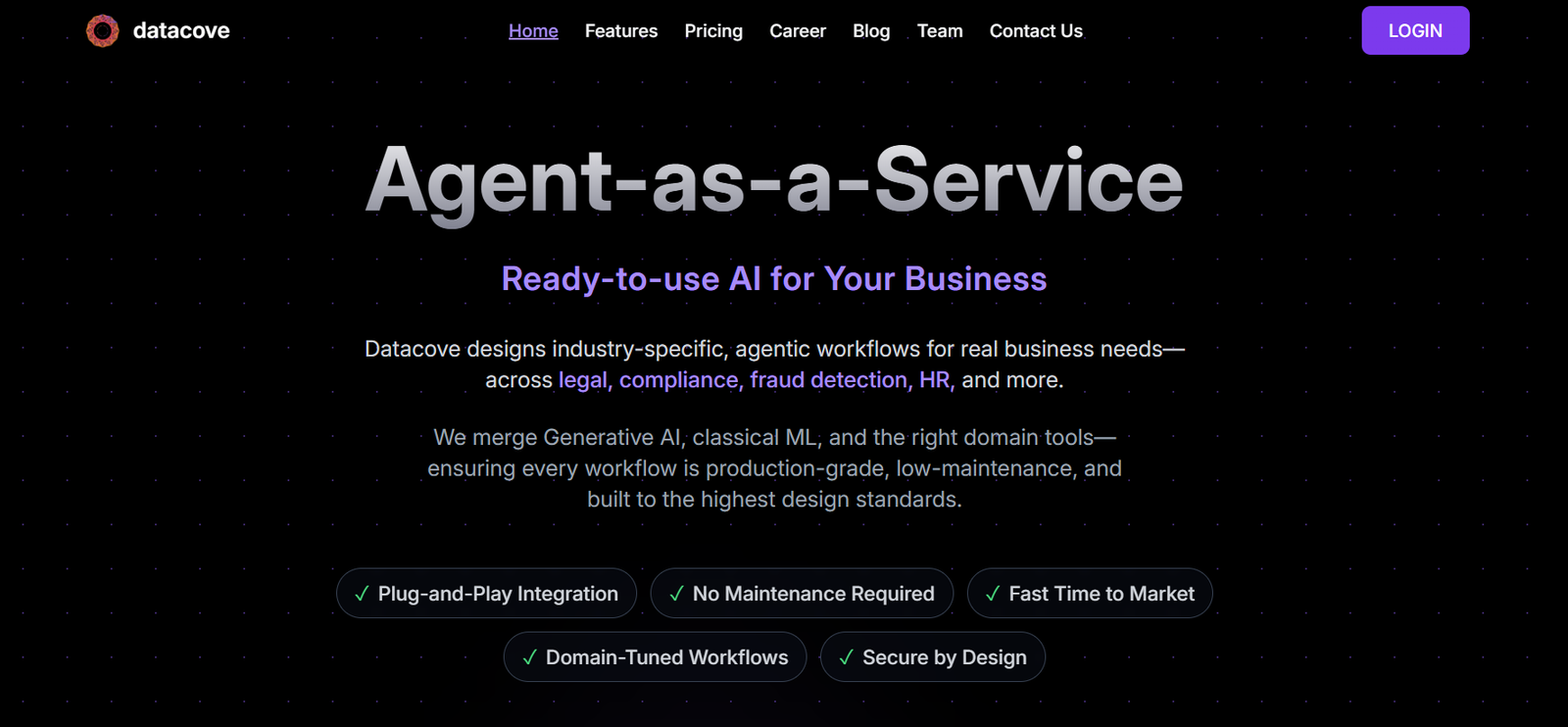
Datacove AI is a secure platform designed to help enterprises safely deploy generative AI tools while maintaining complete control over their data. The tool addresses one of the biggest barriers to enterprise AI adoption—data security and compliance. As businesses look to incorporate large language models into their workflows, many are held back by concerns about sending sensitive information to external cloud-based AI systems.
Datacove solves this by offering a secure, private AI environment where enterprises can build, manage, and deploy generative AI tools without risking their proprietary or customer data. It acts as a bridge between cutting-edge AI capabilities and enterprise-grade data protection.
Features
Datacove AI offers a wide array of enterprise-focused features designed to keep data private while enabling powerful AI workflows.
Private AI Workspaces – Create isolated environments where teams can safely test and use AI without data leaving the organization.
Model Agnostic – Integrate any large language model, whether open-source or proprietary, including models from OpenAI, Anthropic, Mistral, and others.
Enterprise Data Security – Keep all data within your organization’s infrastructure, meeting security and compliance standards.
Audit Trails and Access Control – Detailed activity logs and customizable user permissions help monitor AI usage and enforce accountability.
Secure Model Deployment – Deploy LLMs internally without sending prompts or data to external APIs.
No Data Leakage – Ensure sensitive business information never leaves your secure environment.
Self-Hosted or VPC Deployment – Choose from full self-hosted setup or Virtual Private Cloud (VPC) deployments on AWS or Azure.
Integrations – Connect easily to enterprise tools, databases, or internal systems via APIs or plugins.
How It Works
Datacove AI works by allowing enterprises to integrate AI models within their existing infrastructure, providing secure deployment options that ensure no data ever leaves their controlled environment.
The process starts with choosing a deployment option—self-hosted or VPC. Once set up, teams can create secure AI workspaces where selected models are deployed. Users interact with these models via internal applications or custom tools. Unlike public AI platforms, Datacove ensures that all prompts, outputs, and metadata are stored securely and never sent to external services.
Datacove supports multiple LLM providers, allowing enterprises to select the most appropriate model based on performance, cost, and licensing preferences. IT teams can enforce granular access controls, track user activity, and manage data governance—all within a centralized platform.
Use Cases
Datacove AI is built for enterprise environments and serves various secure use cases.
Internal Knowledge Assistants – Build secure AI assistants that help employees query internal documentation, databases, and files.
Legal and Compliance Support – Safely summarize legal documents, analyze compliance risks, and automate repetitive regulatory tasks.
Customer Support Automation – Use AI to handle tickets or support queries with full data privacy, especially for sensitive customer information.
Software Development – Assist developers with code suggestions, debugging, and documentation without exposing source code to third-party LLM APIs.
Healthcare and Life Sciences – Analyze medical records or research data with models deployed inside secure healthcare systems.
Financial Services – Run financial analysis, report generation, and internal modeling without breaching confidentiality agreements or data privacy regulations.
Pricing
Datacove AI follows a tailored pricing model based on deployment type, usage, and organizational size. The platform does not publicly list flat pricing tiers. Instead, pricing is customized based on the following factors:
Number of users and teams
Choice of deployment: Self-hosted vs. VPC
Volume of AI queries or interactions
Types of models integrated
Support and SLAs required
To get detailed pricing, enterprises are encouraged to book a demo or contact Datacove’s sales team through the website at https://www.datacove.ai. This ensures each client receives a solution aligned with their specific security and infrastructure requirements.
Strengths
Datacove AI stands out in the enterprise AI market due to several unique strengths.
Enterprise-Grade Security – Keeps all AI interactions within the organization’s control, solving the biggest trust issue with generative AI adoption.
Model Flexibility – Support for a variety of LLMs provides flexibility in choosing the right model for specific use cases.
Custom Deployments – Offers self-hosted and VPC-based setups, ideal for highly regulated industries.
No Vendor Lock-in – Since organizations can choose their preferred models, there is no dependency on a single LLM vendor.
Compliance-Friendly – Designed to meet strict compliance requirements such as GDPR, HIPAA, and SOC2.
Audit and Governance Tools – Built-in monitoring, access controls, and logging features support security policies and audits.
Drawbacks
While Datacove AI offers strong security and enterprise features, there are a few limitations to consider.
Custom Pricing – Lack of transparent pricing may delay procurement processes for some organizations.
Requires Technical Setup – Self-hosted or VPC deployments need a capable IT team to manage infrastructure and updates.
Not for Casual Users – The platform is designed for enterprises, making it less accessible to individuals or small businesses with limited technical resources.
Fewer Off-the-Shelf Integrations – Compared to mainstream SaaS AI tools, Datacove may require more setup time to integrate with existing workflows.
Comparison with Other Tools
Compared to popular generative AI tools like OpenAI’s ChatGPT, Microsoft Copilot, or Google Duet AI, Datacove AI offers a fundamentally different value proposition focused on secure enterprise deployment.
ChatGPT and Microsoft Copilot are powerful productivity tools but operate through cloud-based services where enterprise data may be processed externally. These tools are not ideal for organizations with strict data privacy mandates.
Open-source LLM deployments like Llama 3 or Mistral models allow for internal control but require custom infrastructure, which Datacove helps simplify through managed deployments.
Datacove acts as a security-first platform, making it ideal for companies in finance, healthcare, and legal sectors, where data cannot leave the organization’s perimeter.
Unlike Zapier-based AI automation platforms or API-first LLM tools, Datacove focuses on secure model hosting and governance rather than integration and automation.
Customer Reviews and Testimonials
As a specialized enterprise product, Datacove AI does not currently have a large number of public reviews on platforms like Product Hunt or G2. However, feedback from pilot customers and case studies suggests a strong reception among privacy-conscious organizations.
Customers value the ability to run AI tools internally without sending data to external APIs, especially in compliance-heavy industries. The model-agnostic approach and enterprise support offerings are often cited as key benefits.
More formal reviews and testimonials are expected as the platform gains broader adoption. Businesses interested in trying the tool can request a demo directly via the Datacove website.
Conclusion
Datacove AI is a purpose-built solution for enterprises that want to harness the power of generative AI without compromising on data security. With its private deployment model, LLM flexibility, and enterprise-grade governance features, it offers a rare combination of innovation and control.
While it may not be suitable for individuals or small teams, it excels in regulated industries and large organizations with serious data protection requirements. The custom pricing and need for IT involvement are small trade-offs for the peace of mind and compliance assurance it provides.


