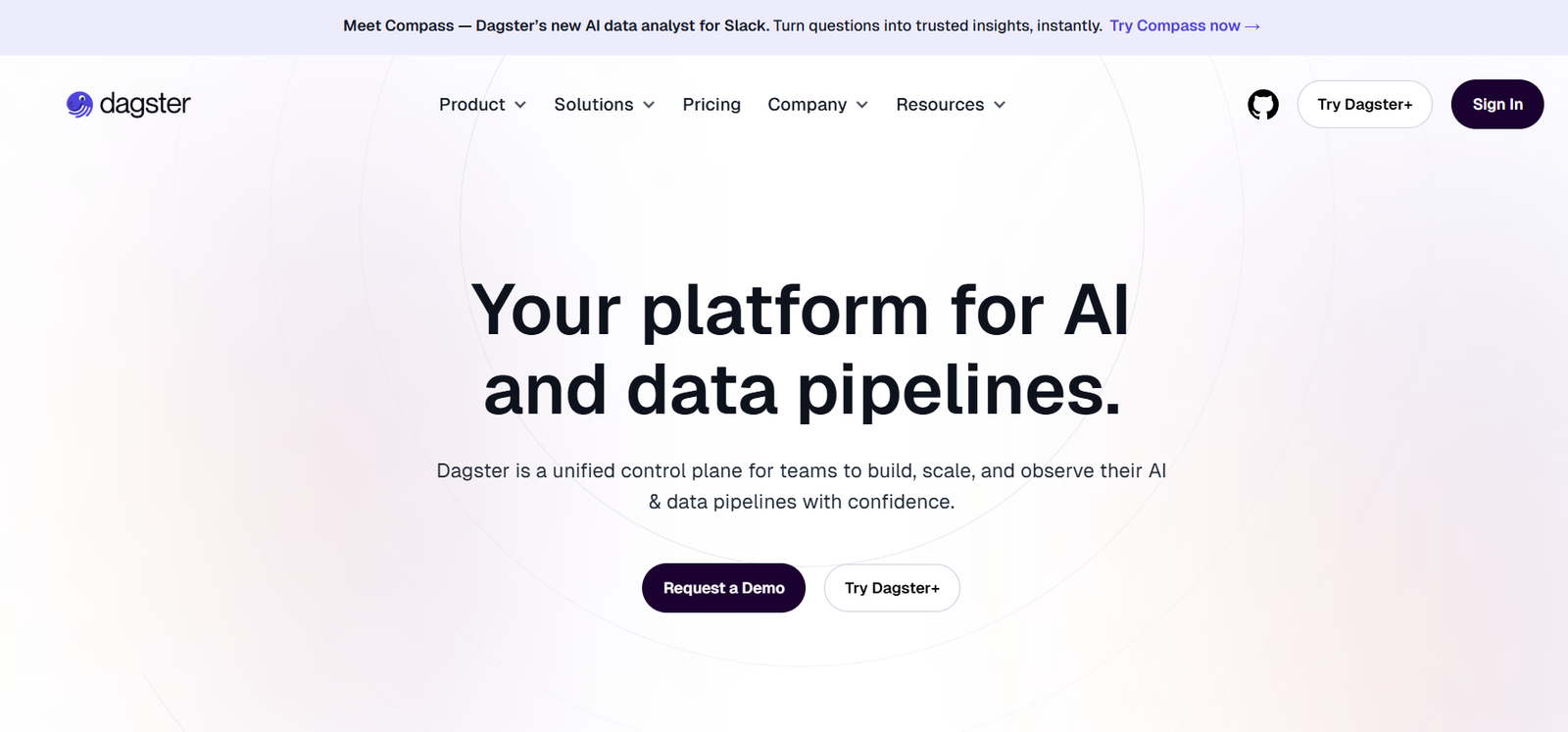
Dagster is a modern data orchestration platform designed to help data teams build, deploy, and monitor robust data pipelines. Built by Elementl, Dagster provides a unified development environment for orchestrating complex data workflows using Python. Unlike traditional schedulers, Dagster treats pipelines as software, emphasizing modularity, observability, and testability.
Dagster enables data engineers and analytics teams to define data workflows with clear boundaries, track data dependencies, and monitor execution in real time. The platform supports local development, CI/CD workflows, and production deployments, making it a scalable solution for both startups and large enterprises.
With native integrations for popular tools like dbt, Airbyte, Snowflake, and more, Dagster empowers teams to adopt best practices in data engineering while maintaining visibility and control over their pipelines.
Features
Dagster offers a rich set of features that help teams build resilient and maintainable data workflows.
Declarative Data Assets: Define your data assets as first-class citizens, allowing clear lineage tracking and dependency management across your pipelines.
Python-Based Development: Use Python to build and test pipelines, making it easy for teams already familiar with modern data tooling.
Rich Observability: Gain full visibility into pipeline runs with logs, metrics, lineage graphs, and step-by-step execution details.
Dagster UI: A modern web-based interface to monitor runs, visualize assets, debug failures, and manage schedules or sensors.
Asset Materialization: Track when and how data assets are generated, enabling auditability and fine-grained control over data freshness.
Flexible Scheduling: Create time-based schedules or event-driven sensors to trigger workflows, supporting dynamic and reactive orchestration.
Integrated Testing: Write unit tests and integration tests using Python, ensuring pipelines are reliable and changes don’t introduce regressions.
Multi-Environment Support: Use Dagster in development, staging, and production with consistent deployment patterns.
Built-In Versioning: Track versions of assets and pipelines, enabling rollback, historical comparisons, and safe updates.
Tool Integrations: Native support for tools like dbt, Airbyte, Great Expectations, Snowflake, BigQuery, Spark, and others.
How It Works
Dagster helps teams go from local development to production with a structured yet flexible workflow:
Step 1 – Define Assets: Use Python functions to define data assets, which can be raw inputs, intermediate transformations, or final outputs.
Step 2 – Build Pipelines (Jobs): Combine multiple assets or operations into jobs, defining how data flows through your system.
Step 3 – Set Schedules or Sensors: Choose when jobs should run—on a cron schedule, based on events, or triggered via external APIs.
Step 4 – Deploy Pipelines: Use the Dagster CLI or integrations with tools like Kubernetes, Docker, or CI/CD platforms to deploy pipelines.
Step 5 – Monitor and Debug: Use the Dagster UI to monitor real-time execution, trace data lineage, and debug any failures.
Step 6 – Iterate and Evolve: Modify assets, add tests, or update schedules without disrupting existing workflows, thanks to modular pipeline definitions.
Use Cases
Dagster supports a wide range of use cases across modern data teams:
ETL and ELT Workflows: Automate data ingestion, transformation, and loading using dbt, Airbyte, or custom connectors.
Data Warehouse Management: Orchestrate updates to Snowflake, BigQuery, or Redshift with full visibility into asset lineage and refresh cycles.
Analytics Engineering: Schedule dbt models with dependency awareness and alerting when models fail or are out-of-date.
Machine Learning Pipelines: Manage data preprocessing, model training, evaluation, and deployment as part of a reproducible workflow.
Data Quality Checks: Run Great Expectations or custom assertions to validate datasets and block downstream jobs if data fails validation.
Data Lakehouse Orchestration: Manage large-scale transformations and partitioned data ingestion across lakehouse platforms like Delta Lake.
CI/CD for Data: Integrate with GitHub Actions or GitLab CI to deploy, test, and version data pipelines using software engineering best practices.
Pricing
Dagster offers a variety of pricing options suitable for different organizational needs:
Dagster Open Source: Free to use under the Apache 2.0 license. Ideal for individual developers or small teams looking to self-host and customize their orchestration.
Dagster Cloud: A managed, production-ready version of Dagster with additional enterprise features. Two tiers are currently available:
Team Plan: Designed for small to mid-sized teams. Includes hosted infrastructure, Dagster UI, asset lineage, job monitoring, and integrations. Starts at $0/month with limits, and scales based on usage.
Enterprise Plan: Tailored for large organizations needing advanced security, compliance (SOC2, HIPAA), SSO, audit logs, and dedicated support. Custom pricing available upon request.
To explore current pricing and feature comparisons, visit the Dagster Pricing Page.
Strengths
Dagster stands out in the data orchestration ecosystem due to its modern, software-centric design:
Developer-Centric: Built for Python developers with a familiar syntax and local-first development experience.
First-Class Asset Modeling: Unlike traditional DAGs, Dagster models data assets explicitly, improving clarity and lineage tracking.
Modularity and Reuse: Components are composable and testable, enabling teams to scale workflows without repetition or complexity.
Production-Ready Observability: Integrated logging, alerting, and lineage give operators the tools they need to monitor pipelines effectively.
Active Community and Ecosystem: Backed by Elementl, with a growing open-source community and regular feature releases.
Strong Integrations: Supports key components of the modern data stack including dbt, Airbyte, Great Expectations, and cloud warehouses.
Flexible Deployment: Use Dagster on-premise, in your cloud, or as a fully hosted service via Dagster Cloud.
Drawbacks
While Dagster offers robust capabilities, there are a few considerations:
Learning Curve: For teams unfamiliar with Python or software development best practices, the initial setup may require more time.
Python-Centric: While powerful, Dagster currently favors Python, which may be limiting for non-Python workflows or mixed-language teams.
Requires Infrastructure for Self-Hosting: Open source users must provision and maintain their own infrastructure, which may be a barrier for small teams.
UI Customization: The Dagster UI is powerful but not easily customizable for unique organizational branding or visualization needs.
Complexity for Small Projects: For very simple workflows, Dagster’s features may be more than necessary.
Comparison with Other Tools
Dagster fits into the modern data orchestration landscape alongside tools like Apache Airflow, Prefect, and dbt Cloud:
Compared to Apache Airflow, Dagster offers a more modern developer experience, better observability, and a richer asset-based approach. Airflow’s DAGs are task-focused, while Dagster focuses on data products.
Compared to Prefect, both tools aim for modern orchestration. Dagster emphasizes asset modeling and version control, while Prefect is known for its hybrid execution model and agent-based architecture.
Compared to dbt Cloud, Dagster is more general-purpose. While dbt excels in SQL-based modeling, Dagster orchestrates entire workflows that may include dbt runs, machine learning, and data quality checks.
Dagster is ideal for teams looking for a unified, Python-first orchestration system that bridges the gap between software engineering and data operations.
Customer Reviews and Testimonials
Dagster has received positive feedback from modern data teams at startups and enterprises alike. Common themes in user testimonials include:
– Easier debugging and monitoring compared to legacy tools
– Modular design that supports scaling and maintainability
– Seamless integration with dbt and other components of the data stack
– Helpful documentation and active support from the Dagster community
Companies like dbt Labs, ZipRecruiter, Notion, and Convoy have adopted Dagster to modernize their data orchestration.
To explore case studies and community stories, visit dagster.io or browse their community resources.
Conclusion
Dagster is redefining data orchestration by bringing software engineering best practices to the world of data pipelines. Its asset-based architecture, Python-first approach, and robust observability make it a top choice for modern data teams seeking reliability, flexibility, and scalability.
Whether you’re orchestrating data warehouse updates, building machine learning workflows, or integrating CI/CD into analytics, Dagster offers a developer-friendly, future-ready solution.
For teams that want to treat data like software—with modularity, versioning, and tests—Dagster is more than just a scheduler; it’s a platform for building better data systems.