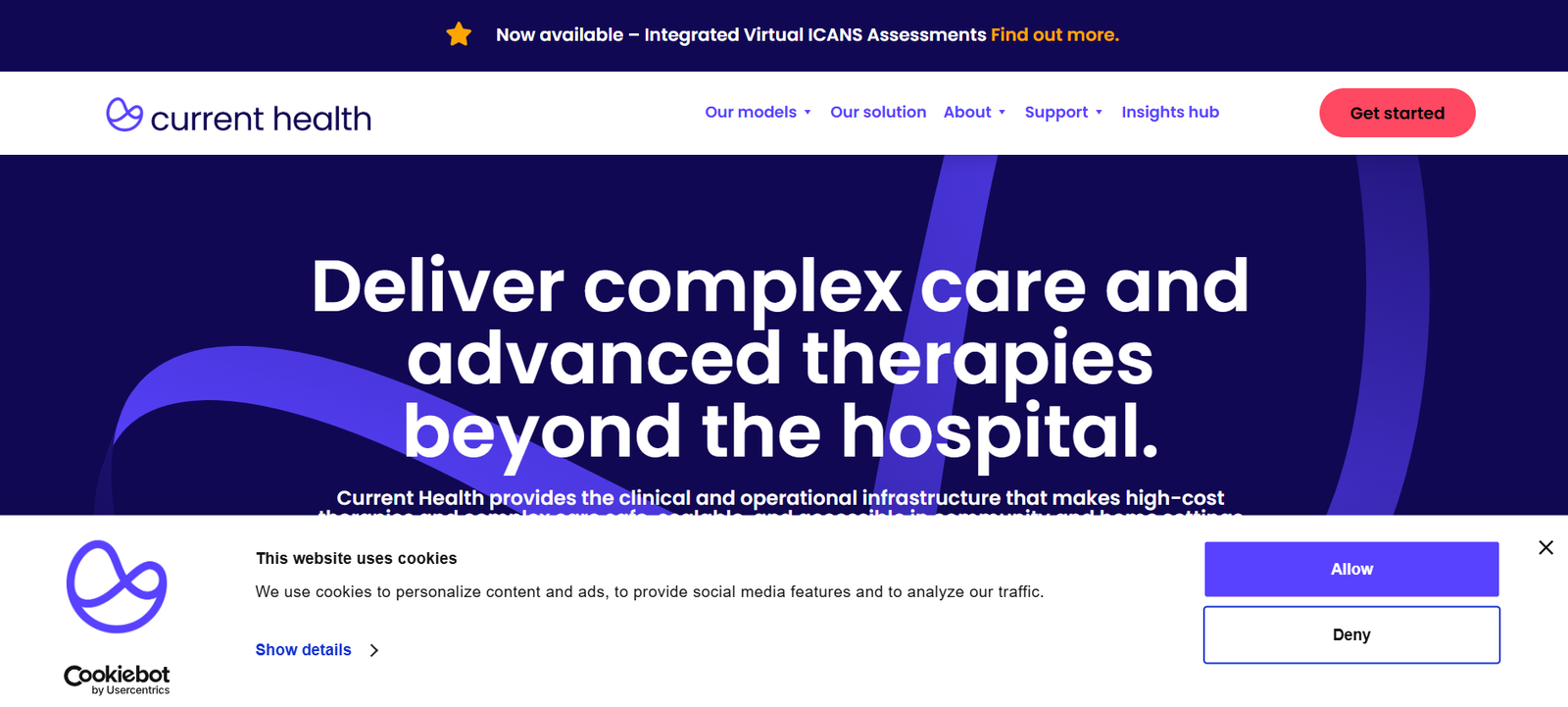
Current Health is a comprehensive remote healthcare platform that empowers health systems to deliver care outside the traditional clinical setting. Combining continuous remote patient monitoring, telehealth capabilities, and advanced analytics, Current Health supports proactive care management and scalable hospital-at-home programs.
Acquired by Best Buy Health in 2021, Current Health helps providers manage patient care across the continuum—from hospital to home—by delivering real-time physiological data, predictive insights, and virtual communication tools. The platform supports patients with chronic conditions, post-acute care needs, and high-risk profiles, enabling earlier intervention and reduced hospital readmissions.
Built with clinical-grade accuracy and seamless integration into existing workflows, Current Health allows healthcare providers to monitor patients remotely while maintaining safety, compliance, and patient satisfaction.
Features
Current Health offers an end-to-end remote care platform designed to deliver high-acuity care at home. The system includes a wearable device for continuous monitoring of vital signs such as heart rate, respiration rate, oxygen saturation, temperature, and movement.
The wearable is paired with a home hub that securely transmits data to the provider in real time. This enables clinicians to assess changes in a patient’s condition and respond promptly.
The platform includes telehealth integration, allowing video consultations, asynchronous messaging, and patient-reported outcomes (PROs) to be collected within the same system.
Current Health also includes medication adherence tracking, integration with peripheral devices (such as blood pressure cuffs and glucose monitors), and tools for managing social determinants of health through its logistics and services ecosystem.
Using AI and predictive analytics, Current Health surfaces alerts for early deterioration or deviation from baseline metrics, allowing care teams to prioritize patients most in need of intervention.
For health systems, the platform offers a centralized command center where care coordinators and clinicians can manage multiple patients, communicate, and document care remotely.
How It Works
When a patient is enrolled in a Current Health program, they are provided with a wearable device and optional peripheral health devices, depending on their condition. These are shipped directly to the patient’s home with instructions and support for easy setup.
The wearable passively collects vital signs and transmits data through a secure, cellular-enabled hub provided by Current Health. This ensures connectivity even in homes without internet access.
All incoming data is analyzed by the platform’s AI algorithms, which detect trends or warning signs of clinical deterioration. If any parameters fall outside a safe range, the system generates alerts for the care team.
Clinicians access a real-time dashboard with patient data, receive alerts, and can conduct telehealth visits within the same interface. Providers can also document interventions, adjust care plans, and schedule follow-ups directly within the platform.
For hospital-at-home programs, Current Health also supports logistical coordination, including in-home nursing, medication delivery, and therapy services, providing a full substitute for in-hospital care.
Use Cases
Current Health is widely used in hospital-at-home programs to care for patients who are stable but still require acute-level monitoring and clinical oversight. These include patients recovering from surgery, pneumonia, heart failure, or COVID-19.
The platform is also used in chronic disease management, particularly for patients with COPD, diabetes, hypertension, and congestive heart failure. Continuous monitoring allows clinicians to adjust treatment proactively based on real-time data.
For post-discharge care, Current Health helps reduce 30-day readmissions by tracking high-risk patients during the transition from hospital to home and enabling timely interventions if complications arise.
In clinical trials, the platform enables decentralized and hybrid study designs by collecting continuous biometric data and engaging participants from their homes, enhancing data quality and reducing dropout rates.
Health systems pursuing value-based care models use Current Health to improve outcomes and reduce costs by managing patient populations more efficiently outside of traditional care settings.
Pricing
Current Health does not list standard pricing on its website. Pricing is typically customized based on deployment size, services required, and patient volume.
Health systems, payers, and research organizations can engage Current Health for tailored pricing models, including per-patient-per-month, enterprise licensing, or program-based pricing for specific use cases like hospital-at-home.
Prospective customers are encouraged to contact the company for a customized quote or to request a pilot program or demo.
Strengths
A major strength of Current Health is its ability to provide clinical-grade continuous monitoring in a home environment, which differentiates it from consumer-grade remote monitoring tools.
The platform’s end-to-end design, including logistics, patient support, telehealth, and analytics, allows it to operate as a full replacement for in-hospital care in many cases.
Its AI-powered predictive capabilities help clinicians focus on patients at greatest risk, improving both care efficiency and patient outcomes.
Integration with leading EHR systems, including Epic and Cerner, ensures smooth workflow adoption without duplicative data entry or administrative burden.
Backed by Best Buy’s logistics infrastructure, Current Health offers robust support for device delivery, setup, and patient onboarding, which simplifies operations for health systems.
Drawbacks
One limitation of Current Health is that it is optimized for enterprise-scale deployments, such as large hospital systems or payers. Smaller practices or clinics may find the solution too complex or resource-intensive.
Initial deployment may require integration and workflow alignment, which could involve setup time, IT support, and staff training.
Patient compliance may vary, particularly with wearable usage or technology adoption in elderly or low-tech populations, although Current Health offers support services to address these barriers.
Another potential drawback is that while the platform supports multiple clinical use cases, it may not be suitable for every patient population, particularly those needing constant hands-on care.
Comparison with Other Tools
Current Health competes with other remote care and hospital-at-home platforms like Biofourmis, Medically Home, and Health Recovery Solutions (HRS).
Compared to Biofourmis, which also offers AI-driven monitoring and therapeutic analytics, Current Health emphasizes integrated logistics and real-time clinical workflows, including hospital-at-home enablement.
Medically Home provides physical infrastructure and in-home clinical services at scale but relies more heavily on third-party integrations, whereas Current Health offers a vertically integrated, tech-driven solution.
HRS is known for post-acute and chronic care management with strong patient engagement features, while Current Health focuses more on clinical-grade monitoring and predictive intelligence, making it more suited to acute care substitution.
Current Health’s stronger AI capabilities, EHR integration, and device support give it a competitive edge in delivering scalable and clinically reliable remote care.
Customer Reviews and Testimonials
Current Health has been adopted by leading health systems such as Geisinger, Mount Sinai, and Baptist Health, with reported success in reducing readmission rates, increasing patient satisfaction, and improving operational efficiency.
Healthcare executives praise the platform for its scalability and reliability, particularly in rapidly deploying hospital-at-home programs during the COVID-19 pandemic.
Clinicians report high confidence in the accuracy of the wearable data, and care teams value the ability to receive alerts and manage patient escalations in real time.
Patients have responded positively to the convenience of receiving hospital-level care at home, with many citing improved comfort, less disruption, and clear communication through the platform.
Conclusion
Current Health is a powerful, clinically validated platform that enables remote care delivery and hospital-at-home programs at scale. By combining wearable technology, AI-driven insights, and seamless clinical integration, Current Health empowers healthcare providers to extend care beyond the hospital walls without compromising quality.
Its robust device ecosystem, predictive monitoring, and telehealth tools make it an ideal solution for organizations looking to enhance outcomes, reduce costs, and increase care accessibility. Backed by Best Buy’s logistics and support infrastructure, it provides a reliable foundation for next-generation healthcare delivery.