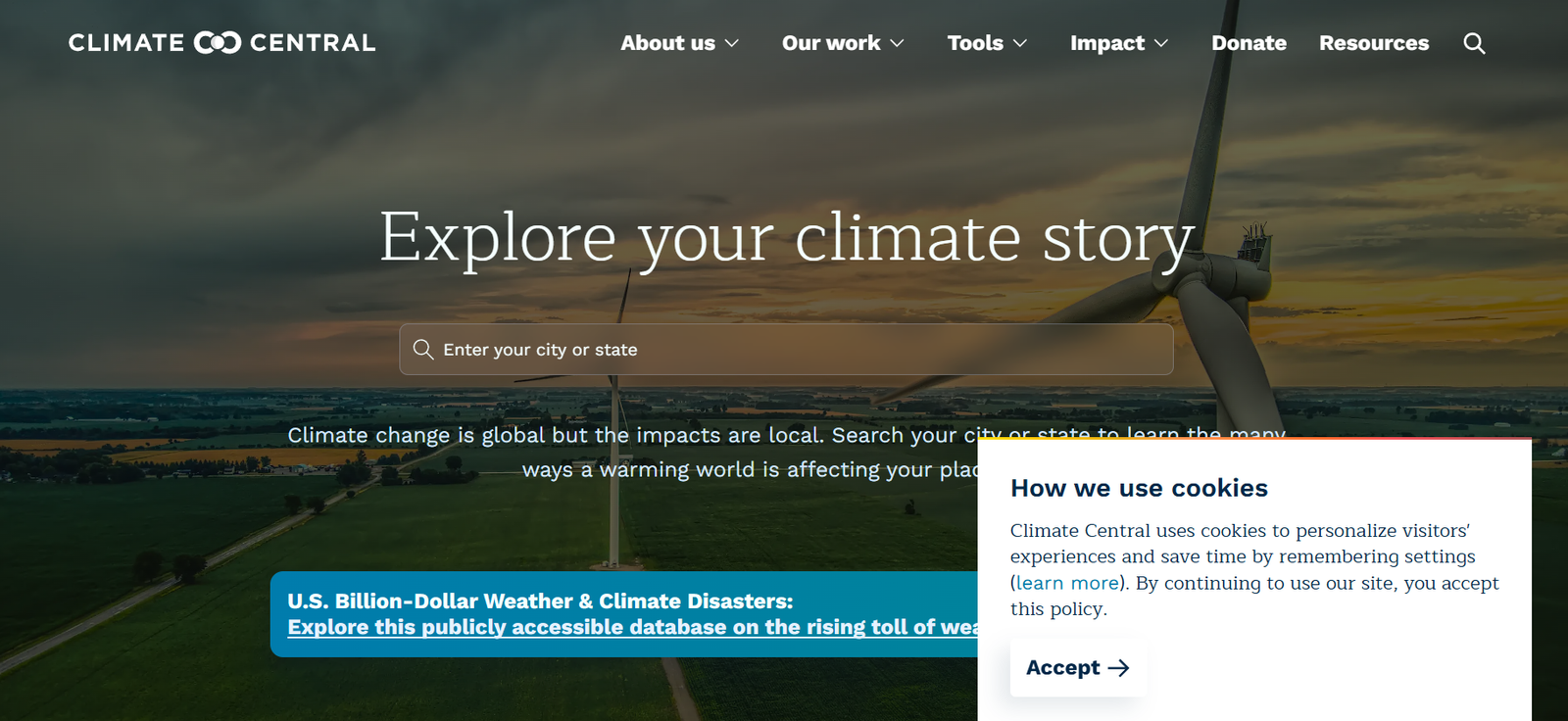
Climate Central is a nonprofit organization that researches and reports on the changing climate and its impact on the public. Combining science, media, and technology, Climate Central provides clear, data-driven insights into climate trends, sea level rise, extreme weather, and greenhouse gas emissions.
Founded in 2008, Climate Central works at the intersection of climate science and public communication. It delivers tools and research that empower journalists, policymakers, educators, and the general public to understand climate risks and take action. The organization is staffed by scientists and communicators who translate peer-reviewed climate research into accessible, actionable resources.
Climate Central is not an advocacy group. It remains nonpartisan and focuses on making science understandable and relevant to real-world decisions.
Features
Climate Central offers a wide range of climate communication tools and research platforms tailored to different audiences.
One of the flagship features is Climate Science Reporting, which provides localized, real-time data on temperature trends, heatwaves, sea level rise, wildfires, and other climate indicators. These reports are used by media outlets and city planners alike.
The Climate Shift Index (CSI) is a breakthrough tool that shows the influence of climate change on daily local weather, including how much global warming contributed to heatwaves and extreme events.
Coastal Risk Screening tools, including Surging Seas, help visualize future sea level rise under different warming scenarios. These tools use high-resolution elevation models and climate projections to identify risks to coastal infrastructure and populations.
The Reforestation Hub, developed with The Nature Conservancy, identifies opportunities for reforestation across the U.S. to support carbon sequestration goals.
Climate Matters is a key initiative that provides localized data, graphics, and support for meteorologists and journalists, helping them communicate climate science clearly and accurately to the public.
Interactive maps and datasets are available for download or embedding, supporting researchers, educators, and local governments.
Climate Central also offers seasonal climate trend tools, methane emissions trackers, and GHG intensity data for energy production.
How It Works
Climate Central combines scientific data, modeling, and public communication to inform decision-makers and the public about climate change impacts.
The organization sources data from peer-reviewed research, satellite observations, and global climate models, including data from NASA, NOAA, and IPCC.
These datasets are analyzed by in-house scientists and presented through interactive platforms, visualizations, and localized summaries.
For example, the Climate Shift Index uses attribution science to analyze how climate change alters the frequency and intensity of specific weather events. The output is a daily index available at the local level.
The Surging Seas tool models future coastal flooding scenarios based on emissions trajectories, sea-level rise projections, and socioeconomic data.
Climate Central also provides open-access API feeds and downloadable graphics, enabling integration into news media, public dashboards, and academic research.
Communication professionals can sign up for Climate Matters, receiving weekly updates and ready-to-use resources for explaining the local impacts of global warming.
Use Cases
Climate Central tools and data are used across sectors to support public awareness, policy development, risk mitigation, and journalism.
Journalists and meteorologists use Climate Central’s graphics and reporting templates to localize climate stories and explain how global warming is impacting their audience’s daily life.
City planners and policymakers use tools like Surging Seas and the Climate Shift Index to assess flood risks, heat stress, and energy needs under future climate conditions.
Educators and researchers use Climate Central’s datasets to teach students and inform community outreach efforts.
Nonprofits and climate advocacy groups use localized data to support public campaigns, grant proposals, and program planning.
Real estate developers and infrastructure investors assess future climate exposure using sea-level rise and temperature projection tools.
Utility companies and grid managers track temperature trends and energy demand to plan more resilient energy infrastructure.
Pricing
Climate Central is a nonprofit organization and offers the majority of its tools, data, and resources for free.
Interactive tools, datasets, maps, and graphics are publicly accessible via the Climate Central website.
APIs and professional use resources may require approval or citation but do not carry a fee.
The Climate Matters program is free for media professionals and meteorologists.
Organizations interested in custom reports or partnerships may need to engage directly with Climate Central for collaboration.
There are no subscriptions, licenses, or enterprise plans listed—its mission-driven approach prioritizes accessibility and public service.
Strengths
Climate Central excels in scientific accuracy, with a team of expert researchers dedicated to translating complex climate models into easy-to-understand insights.
Its tools are localized, meaning users can access city- or county-level projections and risk assessments, which are more relevant than global averages.
The organization is known for its strong relationships with media, especially through the Climate Matters program, which has improved climate reporting quality across hundreds of outlets.
Climate Central’s tools are interactive and user-friendly, with downloadable graphics, embeddable maps, and mobile-friendly interfaces.
All resources are free and open-access, lowering barriers for educators, journalists, and nonprofits.
The platform is nonpartisan and science-driven, increasing its trust and credibility among diverse user groups.
Drawbacks
Climate Central focuses primarily on U.S. and coastal data, with less coverage for other regions or inland vulnerabilities.
While tools are interactive, they are not customizable for advanced modeling by end users—users must rely on preset scenarios and data.
Climate Central is not an advocacy platform, so it does not offer direct action or policy lobbying features that some climate-focused organizations may require.
Organizations looking for commercial climate risk assessments or AI-driven analytics may need to supplement with private platforms like ClimateAI or Cervest.
Because it is non-commercial, response times for custom data requests or partnerships may be slower than enterprise software providers.
Comparison with Other Tools
Compared to climate tech startups like ClimateAI or Jupiter Intelligence, Climate Central focuses on public education and science communication, rather than commercial risk modeling.
Unlike government platforms such as NASA’s Earthdata or NOAA, Climate Central curates data for broader audiences, making it more accessible and easier to interpret.
In contrast to activist organizations like 350.org or Carbon Brief, Climate Central does not engage in lobbying or campaigning—it strictly provides data and tools.
While platforms like Google Earth Engine allow for deeper custom analysis, Climate Central provides ready-made insights, designed for media and public engagement.
Customer Reviews and Testimonials
Climate Central’s tools and data are used by over 900 local television meteorologists, hundreds of media outlets, and dozens of government agencies.
Users praise its clarity, credibility, and ease of use, especially for making complex data relatable to local audiences.
Partners such as The Nature Conservancy, PBS, CNN, and UNEP frequently use Climate Central data in reports and public-facing content.
Educators and city officials report that the platform helps them explain climate threats in community meetings and public consultations.
Conclusion
Climate Central is a trusted nonprofit that transforms climate science into accessible insights for the public, policymakers, and media. With a wide range of free tools covering sea level rise, weather attribution, emissions, and reforestation, it equips society with the knowledge needed to understand and respond to climate change.
By maintaining scientific rigor and public accessibility, Climate Central stands out as a go-to resource for localized, nonpartisan climate data that informs awareness, education, and long-term resilience planning.