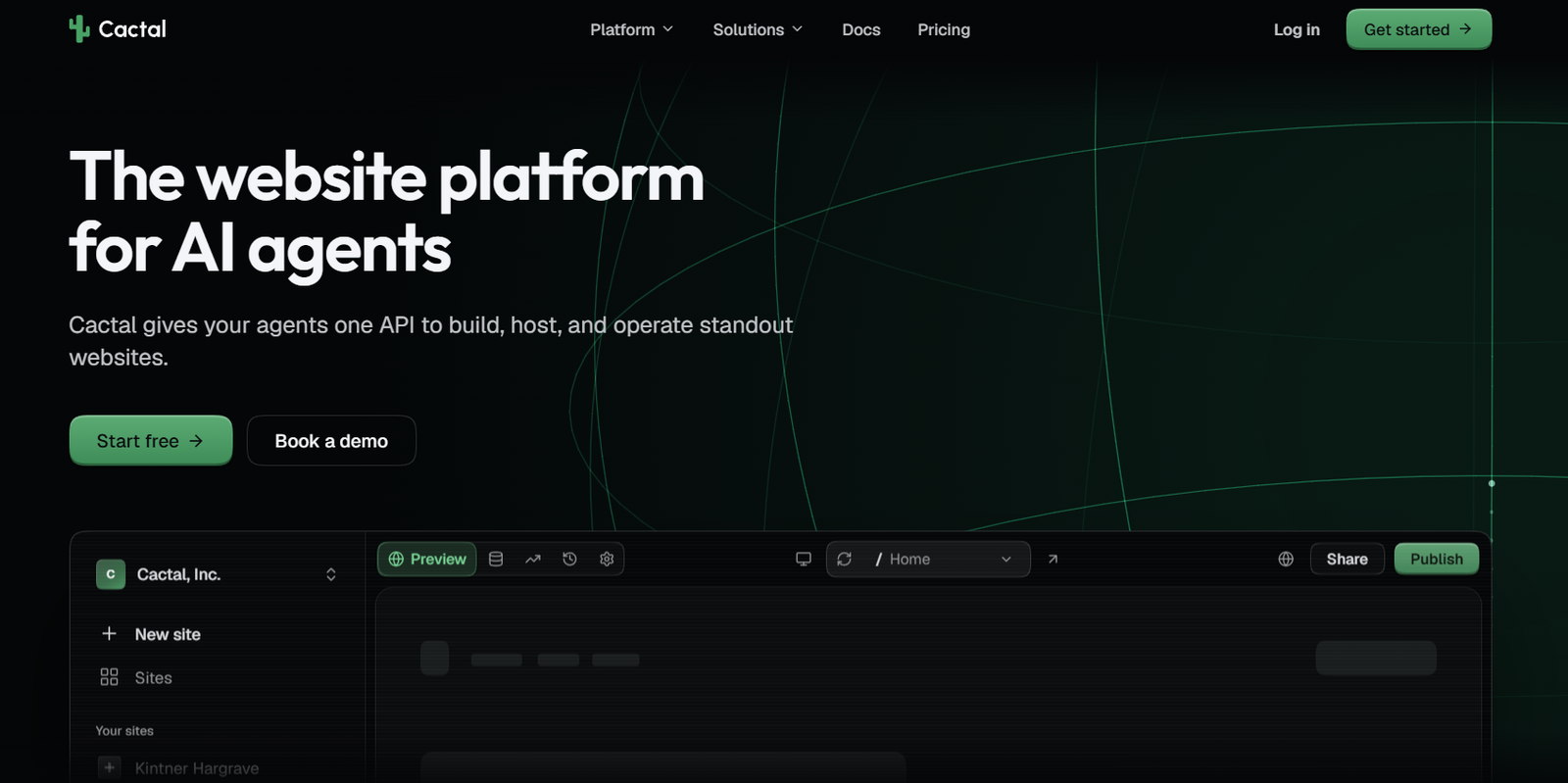
Cactal is an AI agent-native website platform designed to let AI agents build, publish, host and operate real websites. Instead of providing its own isolated AI assistant, Cactal allows users to connect AI agents they already use and give those agents controlled access to the website platform.
The platform works with agents such as Claude Code, Codex, ChatGPT, Cursor, Gemini and other tools capable of communicating through MCP or an API. Users can describe what they want in natural language, and their connected agent can create pages, change content, publish updates, manage domains, review analytics and perform other website management tasks.
Cactal differs from many visual website builders because sites are created as real React code rather than being restricted to a proprietary drag-and-drop page format. This gives developers and AI agents more flexibility when creating custom designs, interactions and integrations.
The platform combines website building with managed hosting, domains, a headless CMS, SEO tools, analytics, version control, access management and quality checks. This allows an AI agent to manage much of the website lifecycle through one environment.
Cactal is particularly suitable for agencies, developers, businesses, SaaS platforms and AI agent companies that want AI to actively create and operate websites rather than simply generate website copy or code snippets.
Features
AI Agent Website Building
Cactal allows users to connect an AI agent and ask it to build complete websites using natural-language instructions.
The agent can create pages, layouts, content and source code without requiring users to manually construct everything through a visual page builder.
Bring Your Own AI Agent
Cactal does not force users to use one proprietary AI model.
Users can connect compatible agents such as Claude Code, Codex, ChatGPT, Cursor, Gemini, Zed and other systems that support MCP or API access.
MCP Support
Cactal provides an MCP server that allows compatible AI agents to interact directly with the platform.
This gives agents access to website creation, source code, CMS, domains, analytics and other authorized capabilities.
API and SDK
Developers can access Cactal programmatically through its API and SDK.
Importantly, API, SDK and MCP access are included even with the Free plan.
Real React Code
Websites created on Cactal are based on real React source code rather than being stored only inside a proprietary page-building system.
This gives developers greater flexibility to build custom functionality and integrations.
Built-In Hosting
Cactal includes managed website hosting.
Pages are served through global infrastructure, with caching and optimization designed to provide fast loading across different locations.
Custom Domains
Paid users can connect their own domains to Cactal websites.
Free users can publish unlimited websites using Cactal-provided domains.
Headless CMS
The platform includes a content management system that can be accessed by people and AI agents.
Agents can use the CMS to create, optimize and publish content according to configured workflows.
AI-Powered Content Operations
Businesses can connect agents to the CMS and create automated content workflows.
For example, an agent can prepare new articles, update website information or manage recurring content publishing.
Built-In SEO
SEO functionality is integrated into the website platform rather than requiring a separate plugin.
AI agents can inspect website content and source code, identify potential SEO problems and make authorized changes.
Website Analytics
Every published site includes built-in analytics.
Cactal tracks information such as visitors and pageviews without requiring users to install a separate analytics script.
The platform states that its analytics do not use cookies or collect personal visitor data.
Automated Reports
Agents can retrieve analytics information and use it to prepare recurring client or internal reports.
This can be particularly useful for agencies managing many websites.
Versioned Publishing
Website changes are versioned, allowing teams to keep track of modifications.
Instant Rollback
If an AI agent or team member makes an unwanted change, users can return the website to an earlier version.
This provides an important safeguard when giving AI agents the ability to modify live websites.
Preview Links
Users can generate preview versions before publishing changes.
Clients or team members can open the preview link without needing to create an account.
Quality Gates
Cactal automatically checks changes before they are published.
Its quality-control pipeline examines areas such as content schema, site configuration, imports, formatting, types, code quality, routes, build status and rendering.
If a check fails, the issue can be returned to the agent for correction.
Access Controls
Access can be granted separately for individual websites and users.
This is particularly useful for agencies managing sites for multiple clients.
Unlimited Members
Paid plans do not charge per seat.
Businesses can add designers, writers, clients and other collaborators while controlling which sites they can access.
Secure API Keys
Cactal states that API keys are hashed and securely stored.
Sensitive activities are also captured through audit logs.
HTTPS
Website requests are served over HTTPS to provide secure connections for visitors.
Third-Party Integrations
Because sites use real code, they can be integrated with external services such as CRMs, booking systems and other web applications.
Code Portability
Users own their website code.
If they decide to leave Cactal, the React source can be moved to another hosting environment or adapted for platforms such as Next.js or WordPress.
Unlimited Traffic
Cactal does not meter or cap website traffic according to its current pricing model.
Charges are based primarily on websites using custom domains rather than the number of visitors they receive.
How It Works
First, users create a Cactal account. The Free plan does not require a payment card.
They then connect a compatible AI agent through MCP, API or the available integration method.
Users describe the website they want in natural language.
The AI agent creates the website and its pages using Cactal’s platform.
Users can review the generated site through a preview link before publishing it.
If changes are required, they simply provide additional instructions to their agent.
Cactal’s quality-control pipeline checks changes before they reach the published website.
The website can then be published using a free Cactal domain.
Users who upgrade to Pro can connect their own custom domain.
After launch, the agent can continue managing the site. It can update pages, work with CMS content, optimize SEO, inspect analytics and perform other authorized operations.
Every change is versioned, allowing users to roll back unwanted modifications.
Agencies can repeat the same process across numerous client websites from one environment.
Use Cases
Web Development Agencies
Agencies can use AI agents to create, launch and maintain websites for multiple clients from one platform.
Freelance Web Designers
Freelancers can rapidly prototype websites, share preview links with clients and use AI agents to implement requested changes.
Small Businesses
Businesses can use Cactal to maintain their websites through natural-language instructions without depending on a developer for every small update.
Developers
Developers can use the API, SDK, MCP server and real React source code to build highly customized website workflows.
AI Agent Platforms
Companies building AI agents can connect their agents to Cactal and give them website creation and publishing capabilities.
SaaS Companies
Software platforms can use Cactal’s APIs and developer tools to add website-building functionality to their own products.
Marketing Agencies
Marketing teams can automate content creation, SEO updates, website changes and analytics reporting.
Content Teams
Teams can connect AI agents to the CMS to prepare, optimize and publish content on a recurring schedule.
Client Website Management
Agencies managing many clients can keep websites within one dashboard while assigning separate access permissions to each customer.
Rapid Website Prototyping
Teams can ask AI agents to generate several page or website variations quickly and then select the strongest concept for further development.
Pricing
Cactal currently offers Free, Pro and Enterprise plans.
Free: $0 per Month
The Free plan is available permanently and does not require a credit card.
It includes unlimited websites published on Cactal domains, bring-your-own AI agent functionality and full API, SDK and MCP access.
Users need to upgrade when they want to connect their own custom domain.
Pro: $20 per Month
The Pro plan costs $20 per month for one website using the user’s own domain.
Annual billing is listed at $240 per year.
It includes everything in Free along with managed hosting, storage and bandwidth, a headless CMS, built-in SEO, versioned publishing, instant rollback, website analytics, unlimited members and per-site roles.
Additional websites using custom domains cost $20 per month each.
With annual billing, additional custom-domain websites are listed at $192 per year each.
Enterprise: Custom Pricing
Enterprise pricing is customized according to organizational requirements.
It includes everything in Pro plus custom website and API limits, SSO, security review, SLA arrangements, priority support, onboarding and migration assistance.
An important aspect of Cactal’s pricing is that it does not charge users according to website traffic or team seats. Users primarily pay for websites operating on their own domains.
AI model or agent costs are separate because users bring their own AI agent and maintain their existing model subscriptions or API arrangements.
Strengths
Cactal is specifically designed around AI agents rather than adding AI as a secondary feature to a traditional website builder.
Users can bring their preferred AI agent instead of being locked into one proprietary model.
API, SDK and MCP access are available even on the Free plan.
Websites use real React code, providing greater customization and portability than closed page-building formats.
The Free plan allows unlimited websites on Cactal domains with no time limit.
Built-in hosting, CMS, SEO, analytics and versioning reduce the number of separate website services users need to manage.
Quality gates provide an important safeguard when AI agents are modifying website code.
Instant rollback reduces the risk associated with unwanted AI or human changes.
The pricing model does not charge according to traffic or team seats.
Users own their source code and can move it elsewhere, reducing platform lock-in.
Drawbacks
Cactal requires users to bring their own AI agent, so the cost of Claude, ChatGPT, Codex or another model may be separate from the Cactal subscription.
Users looking for a conventional drag-and-drop website builder may find Cactal’s agent-first approach unfamiliar.
Although coding knowledge is not required for basic use, technical knowledge can become valuable when building complex integrations or modifying advanced React functionality.
Using a custom domain requires a paid subscription.
Each additional custom-domain website adds another monthly or annual charge, which agencies should consider when managing large numbers of client sites.
AI-generated websites and content still require human review for factual accuracy, branding, accessibility, legal compliance and business requirements.
Giving AI agents website access also requires careful permission management, particularly when agents can publish changes to production sites.
Comparison with Other Platforms
Cactal differs from traditional website builders because it is designed around AI agents from the beginning.
Conventional no-code website builders usually provide a visual editor and may add AI features for generating pages, text or images. Cactal instead lets an external AI agent operate the website platform directly through MCP and APIs.
Another important difference is the underlying site architecture. Cactal creates real React source code rather than restricting websites to a proprietary page format.
Compared with AI coding assistants, Cactal provides the infrastructure those agents need after generating code. Hosting, domains, CMS, SEO, analytics, publishing, access management and rollback are integrated into the same platform.
This makes Cactal particularly relevant when users want an AI agent to manage the entire website lifecycle rather than simply generate initial website code.
Customer Reviews and Testimonials
Customer reviews and testimonials are not clearly available on the official website.
The official site showcases websites built using Cactal, but these examples should not be treated as independent customer reviews or testimonials.
Conclusion
Cactal is an interesting website platform built specifically for the emerging era of AI agents.
Instead of asking users to learn another visual website builder, it allows them to connect agents they already use and instruct those agents to build, publish and operate websites.
Its combination of real React code, managed hosting, CMS, SEO, analytics, versioning, quality controls, API access and MCP integration makes it particularly useful for developers, agencies, SaaS companies and businesses interested in agent-driven website operations.
The Free plan is also attractive because users can build and publish unlimited websites on Cactal domains while receiving full API, SDK and MCP access.
Cactal becomes especially compelling for agencies and developers that want AI agents to do more than generate website code. The agents can continue managing content, SEO, analytics, publishing and ongoing website changes after the initial site goes live.