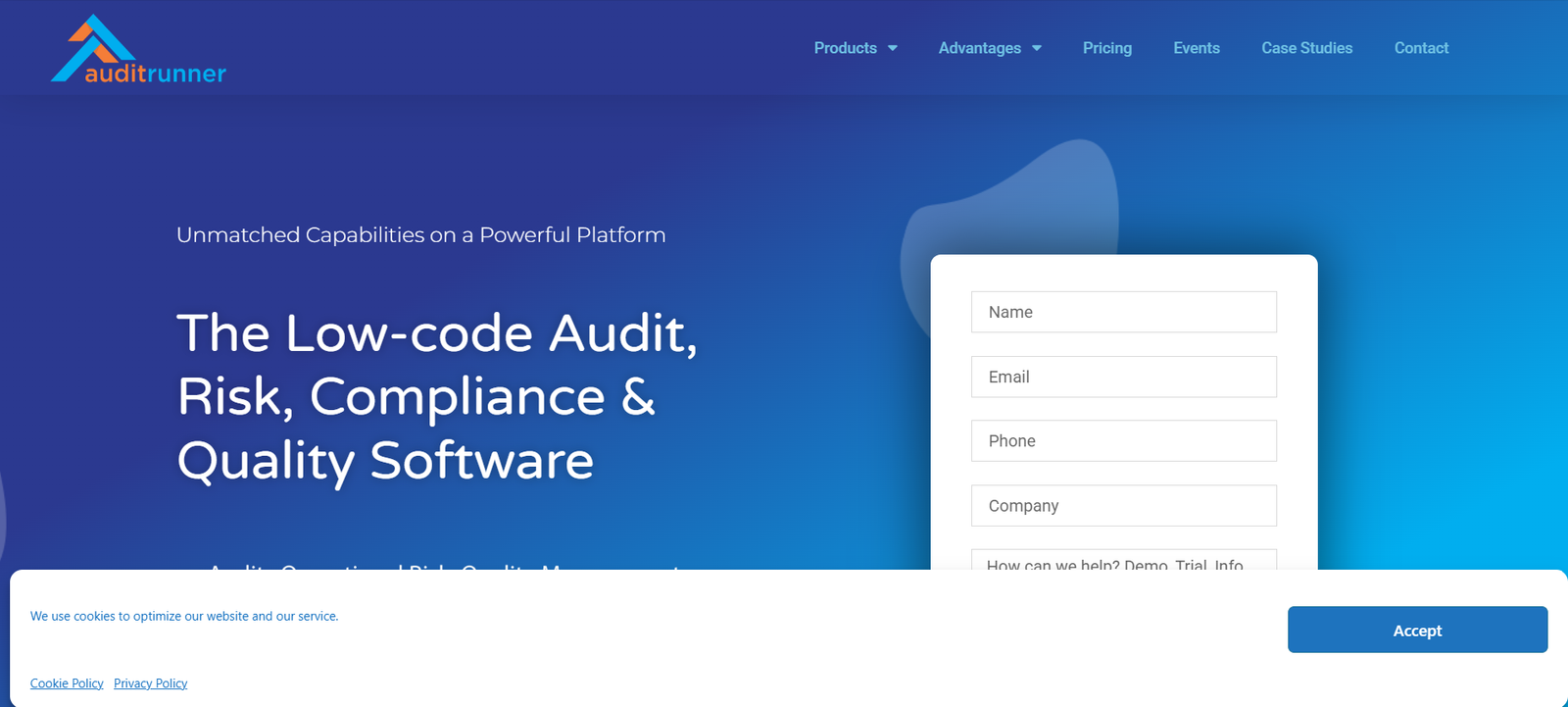
Auditrunner is a unified platform that provides end-to-end automation for governance, risk, and compliance (GRC), internal audit, risk management, IT governance, and quality control. Designed to help organizations manage complex regulatory requirements and internal processes, Auditrunner offers a highly customizable low-code platform that adapts to each organization’s needs. With strong workflow automation, analytics, and reporting tools, Auditrunner simplifies GRC operations across multiple departments while maintaining full visibility and control.
Features
Auditrunner is built as a modular, all-in-one platform with the following core features:
Internal Audit Management: Plan, execute, and monitor audits with risk-based audit planning and real-time tracking.
Risk Management: Identify, assess, and mitigate operational and strategic risks with integrated risk registers.
Compliance Management: Manage compliance with internal policies and external regulations like SOX, ISO, GDPR, HIPAA, and more.
Document Management: Store, track, and control access to policies, procedures, and regulatory documents.
Workflow Automation: Automate and customize workflows using a drag-and-drop interface with low-code capabilities.
Issue and Corrective Action Tracking: Log findings, assign actions, and track remediation status across departments.
Real-Time Dashboards and Reporting: Access compliance scores, risk heat maps, and audit performance metrics in a single view.
Access Controls and User Roles: Ensure secure access with customizable user roles and permissions.
These features help organizations break down departmental silos and foster collaboration across audit, risk, and compliance teams.
How It Works
Auditrunner operates as a web-based platform where organizations can configure each module according to their internal processes. Users access dashboards based on their role—auditors, risk managers, compliance officers, or executives—and work within pre-defined workflows. Each module supports automated reminders, audit trails, and real-time data synchronization. Administrators can design forms and rules using low-code tools to meet regulatory and operational requirements. Data collected during audits, assessments, or policy reviews is automatically compiled into actionable reports and dashboards. Integration with third-party tools and legacy systems is also supported for enterprise environments.
Use Cases
Auditrunner is used by organizations in finance, healthcare, manufacturing, government, energy, and education to centralize and digitize their GRC activities. A financial institution may use it for risk-based internal audits and SOX compliance. A healthcare provider can manage HIPAA controls, policy updates, and incident tracking within one system. Manufacturing firms rely on Auditrunner for ISO 9001 and quality assurance processes. Government agencies benefit from automated internal control frameworks and documentation workflows. The platform is also valuable for IT governance, including cybersecurity risk assessments and vendor compliance reviews.
Pricing
Auditrunner follows a custom pricing model based on the number of users, modules selected, and organization size. Pricing is not listed on the website. Interested businesses can request a tailored quote by contacting the Auditrunner team. The platform is offered as both cloud-based (SaaS) and on-premise, with implementation support included. Packages typically include onboarding, training, support, and regular updates. Flexible licensing models accommodate mid-sized and enterprise-level organizations with scalable options for expanding teams or regulatory scope.
Strengths
Auditrunner’s main strengths are its modular architecture, adaptability, and low-code customization. Organizations can start with core modules and expand as their needs evolve. The ability to customize workflows without relying heavily on IT reduces deployment time and costs. Its comprehensive feature set means users don’t need to juggle multiple tools—everything from audit execution to policy review lives on one platform. Real-time visibility and collaboration features improve transparency and accountability. The platform is also known for responsive support and quick implementation, especially when tailored to regulated industries.
Drawbacks
Auditrunner’s extensive customization may require initial time investment during setup and configuration. While low-code tools make changes easier, some organizations may still need consultation for more complex workflows. The platform is robust, which may be more than needed for very small organizations with limited GRC requirements. Also, the lack of transparent pricing on the website might slow down initial evaluation for teams comparing tools. Some integrations may require additional setup, depending on the existing IT infrastructure.
Comparison with Other Tools
Compared to GRC platforms like MetricStream, LogicManager, and Resolver, Auditrunner offers greater flexibility through its low-code customization and modular design. MetricStream is known for deep functionality but can be complex and resource-heavy. LogicManager provides pre-built templates but may be less adaptable for unique internal processes. Resolver focuses on enterprise risk management but lacks the broader audit and compliance capabilities found in Auditrunner. For organizations seeking a customizable, all-in-one GRC solution with rapid deployment, Auditrunner provides a practical and cost-effective alternative.
Customer Reviews and Testimonials
Customers report high satisfaction with Auditrunner’s user-friendly interface, configurability, and support. Testimonials highlight the ability to centralize risk, audit, and compliance data in a single platform, resulting in better collaboration and faster decision-making. Many users praise the flexibility of the system and the reduction in manual tasks thanks to automation. Audit teams note faster audit cycles and easier reporting, while compliance officers appreciate real-time tracking of policies and procedures. The platform is especially popular among organizations looking to modernize GRC functions without high implementation costs.
Conclusion
Auditrunner is a powerful, flexible platform that simplifies governance, risk, and compliance management through automation, integration, and user-focused design. With modules for audit, risk, compliance, policy management, and more, it helps organizations gain real-time control over their GRC landscape. The low-code customization and modular scalability make it suitable for mid-sized businesses and large enterprises alike. For teams seeking a reliable, centralized solution to replace spreadsheets and disconnected systems, Auditrunner offers the tools and flexibility needed to build a compliant, resilient organization.