
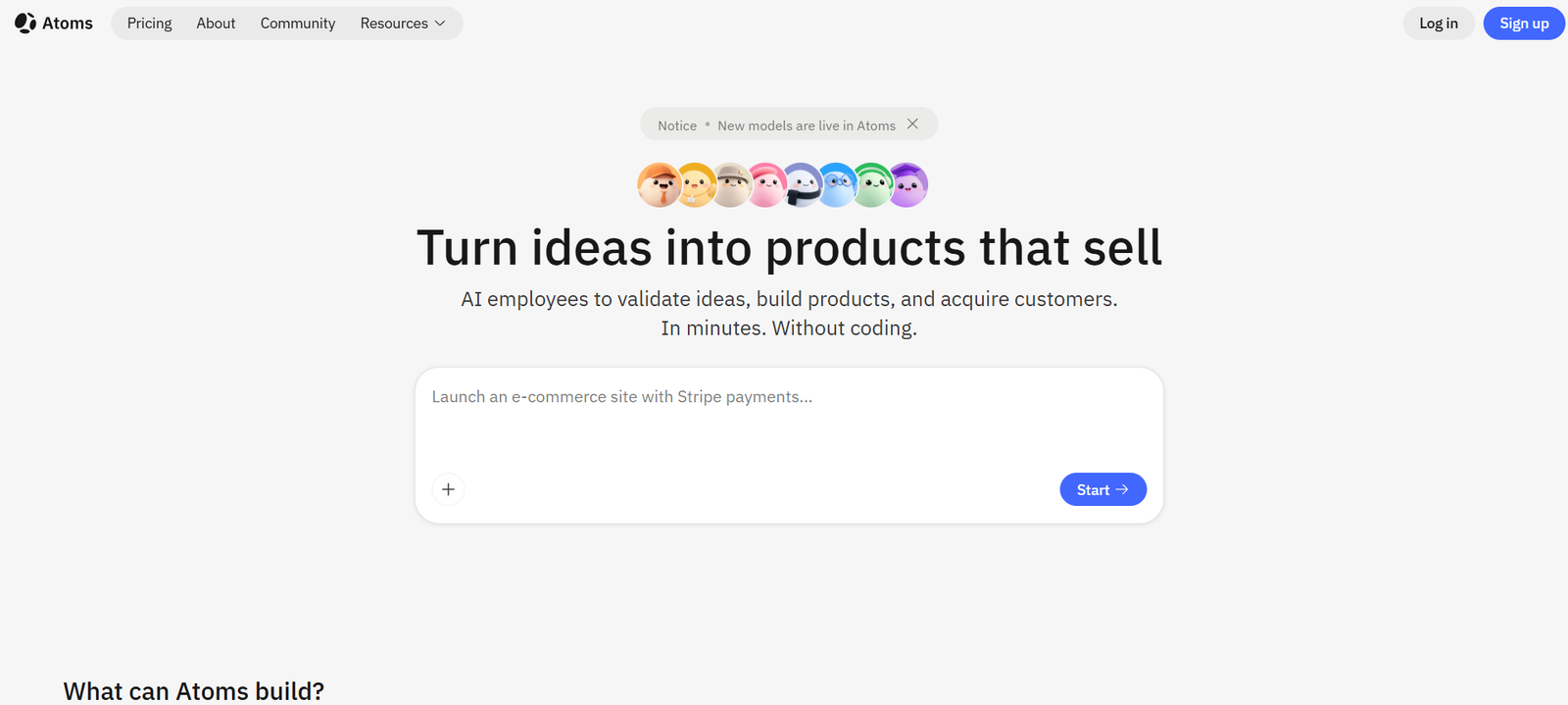
Atoms is an AI powered development platform designed to turn ideas into functional websites, applications and digital products using natural language. Instead of requiring users to manually write every line of code, users describe what they want to build and a team of specialized AI agents helps research, plan, design, code, test and launch the product.
The platform is designed around a multi-agent approach. Different AI agents take on roles similar to members of a product and development team, including a Team Leader, Product Manager, Architect, Engineer, Deep Researcher, SEO Specialist, Ads Specialist and Data Analyst.
Atoms can create full-stack applications rather than only visual website prototypes. Its built-in backend infrastructure supports functionality such as user authentication, databases, object storage, integrations, hosting and Stripe payments.
Users can build SaaS applications, internal business tools, customer portals, personal websites, e-commerce experiences and other web products. Atoms is designed to be accessible to non-programmers, while developers can still inspect, edit, export and extend the generated code.
Features
Multi-Agent AI Team
Atoms uses multiple specialized AI agents rather than relying on one general AI assistant to complete the entire development process.
Each agent focuses on a particular area such as market research, product planning, architecture, engineering, SEO, advertising or data analysis. The agents can work together to move a project from an initial idea toward a functioning product.
Natural Language App Building
Users can describe an application in ordinary language instead of writing code.
For example, a founder could describe a SaaS dashboard requiring user accounts, a database, analytics and subscription payments. Atoms can then plan and generate the necessary application components.
AI Product Manager
The Product Manager agent helps turn a broad idea into a more clearly defined product specification.
It can help establish features and scope before development begins, reducing the risk of building an unnecessarily complicated first version.
AI Architect
The Architect agent focuses on the technical structure of the application.
It helps determine how different components should be organized so the resulting product has an appropriate foundation.
AI Engineer
The Engineer agent generates production-oriented full-stack code.
Atoms can work across frontend and backend development, including user interfaces, API routes, database queries, data models and integrations.
Deep Research Agent
The Deep Researcher helps users investigate markets, identify demand and explore potential opportunities before or during product development.
This makes Atoms useful not only for coding but also for early product validation.
SEO Specialist
Atoms includes an SEO agent that can help create search friendly pages and automate aspects of SEO optimization.
This extends the platform beyond application development into customer acquisition and product growth.
Ads Specialist
The Ads Specialist is designed to assist with advertising workflows, including campaign creation, tracking and optimization.
This gives Atoms a broader business focus than AI builders that stop once an application has been generated.
Data Analyst
The Data Analyst agent can examine data and surface useful insights, including information that may help users identify marketing opportunities and make business decisions.
Race Mode
Race Mode allows multiple AI models or agent teams to work on the same task in parallel.
Users can compare different approaches and choose the implementation they prefer instead of relying entirely on a single AI generated result.
Atoms states that Race Mode can improve accuracy by allowing users to compare alternative solutions.
Visual Editor
Atoms includes a visual editor for modifying layouts and components.
This can be helpful for non-technical users who want to adjust the appearance of a page without manually changing source code.
Full-Stack Backend
Atoms Cloud provides backend infrastructure required for functional applications.
This includes capabilities such as user authentication, relational databases, object storage, integrations and scalable hosting.
Stripe Integration
Applications can include Stripe payment functionality, making it possible to build subscription based or paid digital products.
This is particularly useful for founders building SaaS applications and other products intended to generate revenue.
One-Click Deployment
Atoms can deploy completed applications to Atoms Cloud.
Users can publish a live URL without manually configuring hosting and server infrastructure.
Paid plans also support custom domains.
AI Integrations
Atoms provides access to AI models such as GPT and Gemini for applications built on the platform.
The platform is designed to simplify these integrations without requiring users to manually configure API keys for every supported model.
Existing Codebase Support
Developers can import an existing project and ask Atoms to add or modify features.
The platform can analyze the existing structure and generate code intended to fit the project’s patterns and architecture.
Code Editor
Although Atoms is designed for no-code or natural-language development, technical users can access and edit the underlying code.
Code Export
Users can export generated code rather than keeping the entire application permanently locked inside Atoms.
This gives developers the option to continue development elsewhere.
GitHub Sync
Projects can be synchronized with GitHub, giving users greater control over their source code and development workflow.
After exporting, users can run the application locally or deploy it on their own infrastructure.
Multiple Programming Technologies
Atoms can generate code using technologies such as TypeScript, JavaScript and Python.
It also works with frameworks and technologies including React, Next.js and Node.js, depending on project requirements.
Multilingual Interaction
Users can communicate with Atoms in multiple languages.
This can make AI assisted development more accessible to people who prefer describing their product ideas in their native language.
How It Works
Step 1: Describe the idea
Tell Atoms what you want to create using normal language. Explain the purpose of the product, intended users and important features.
Step 2: Let AI research and plan
Specialized agents can research the market and turn the idea into a clearer product plan.
Step 3: Review the specification
Check the proposed features, structure and development plan before allowing the AI team to continue.
Step 4: Generate the application
Atoms’ engineering agents create frontend, backend, database and integration components required for the project.
Step 5: Compare approaches
Where appropriate, use Race Mode to generate multiple approaches and choose the version that best matches the project.
Step 6: Preview the product
Run the generated application and examine its pages, functionality and user experience.
Step 7: Request changes
Describe required modifications in natural language or use the visual editor to adjust elements directly.
Step 8: Add business functionality
Configure features such as user authentication, databases, Stripe payments, AI integrations and other supported capabilities.
Step 9: Deploy
Publish the finished application to Atoms Cloud and connect a custom domain when supported by the selected plan.
Step 10: Continue improving
Use SEO, advertising, research and data agents to help improve the product after launch.
Use Cases
Startup Founders
Founders can turn a product concept into a working MVP without immediately hiring a complete engineering team.
They can use research agents to explore demand, product agents to establish scope and engineering agents to build the application.
Non-Technical Entrepreneurs
People without programming knowledge can describe the application they need in natural language and allow Atoms to handle much of the technical implementation.
SaaS Development
Atoms can create subscription based SaaS applications with user authentication, database storage and Stripe payment functionality.
Internal Business Tools
Businesses can build dashboards, administrative systems and internal tools for managing company data and workflows.
Developers
Professional developers can use Atoms to generate features, APIs, frontend components, tests and other code while retaining the ability to inspect and modify the output.
E-commerce Projects
Users can create product focused websites and integrate Stripe for supported payment workflows.
Personal Websites
Individuals can build portfolios, blogs and personal brand websites through conversational instructions.
Agencies
Digital agencies can use Atoms to prototype and build client applications faster, particularly for early versions and smaller web projects.
Product Teams
Product teams can use AI agents to move from research and product specifications to architecture and development within one environment.
Marketers
SEO and advertising agents can support the growth side of a product after the initial application has been created.
Pricing
Atoms offers Free, Pro and Max plans using a credit based system.
Free Plan
The Free plan costs $0 per month.
It currently includes:
15 daily credits
Up to 25 monthly credits
2 GB disk space
Unlimited project sharing
Up to 2 Atoms backend projects
The Free plan is intended for users who want to experiment with Atoms and build smaller projects.
Pro Plan
The Pro plan starts at $20 per month.
Credit tiers currently include:
100 credits for $20 per month
250 credits for $50 per month
350 credits for $70 per month
Pro includes features such as:
10 GB disk space
Private projects
Project downloads
Removal of the Atoms badge
Project editing
Credit rollovers
Unlimited Atoms backend projects
Atoms Production Cloud
Custom domains
Unlimited team members
Centralized billing
Centralized access management
Max Plan
The Max plan starts at $100 per month.
The default tier provides 500 credits for $100 per month.
Additional tiers include:
1,000 credits for $200 per month
1,500 credits for $300 per month
Additional options extending to significantly larger credit packages
Max includes Pro capabilities along with:
100 GB disk space
Approximately 2x compute resources compared with Pro
Race Mode
The official website states that Race Mode can improve accuracy by running multiple AI approaches and allowing users to compare the results.
Atoms also provides annual billing, with the website advertising savings of up to 21%.
Pricing and credit allocations may change, so users should confirm current costs before subscribing.
Strengths
One of Atoms’ main strengths is its multi-agent approach. Product planning, architecture, engineering, research, SEO and marketing are handled by specialized AI roles rather than being presented as a single generic chatbot.
The platform builds both frontend and backend functionality, making it more suitable for functional applications than tools designed only to create static web pages.
Built-in authentication, database infrastructure, storage, hosting and Stripe integration reduce the amount of external setup required to launch a web product.
Non-technical users can work through natural language, while developers retain access to code and can specify their preferred technologies.
Code export and GitHub synchronization reduce platform lock-in and allow users to move projects to their own infrastructure.
Race Mode is another interesting feature because it allows users to compare multiple AI generated implementations rather than accepting the first result.
The addition of research, SEO, advertising and data analysis agents also extends Atoms beyond coding into product validation and growth.
Drawbacks
Atoms uses a credit based pricing model, so the cost of developing a complex application can depend on how much AI work is required.
Users may therefore need to monitor credit consumption when repeatedly generating or revising complex features.
AI generated applications still require testing. Security, payment processing, authentication, database logic and other important functions should be carefully reviewed before a product is released publicly.
Although no coding knowledge is required for basic use, technical understanding can still be valuable when debugging complicated applications or evaluating AI generated architecture.
Some experienced development teams may prefer more direct control over their development environment rather than relying heavily on an AI managed workflow.
Race Mode and the largest compute and storage allowances are associated with the Max tier, making some advanced capabilities relatively expensive for casual users.
Comparison with Other Platforms
Atoms competes with AI app builders and AI coding environments that allow users to create software through natural language.
Its main difference is the multi-agent model. Rather than presenting only an AI coding assistant, Atoms creates a virtual team containing roles such as Product Manager, Architect, Engineer, Researcher, SEO Specialist and Data Analyst.
Compared with traditional coding assistants such as GitHub Copilot, Atoms is designed to build entire features and applications rather than primarily suggesting individual lines or blocks of code while a developer types.
Compared with basic no-code website builders, Atoms provides full-stack functionality including authentication, databases, APIs, integrations and payments.
It also goes beyond the initial development stage by including AI agents focused on market research, SEO, advertising and analytics.
However, established coding environments and no-code platforms may provide larger integration ecosystems or more mature manual development controls. The best choice depends on whether users want an AI led development workflow or prefer to maintain greater hands-on control over every technical decision.
Customer Reviews and Testimonials
Atoms displays customer success stories and testimonials on its official website.
One published example comes from a window cleaning business owner in the United States who describes using Atoms to create a single application combining booking estimates, scheduling and customer documents that had previously been handled through multiple applications.
The official website also displays logos associated with users or builders from major companies and organizations and highlights community and product recognition.
These examples are presented by Atoms itself and should therefore be considered company published customer information rather than independent third party reviews.
Conclusion
Atoms is an AI development platform designed to take users beyond simple code generation and toward complete product creation.
Its team of specialized AI agents can assist with market research, product planning, architecture, full-stack development, testing, SEO, advertising and data analysis. This makes the platform particularly interesting for founders who want help across several stages of launching a digital product.
Non-technical entrepreneurs can describe what they want in natural language, while developers can inspect, modify and export the generated code. Built-in authentication, databases, Stripe payments, hosting and one-click deployment further simplify the process of turning an idea into a working web application.
Atoms is particularly suitable for startup founders, indie developers, agencies and businesses building SaaS products, internal tools, customer portals, e-commerce experiences or websites.
The Free plan provides a way to experiment with the platform, while Pro and Max plans are aimed at more serious development and higher usage.
Overall, Atoms is worth considering for users who want an AI team to help move an idea through research, planning, development and launch rather than using AI only as a coding autocomplete tool.


