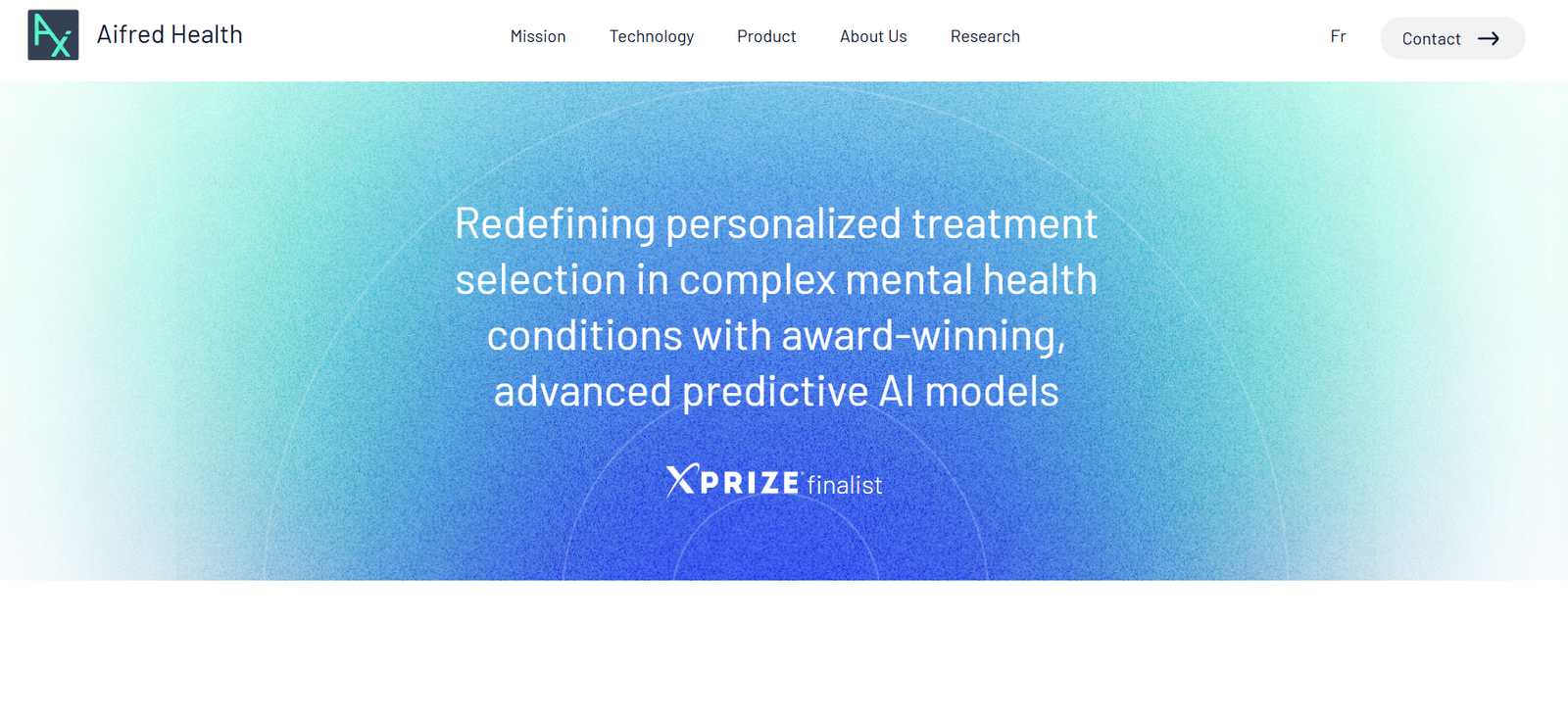
Aifred Health is a health technology company that uses artificial intelligence to support clinical decision-making in mental health care. Its core product is an AI-powered platform designed to assist clinicians in diagnosing, treating, and managing conditions such as major depressive disorder (MDD) and anxiety.
The platform integrates clinical guidelines with machine learning to recommend personalized treatment options based on individual patient profiles. Aifred’s technology aims to reduce the trial-and-error process commonly associated with prescribing mental health treatments and improve time to remission.
Developed in collaboration with psychiatrists, researchers, and data scientists, Aifred Health is grounded in evidence-based care and designed to integrate seamlessly into primary care and psychiatry workflows.
Features
AI-Powered Treatment Selection: Aifred Health uses AI to analyze patient data and recommend personalized treatment plans for depression and anxiety. The system supports clinicians in selecting first-line and next-line therapies with higher predicted efficacy.
Measurement-Based Care Tools: The platform includes validated mental health assessments like PHQ-9 and GAD-7 to monitor symptoms over time, ensuring that treatment is adjusted based on outcomes.
Clinical Guidelines Integration: Aifred aligns with leading clinical guidelines, such as the CANMAT (Canadian Network for Mood and Anxiety Treatments) guidelines, to ensure that AI recommendations are medically appropriate and evidence-based.
Patient Engagement Interface: Patients can complete assessments and view progress via a digital interface that promotes shared decision-making and collaboration with providers.
EHR Integration: Aifred is designed to integrate with electronic health record systems to streamline clinician workflows and reduce administrative burden.
Secure and Compliant Platform: Aifred is built to meet healthcare data security standards including HIPAA and PIPEDA compliance, ensuring that sensitive patient data is protected.
Clinical Decision Support Dashboard: The clinician-facing dashboard presents assessment trends, treatment history, and AI-driven insights to support diagnostic clarity and optimize treatment plans.
How It Works
Clinicians begin by creating a patient profile within the Aifred Health platform, entering relevant demographic, clinical, and historical data. The patient is then asked to complete standardized mental health questionnaires, such as the PHQ-9 for depression severity.
Aifred’s AI algorithms process this data, compare it to a large database of treatment outcomes, and generate personalized treatment recommendations based on predicted effectiveness for that individual. These insights are presented within a decision-support dashboard that the clinician can use during patient visits.
The platform facilitates measurement-based care by tracking symptoms over time. Clinicians can adjust treatment plans based on changes in symptom severity and patient feedback. Patients can also access the platform through a web interface or mobile device to complete assessments and stay informed about their progress.
By combining data-driven insights with clinical expertise, Aifred supports better-informed treatment decisions and helps patients reach remission more quickly.
Use Cases
Primary care physicians use Aifred Health to enhance mental health treatment in general practice, where psychiatric expertise may be limited but demand for care is high.
Psychiatrists adopt Aifred’s platform to support medication selection and monitor treatment efficacy more systematically, especially in complex or treatment-resistant cases.
Hospitals and behavioral health clinics integrate Aifred to deliver consistent, measurement-based care across providers and improve outcomes tracking.
Medical schools and residency programs use the platform as a teaching tool to train clinicians in guideline-based, data-supported mental health treatment.
Digital health platforms embed Aifred to provide AI-enhanced mental health assessments and triage tools for virtual care environments.
Employers and health systems leverage Aifred in population mental health strategies to ensure early intervention and optimize care pathways.
Pricing
Aifred Health does not publicly list pricing on its website. Pricing is typically customized based on deployment scale, organization type, and integration needs.
Factors that may influence pricing include:
Number of users or clinicians
Volume of patients managed
EHR integration complexity
Support and onboarding services
Customization and analytics features
Interested healthcare organizations and providers can request a demo and obtain a personalized quote by contacting the Aifred Health team directly through their official website.
Strengths
Aifred Health addresses a major gap in mental health care by offering AI-powered decision support to reduce the trial-and-error nature of depression treatment.
The platform improves clinical efficiency by centralizing assessments, treatment guidance, and progress monitoring in one digital interface.
It empowers clinicians with predictive insights based on real-world patient data, supporting more confident and personalized treatment choices.
By following evidence-based guidelines, Aifred ensures clinical recommendations remain medically sound and defensible.
The inclusion of patient-facing tools promotes transparency, engagement, and shared decision-making, which are critical to long-term treatment adherence.
Its privacy-first design, compliant with major healthcare regulations, ensures data security and builds trust among patients and providers.
Drawbacks
Aifred Health’s focus is currently limited to mood and anxiety disorders, which may not serve the needs of clinicians managing broader psychiatric conditions like bipolar disorder, psychosis, or substance use disorders.
The AI model’s effectiveness is tied to the quality of input data; inaccurate or incomplete patient information may limit the utility of its recommendations.
While designed to support, not replace clinical judgment, some providers may be cautious about relying on AI for treatment selection without full understanding of its internal algorithms.
Integration with certain EHR systems may require IT support and could pose implementation delays in more complex clinical environments.
Pricing is not transparent, which may present challenges for small practices or individual providers evaluating cost feasibility.
Comparison with Other Tools
Aifred Health operates in a growing field of digital mental health decision support platforms, including competitors like Limbix, Taliaz, and Quartet Health.
Limbix focuses more on digital therapeutics and behavioral therapy for adolescents, whereas Aifred centers its offering on medication decision support for adult patients with depression and anxiety.
Taliaz also uses AI to guide antidepressant selection based on genetic and clinical data but is more focused on pharmacogenomics, while Aifred integrates clinical guidelines and patient-reported outcomes in real time.
Quartet Health is a care coordination platform that connects patients to mental health providers but does not offer AI-driven decision support or personalized treatment prediction.
Aifred Health’s key differentiator lies in its fusion of clinical guideline compliance, AI-powered treatment prediction, and structured symptom monitoring within a single decision-support system.
Customer Reviews and Testimonials
Aifred Health has received recognition from institutions like the Montreal-based Mila Institute for AI, as well as participation in global health innovation programs and accelerator initiatives.
Clinicians who have used Aifred report improved confidence in treatment decisions and more structured approaches to patient monitoring.
Medical educators have cited the platform’s value in training young clinicians to adopt evidence-based practices in mental health care.
Pilot programs have shown promise in reducing the time to remission in patients with depression, particularly when clinicians use Aifred to adjust therapy based on measurement-based care principles.
Healthcare organizations considering digital transformation in mental health treatment often reference Aifred’s clinical credibility and research-backed model.
Conclusion
Aifred Health is transforming mental health care with AI-driven clinical decision support that personalizes treatment and simplifies care workflows. By aligning with evidence-based guidelines and delivering real-time insights based on patient data, Aifred enables clinicians to make smarter, more effective treatment decisions for depression and anxiety.
For primary care practices, psychiatry departments, and digital health innovators looking to improve mental health outcomes, Aifred Health offers a validated, scalable, and privacy-conscious solution that enhances both provider performance and patient experience.