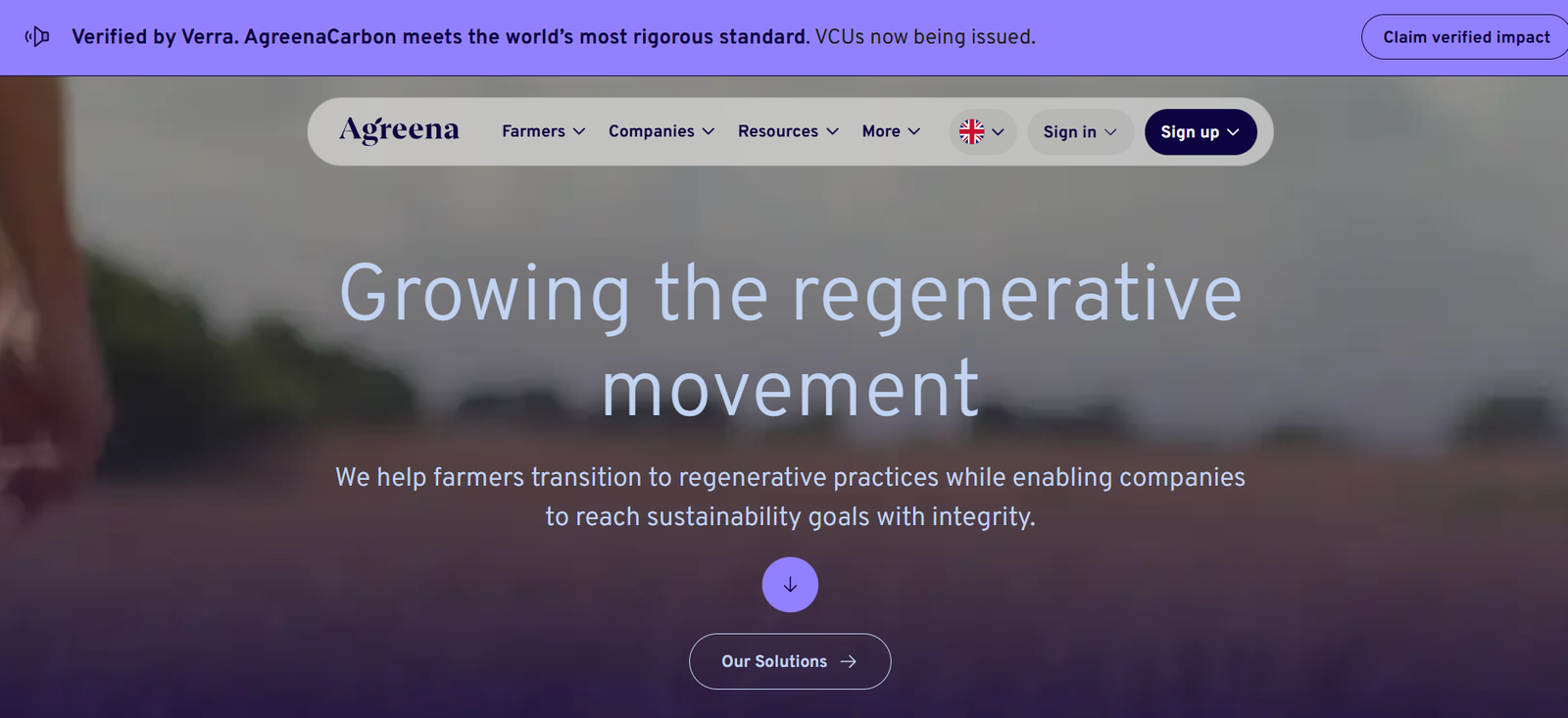
Agreena is a European-based agtech platform that empowers farmers to transition to regenerative agriculture by generating verified carbon credits. Through a combination of advanced technology, agronomic expertise, and transparent carbon certification, Agreena provides farmers with a new revenue stream while improving soil health and supporting sustainable food systems.
Founded in Denmark, Agreena operates across more than 20 countries, working with thousands of farmers to quantify and monetize the climate benefits of sustainable farming practices. The platform focuses on promoting carbon sequestration in soils by encouraging practices such as reduced tillage, cover cropping, and diverse crop rotations.
Agreena’s mission is to accelerate the agricultural sector’s contribution to climate change mitigation. By turning climate-positive farming into a business opportunity, Agreena helps farmers become key players in the global transition toward a low-carbon economy.
Features
Carbon Farming Program
Agreena’s core offering is a soil carbon certification program that enables farmers to earn carbon credits by adopting regenerative practices. These credits can be sold in voluntary carbon markets.
Regenerative Practice Tracking
The platform tracks and verifies farming activities like reduced tillage, cover crops, and crop diversification to measure their carbon impact.
Annual Soil Carbon Assessment
Farmers receive yearly assessments based on field-level data and modeling to determine the carbon sequestration achieved during the season.
Third-Party Verification
Carbon credits generated through Agreena are certified under internationally recognized standards with third-party audits to ensure credibility and traceability.
Farmer Dashboard
Agreena provides a digital dashboard where users can register fields, input practice changes, view estimated carbon earnings, and track program compliance.
Multi-Year Contracts
Farmers can enroll in multi-year contracts that offer stability and long-term planning for transitioning to regenerative systems.
Support from Agronomic Advisors
Agreena offers expert advice and support to help farmers identify suitable regenerative practices based on their crop type, soil conditions, and regional climate.
Market Access for Carbon Credits
Agreena connects farmers to the voluntary carbon market, enabling them to sell carbon credits to companies seeking to offset emissions.
Data Privacy and Ownership
Farmers retain ownership of their data, and Agreena ensures transparency and control over how data is used and shared.
Soil Health Co-Benefits
In addition to carbon capture, Agreena’s practices help improve water retention, reduce erosion, and enhance biodiversity in agricultural systems.
How It Works
Farmers start by registering their land and farming practices on the Agreena platform. During onboarding, they select the fields they want to enroll and provide historical data on cropping patterns, tillage, fertilizer use, and cover cropping.
Once the baseline is established, Agreena calculates the potential carbon sequestration that could be achieved by switching to regenerative practices. This involves modeling based on the IPCC-compliant RothC soil carbon model, adjusted for field-level data and regional conditions.
Throughout the season, farmers implement agreed-upon practices—such as reducing tillage intensity, introducing cover crops, or changing crop rotations. These actions are logged through the platform, and additional data such as satellite imagery and field reports may be used to verify compliance.
At the end of the season, Agreena conducts a carbon assessment to determine how much carbon has been sequestered or how many emissions have been reduced. This is then verified by a third party.
Once verified, carbon credits are issued and either sold by Agreena on the voluntary carbon market or retained by the farmer. Revenue from the credit sales is shared with the farmer based on agreed terms. The entire process is repeated annually, with adjustments made based on outcomes and new practices.
Use Cases
Revenue Diversification
Farmers use Agreena to earn income from their sustainable practices by generating and selling verified carbon credits.
Soil Health Improvement
By adopting regenerative methods, farmers improve soil structure, increase organic matter, and enhance nutrient availability.
Risk Reduction
Healthier soils are more resilient to drought, floods, and extreme weather, helping farmers manage climate-related risks.
Sustainability Reporting
Agreena supports farms and agribusinesses in meeting ESG (Environmental, Social, and Governance) targets by providing traceable carbon data.
Certification and Market Access
Farmers can demonstrate their environmental stewardship and access premium markets that value sustainability and traceability.
Long-Term Farm Viability
Transitioning to regenerative agriculture supports long-term productivity, reduces reliance on chemical inputs, and builds farm resilience.
Landowner Collaboration
Tenant farmers can partner with landowners to implement regenerative practices and share the benefits of carbon revenue and improved land value.
Corporate Offsetting Partnerships
Agreena connects farms with businesses that are looking to offset emissions by supporting agricultural carbon removal.
Government Incentive Alignment
Agreena’s model aligns with emerging agricultural policies in Europe that reward climate-smart farming and eco-schemes under the Common Agricultural Policy (CAP).
Pricing
Agreena does not charge upfront fees for farmers to join the platform. The business model is based on shared revenue from carbon credit sales.
Key pricing elements include:
Free onboarding and registration for farmers
Agreena covers certification and verification costs
Revenue from sold carbon credits is split between Agreena and the farmer, with farmers retaining the majority share
No cost to participate unless credits are generated and sold
The specific revenue share depends on contract terms, market conditions, and project complexity. Agreena offers transparent pricing during onboarding and ensures that farmers understand the value they are expected to receive before committing.
For organizations or businesses looking to buy carbon credits through Agreena, pricing is based on volume, certification, and credit vintage. Buyers receive full traceability and documentation.
Strengths
Farmer-Centric Model
Agreena puts farmers first by offering fair revenue sharing, transparency, and full data ownership.
No Upfront Costs
Farmers can enroll without paying fees, and Agreena takes on the risk of certification and verification.
Science-Based Methodology
Agreena uses IPCC-aligned soil carbon models and independent third-party verification to ensure credit validity.
Scalable and Digital
The entire process is managed through a cloud-based platform that simplifies enrollment, data entry, and performance tracking.
Market Access
Agreena provides access to premium carbon markets, allowing farmers to reach buyers who value high-integrity agricultural carbon credits.
Supports Transition to Regenerative Agriculture
The platform directly incentivizes environmentally friendly practices that improve farm resilience and long-term sustainability.
Multi-Year Engagement
Long-term contracts offer planning security and encourage consistent regenerative farming over time.
Strong European Presence
Agreena is well-positioned in the EU market and aligned with European agricultural policy trends and climate initiatives.
Drawbacks
Limited Global Coverage
Currently, Agreena primarily operates in Europe, which may limit access for farmers in other regions unless expansion continues.
Dependent on Carbon Markets
Farmer revenue is tied to voluntary carbon market prices, which can fluctuate based on global demand and policy shifts.
Practice Change Required
To qualify, farmers must adopt new practices, which may involve risk, equipment changes, or learning curves.
Verification Timeline
Carbon credit issuance is not immediate and depends on data collection, third-party verification, and annual assessments.
Requires Accurate Data Entry
Farmers need to provide detailed historical and current field data, which can be time-consuming for those without digital records.
Comparison with Other Tools
Compared to other carbon farming platforms like Indigo Ag, Nori, or Regrow, Agreena distinguishes itself by focusing specifically on European farms and aligning with EU climate regulations and CAP initiatives.
While platforms like Indigo Ag operate globally and focus heavily on the U.S., Agreena offers regionally tailored support, local agronomist expertise, and European-specific contract structures.
Unlike Nori, which uses blockchain for carbon credit transactions, Agreena focuses on verified, third-party certified credits under established global standards, giving buyers more confidence in offset legitimacy.
Agreena also differs from precision ag tools such as Granular or Climate FieldView, which focus more on farm operations. Agreena is purpose-built for carbon certification and soil health monitoring.
Customer Reviews and Testimonials
Farmers who use Agreena report positive experiences, citing the simplicity of the platform and the ability to monetize sustainable practices without upfront investment. Testimonials highlight the professionalism of the support team and the clarity of communication throughout the process.
Agreena has partnered with both large and small farms, many of whom value the opportunity to diversify income while doing something beneficial for the environment. Users also appreciate the scientific rigor and transparency of the credit certification process.
The platform has been featured in reputable agtech publications and has received support from climate-focused investors and industry stakeholders across Europe.
Conclusion
Agreena is helping lead the transformation of agriculture into a climate-positive force. By rewarding farmers for adopting regenerative practices, Agreena enables sustainable farming to become a viable and profitable business model.
With its user-friendly platform, science-backed methodology, and transparent carbon credit certification, Agreena empowers growers to generate new income while improving soil health and supporting environmental goals. For European farmers looking to transition toward regenerative agriculture, Agreena provides the financial incentives, tools, and support needed to succeed.
As climate pressures increase and demand for carbon removal grows, Agreena offers a timely and credible solution that bridges farming and climate action—helping build a future where agriculture is both productive and planet-friendly.