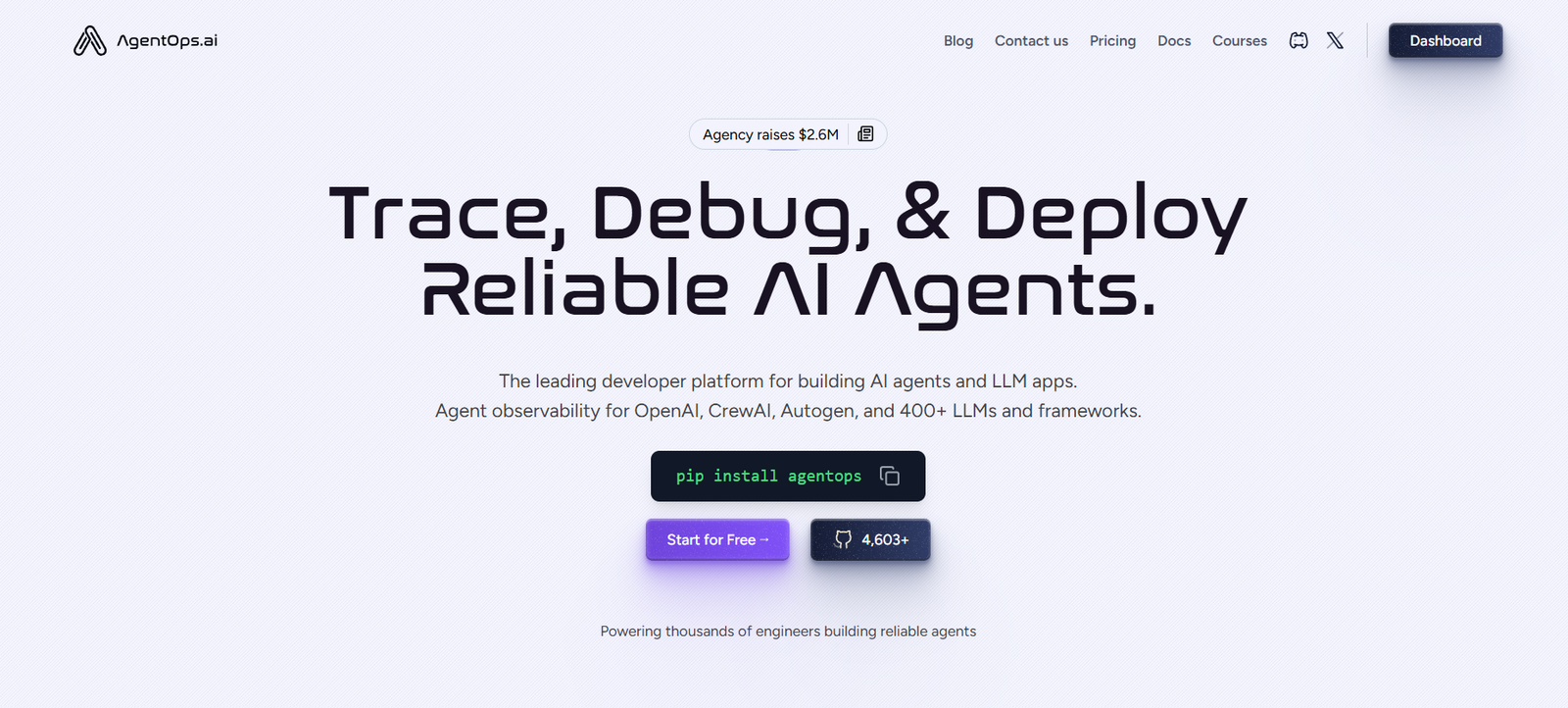
AgentOps is an observability and monitoring platform designed specifically for autonomous AI agents. As AI agents become more advanced and capable of performing tasks without constant human oversight, ensuring their reliability, effectiveness, and safety is critical. AgentOps enables developers and AI teams to monitor agent behavior, track performance metrics, detect issues, and iterate quickly using real-time insights.
The platform acts as a layer between your AI agents and production environments, offering dashboards, event logs, error tracking, and decision-tree visualization. Whether you’re using open-source agent frameworks or proprietary models, AgentOps helps bring clarity and confidence to AI automation workflows.
AgentOps is particularly useful for developers building with frameworks like Auto-GPT, LangChain, or custom LLM-based agents, offering the tools needed to build robust, trustworthy AI systems.
Features
AgentOps offers a specialized suite of features tailored for monitoring and optimizing AI agents in real-world scenarios:
Agent Observability
Gain complete visibility into how AI agents operate across tasks, decisions, and iterations with real-time telemetry.
Event Logging
Track each decision, tool invocation, API call, and model output in a timestamped, structured format.
Session Replay
Revisit past agent sessions and inspect step-by-step actions to understand decision-making and outcomes.
Custom Metrics
Define and monitor metrics such as success rates, latency, failure conditions, and more to evaluate performance over time.
Error Detection and Alerts
Automatically detect unexpected behaviors, errors, or regressions, and get notified through your preferred communication channels.
Performance Dashboards
Visualize agent performance with charts, trends, and KPIs to support continuous improvement and debugging.
Tool Usage Analytics
See which tools or APIs your agents use most, and how efficiently they are invoked across tasks.
Versioning and Experiment Tracking
Compare agent behavior across different model versions or prompt configurations to evaluate improvements or regressions.
Privacy and Security Controls
Ensure that all monitoring is done securely, with encryption and access controls for sensitive environments.
Integrations
Supports integrations with popular frameworks and tools like Auto-GPT, LangChain, Pinecone, Vector DBs, and custom agent stacks.
How It Works
AgentOps integrates with your existing AI agent framework through lightweight SDKs or APIs. Once integrated, it begins logging and monitoring agent activities in real-time. Developers can define key events or decision points they want to track, and AgentOps will collect this telemetry and send it to the dashboard.
Within the AgentOps interface, users can view live sessions, replay past runs, and inspect each step the agent takes — including which tools it used, what it decided, and what the outcome was. When issues arise, the system can trigger alerts or log them for further review.
Over time, AgentOps builds up performance profiles that help teams identify failure patterns, iterate faster, and deploy more reliable autonomous agents into production.
Use Cases
AI Startups
Monitor and debug AI agents during prototyping, beta testing, or initial deployment phases.
Enterprise AI Teams
Ensure reliability and safety in production environments where AI agents support business-critical tasks.
LLM Developers
Analyze how different models or prompts affect decision-making, and track improvements over time.
Open-Source Agent Builders
Use with popular agent frameworks like LangChain or Auto-GPT to gain transparency into agent behavior.
Toolchain Optimization
Identify inefficiencies or overuse of specific tools and optimize task orchestration logic accordingly.
Agent Experimentation
Run A/B tests between different agent strategies or configurations and analyze which performs better.
Customer Support Automation
Improve and audit the behavior of autonomous agents deployed in customer-facing environments.
Pricing
As of June 2025, AgentOps offers a free plan and several tiered options suitable for individuals, teams, and enterprises.
Free Plan
1 agent monitored
Basic observability (event log and replay)
Up to 1,000 monthly actions
Community support
Pro Plan – $29/month
Up to 5 agents
Advanced dashboards and metrics
Session replays and alerts
50,000 monthly actions
Email support
Team Plan – $99/month
20+ agents
Custom metrics
Team collaboration features
SLA-based support
Integrations with Slack, PagerDuty, and more
Enterprise Plan – Custom Pricing
Unlimited agents
Dedicated infrastructure
Enhanced data privacy and access controls
Enterprise SSO
Premium support and onboarding
You can start for free or request a demo via https://www.agentops.ai.
Strengths
AgentOps solves a key problem for developers of autonomous AI systems: visibility. It provides transparency into agent behavior and enables teams to confidently deploy and manage agents without flying blind.
Its integration-friendly approach works with popular agent frameworks, making it accessible to both startups and enterprise AI teams. Real-time logs, session replays, and performance metrics provide actionable insights without the need to build custom observability tools from scratch.
Its dashboard-driven UI, alert system, and historical comparisons are especially valuable for continuous improvement, testing, and debugging.
Drawbacks
AgentOps is a niche tool that caters specifically to autonomous AI agent builders. It may not be relevant for teams that are not using multi-step agent systems or that rely on simpler AI API calls without orchestration.
Since the platform is relatively new, documentation and community support may still be evolving. Also, some features like advanced team management, integrations, or high-volume usage are gated behind paid tiers.
Teams using entirely closed-source or offline AI models may need additional setup to comply with data privacy requirements.
Comparison with Other Tools
While traditional observability platforms like Datadog or New Relic focus on infrastructure and application performance, AgentOps is purpose-built for AI agents and LLM workflows. It offers agent-specific features like tool tracing, decision-tree replay, and prompt output analysis that generic observability tools lack.
Compared to internal dashboards built by engineering teams, AgentOps offers a plug-and-play solution that saves development time. Against open-source agent tracking libraries, it provides a more polished interface, scalability, and support.
There are few direct competitors in this exact space, making AgentOps an early mover with a specialized and well-timed offering for the growing AI agent ecosystem.
Customer Reviews and Testimonials
Early adopters of AgentOps include AI developers building with Auto-GPT and LangChain. Many have praised the tool for saving hours of debugging time and helping them understand unexpected agent behavior.
Startup teams report that AgentOps helped them deploy AI agents into production environments with more confidence and less risk. They highlight the replay and session tracking tools as particularly useful during development and QA.
Community feedback suggests that AgentOps is becoming a key tool in the AI development stack for teams prioritizing reliability and transparency.
Conclusion
AgentOps is an essential observability platform for developers building and deploying autonomous AI agents. With features tailored to tracking, debugging, and optimizing agent behavior, it fills a major gap in the AI development lifecycle.
As autonomous agents become more common in real-world applications, tools like AgentOps will be critical to ensure safe, efficient, and accountable AI systems. Whether you’re working on prototypes or managing production deployments, AgentOps brings structure, insight, and control to your AI workflows.