
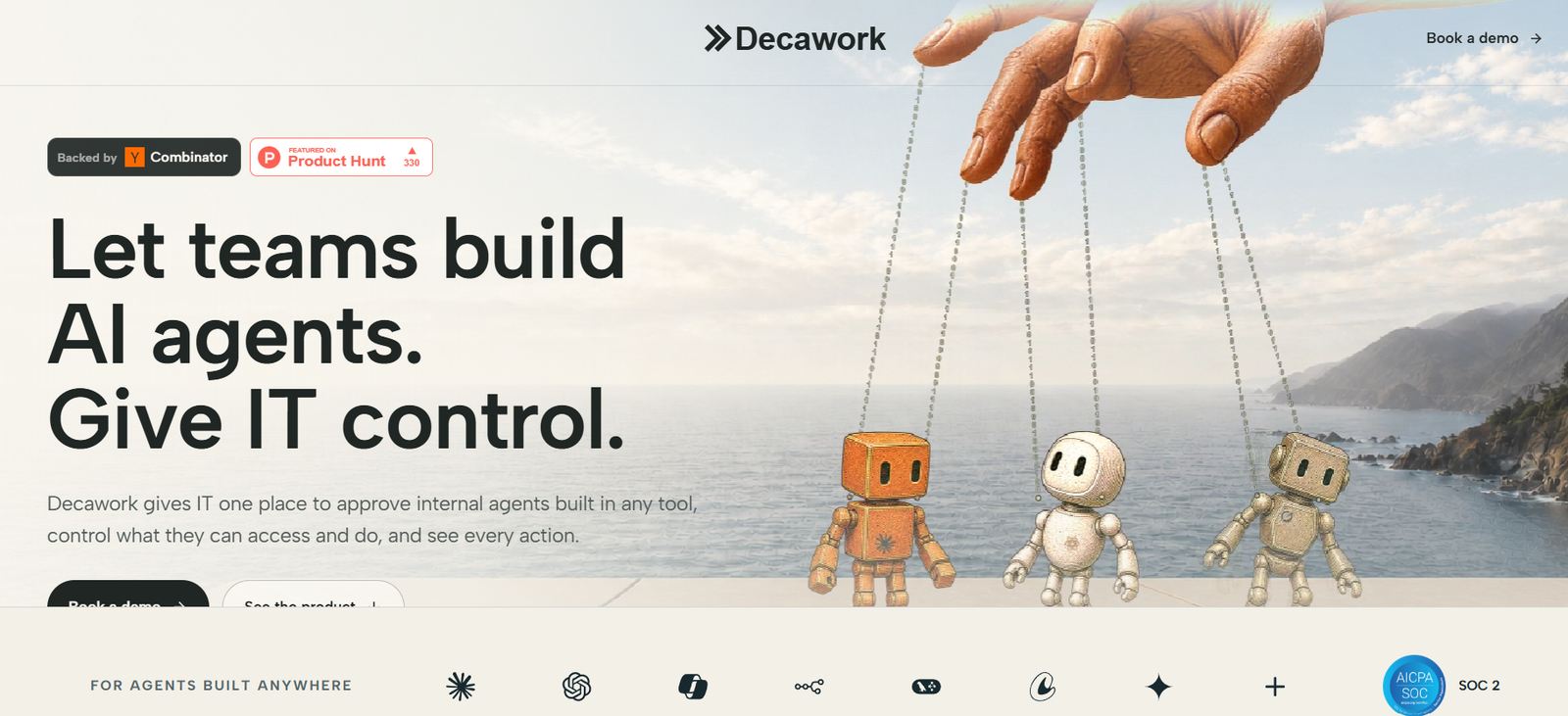
Decawork is an AI agent governance and control platform designed for companies deploying internal AI agents across different teams, tools, and frameworks.
As employees increasingly build agents with tools such as ChatGPT, Claude Code, Codex, n8n, Microsoft Copilot, OpenAI Agents SDK, LangGraph, CrewAI, and Gemini, organizations face a new challenge: deciding what those agents should be allowed to access and do.
Decawork provides a centralized control layer for this problem.
Organizations can connect agents built with different tools, define company policies in plain English, route agent actions through Decawork, and evaluate those actions before they execute.
The platform uses company-specific models that consider company policies, the agent’s current task, and previous actions when deciding whether a requested action should be allowed.
This contextual approach means the same technical action can be acceptable for one task but inappropriate for another.
Decawork also maintains a centralized inventory of agents so IT and security teams can see which agents are running, who owns them, what tools they can reach, and what activity they have performed.
The platform is particularly relevant to organizations that want employees to continue experimenting with AI agents without giving those agents unrestricted access to sensitive company systems.
Features
AI Agent Governance
Decawork provides a governance layer for AI agents operating inside an organization.
IT can establish rules governing what agents are permitted to access and what actions they can perform.
Company-Specific Models
Decawork can train a model around an organization’s policies and interests.
This model evaluates agent actions according to the company’s requirements rather than applying only generic AI safety rules.
Plain-English Policies
Organizations can describe policies in natural language.
This makes policy creation more accessible than requiring every governance rule to be written as application code.
Context-Aware Decisions
Agent actions are evaluated in context.
The system can consider:
Company policies
The agent’s current task
Previous actions
Available tools
Agent identity
Human approval requirements
This allows Decawork to distinguish between actions that may technically look similar but serve different purposes.
Real-Time Action Approval
The company-specific model can evaluate an agent’s requested action before it runs.
An action can be approved when it is appropriate for the current task.
Human Approval Gates
Organizations can define circumstances where an AI model should not make the final decision automatically.
Sensitive actions can require a person to step in and approve them.
Dynamic Access Control
Access does not need to remain permanently available simply because an agent received permission earlier.
Decawork is designed to evaluate access according to the task currently being performed.
Permissions can be reassessed as the agent works and revoked when they are no longer required.
Central Agent Inventory
Decawork gives IT a centralized view of internal AI agents operating across the organization.
Teams can see which agents are live or paused and keep ownership and activity information together.
Agent Identity
Individual agents can be identified rather than allowing AI activity to appear under a shared or employee account.
This makes governance and accountability easier.
Agent Ownership
Organizations can associate agents with responsible teams or owners.
This helps IT understand who is accountable for an agent and its purpose.
API Traffic Control
Decawork can connect and route AI agent API requests through its governance layer.
This allows policy decisions and oversight to be applied to agent activity.
MCP Traffic Control
The platform also supports MCP tool-call traffic.
This is particularly relevant as AI agents increasingly connect to external systems and tools through the Model Context Protocol.
Activity Visibility
IT teams can see agent activity from a centralized interface.
This reduces the risk of internal agents operating without organizational visibility.
Approvals Workspace
Decawork provides an area for managing actions that require approval.
This allows organizations to keep sensitive AI activity under human oversight.
Policy Management
Policies can be created and maintained centrally rather than being implemented separately inside every agent.
Agent Pause Controls
Agents can be paused when they should temporarily stop operating.
Agent Retirement
Organizations can retire agents that are no longer required.
This helps prevent old experimental agents from retaining unnecessary access to company systems.
Multi-Framework Support
Decawork is designed around agents built elsewhere rather than forcing every team to adopt a single development framework.
Examples presented by the company include agents associated with:
ChatGPT
Claude Code
Codex
n8n
Microsoft Copilot
Microsoft Agent Framework
OpenAI Agents SDK
LangGraph
CrewAI
Gemini
Cross-Department Governance
The platform can govern agents used by different business functions.
Examples shown by Decawork include:
Marketing
Recruiting
People Operations
Human Resources
IT
Legal
Security
Finance
Customer Support
Sales and Revenue Operations
Engineering
Customer Success
Security-Oriented Architecture
Decawork is built around controlling agent access rather than simply monitoring agents after an action has occurred.
The goal is to prevent inappropriate actions before execution where policies require it.
SOC 2
The official website displays SOC 2 status as part of its security positioning.
Organizations evaluating Decawork should request the relevant security and compliance documentation during procurement.
How It Works
Step 1: Identify Internal Agents
Determine which AI agents are already being built or operated across the company.
These agents can originate from different AI tools and frameworks.
Step 2: Connect the Agents
Route supported API requests and MCP tool calls through Decawork.
Step 3: Assign Ownership
Associate each agent with the relevant team or responsible owner.
Step 4: Define Company Policies
Describe organizational requirements and restrictions in plain English.
Step 5: Establish Human Approval Rules
Determine which sensitive actions should require a person to approve them.
Step 6: Let Agents Work
Teams continue using their agents for their intended tasks.
Step 7: Evaluate Actions
When an agent attempts an action, Decawork evaluates it according to company policies and current context.
Step 8: Allow or Escalate
Appropriate actions can proceed.
Sensitive or questionable actions can be escalated for human approval according to company policy.
Step 9: Monitor Activity
IT can see which agents are running, their owners, available tools, and recent activity.
Step 10: Revoke Access When Appropriate
Access can be reassessed and removed when it is no longer required for the current task.
Step 11: Pause or Retire Agents
Agents that are unsafe, unnecessary, outdated, or no longer owned can be paused or retired.
Use Cases
Enterprise AI Governance
Organizations can establish a common governance layer across internal AI agents.
Shadow AI Agent Management
IT can discover and bring employee-built agents under organizational control rather than blocking every internal AI experiment.
HR Agents
Employee-policy and onboarding agents can access only the information required for their current tasks.
Recruiting Agents
Candidate briefing agents can be governed according to hiring-data access policies.
Finance Agents
Invoice reconciliation and other finance agents can operate under defined permissions and approval requirements.
Legal Agents
Contract-review agents can work with controlled access to company information.
Security Agents
Security triage agents can operate while maintaining visibility and accountability.
Customer Support
Support escalation agents can connect with internal systems while remaining subject to company policies.
Engineering Agents
Release coordination and engineering agents can operate across development tools with centralized oversight.
Marketing Agents
Content and workflow agents can access approved tools without receiving unrestricted company credentials.
Sales and RevOps
Pipeline and revenue agents can operate under defined access policies.
Agent Lifecycle Management
Companies can govern agents from initial deployment through active operation, pausing, and eventual retirement.
Pricing
Decawork does not currently publish standardized pricing on its official website.
There is no clearly available public pricing table listing monthly subscriptions, per-agent charges, per-user pricing, or enterprise licence costs.
The official website instead directs prospective customers to book a live walkthrough with the Decawork team.
This suggests that current deployments follow a sales-led or customized enterprise pricing process.
Organizations interested in Decawork should contact the company directly for a quote based on their number of agents, integrations, organizational requirements, security needs, and deployment scale.
Pricing details are not clearly mentioned on the official website.
Security
Security and access control are central to Decawork’s product rather than optional supporting features.
Organizations can establish company-specific policies that determine whether an agent action is appropriate.
The platform can evaluate API and MCP tool activity before execution and require human approval for actions that should not be automatically authorized.
Decawork also provides centralized visibility into agent identity, ownership, available tools, and activity.
The official website displays SOC 2 status.
Organizations handling sensitive employee, customer, financial, healthcare, legal, or proprietary information should still conduct their normal vendor-security and compliance review before deployment.
Strengths
Framework-Agnostic Approach
Companies do not need every employee to build agents with the same development platform.
Centralized Governance
Agents created across different departments can be managed through one control layer.
Context-Aware Approval
Decisions can consider the current task and previous activity rather than applying only static allow-or-deny rules.
Company-Specific Policies
Organizations can encode their own requirements rather than relying solely on generic model policies.
Plain-English Rules
Policies can be described naturally rather than requiring every rule to be programmed manually.
API and MCP Coverage
Support for both API traffic and MCP tool calls addresses two important ways modern agents interact with company systems.
Human Oversight
Sensitive actions can be escalated to people when necessary.
Agent Inventory
IT receives visibility into agents operating across different business functions.
Lifecycle Controls
Agents can be governed, paused, and eventually retired.
Designed for Existing Agents
Decawork is not primarily another agent-building platform. It is designed to govern agents teams have already created.
Drawbacks
Public pricing is not currently available.
Companies need to contact Decawork and go through a demo or sales process to determine costs.
Decawork is primarily an enterprise IT and security product. Individual users and small teams that simply want to build an AI agent may not need this level of governance.
The platform adds a governance layer to an organization’s AI infrastructure, which can require integration and policy-design work.
Organizations must still create sensible internal AI policies. Technology cannot automatically determine every company’s legal, ethical, operational, and security requirements.
Human approval gates can improve control but may also slow workflows when configured too aggressively.
The platform is relatively new, so its long-term enterprise deployment record and independent customer-review base are still developing.
Comparison with Other Platforms
Decawork differs from conventional AI agent builders because its primary purpose is not to help employees create another agent.
Instead, it focuses on what happens after employees begin building and deploying agents.
Agent-building frameworks concentrate on prompts, models, tools, workflows, memory, and orchestration. Decawork concentrates on governance questions such as who owns an agent, what it can access, whether a particular action should execute, when a person needs to approve it, and when access should be revoked.
Its framework-agnostic approach is also important.
Organizations may already have agents built with ChatGPT, Claude Code, Codex, n8n, LangGraph, CrewAI, OpenAI Agents SDK, Gemini, Microsoft tools, and other platforms. Decawork aims to provide a common governance layer without requiring those teams to rebuild every agent using one vendor’s framework.
This makes Decawork most relevant to companies experiencing rapid internal adoption of AI agents and needing IT and security controls around that growth.
Customer Reviews and Testimonials
A substantial collection of independently verified enterprise customer reviews is not yet clearly available on Decawork’s official website.
Decawork is a relatively new product and launched publicly in 2026.
Early public discussion around the product has focused on problems such as AI agent ownership, access control, credentials, auditability, and the difficulty of governing employee-built agents.
These early reactions can help demonstrate interest in the problem Decawork is addressing, but they should not be treated as evidence of long-term customer satisfaction.
Organizations considering deployment should request product demonstrations, security documentation, customer references, and implementation information directly from Decawork.
Conclusion
Decawork is an AI agent governance platform built for a problem that is becoming increasingly important inside organizations: employees can now build useful AI agents much faster than IT teams can traditionally approve and govern them.
Rather than forcing employees to rebuild those agents in one company-approved development platform, Decawork provides a control layer across agents built with different tools.
Organizations can define policies in plain English, connect API and MCP traffic, maintain an inventory of agents, track ownership and activity, evaluate actions in context, require human approval for sensitive operations, and revoke access when a task is complete.
Its company-specific model approach is particularly notable. Instead of evaluating an action in isolation, Decawork can consider company policies, the agent’s current task, and previous actions before deciding whether the operation should proceed.
The platform is best suited to IT, security, compliance, and enterprise technology teams managing a growing number of internal AI agents.
Its main limitations are the lack of public pricing, the integration effort associated with enterprise governance, and its relatively early stage as a 2026 product.
For organizations that want employees to continue building AI agents while maintaining centralized control over what those agents can actually do, Decawork offers a specialized governance layer between AI experimentation and production use.


