
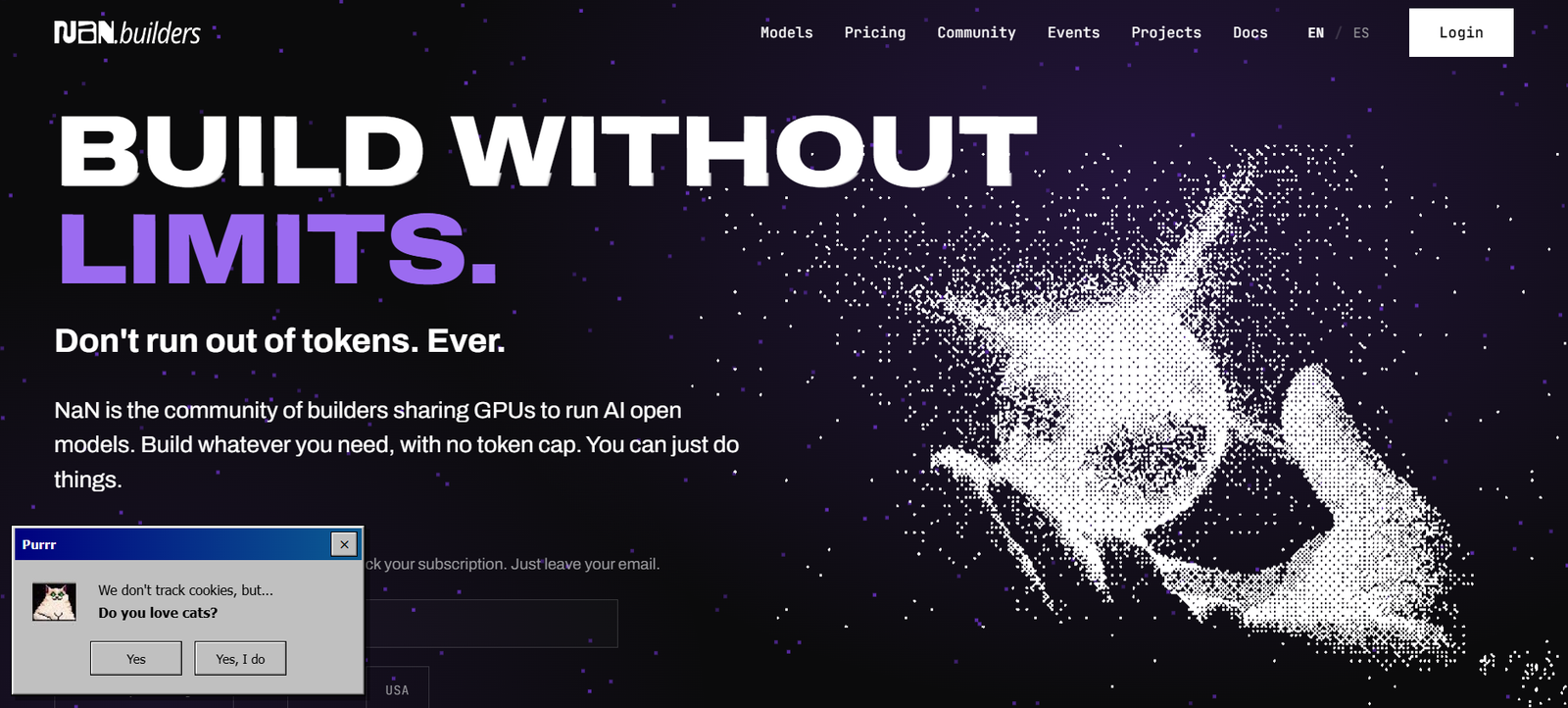
NaN is a community and shared AI inference platform built for developers, indie hackers, AI builders, and teams that want to use powerful open models without operating their own GPU infrastructure.
Instead of requiring every developer to purchase expensive hardware or configure GPU servers, NaN brings members together around a shared inference cluster. Members receive access to open AI models running continuously on dedicated infrastructure and can connect their applications and coding tools through an OpenAI-compatible API.
This makes NaN particularly relevant for people building AI agents, coding assistants, applications, automations, voice tools, research systems, and other projects that consume large amounts of model inference.
NaN is also structured as a private builder community rather than only an API provider. Members can participate in Discord discussions, events, workshops, hackathons, and model selection. The community periodically votes on which open models should be added to the shared cluster.
The platform emphasizes privacy as well. NaN states that prompts and model responses are not logged, processing takes place in the European Union, and customer code is not used for model training.
Features
Shared GPU Infrastructure
NaN gives members access to shared GPU infrastructure for running open AI models. This removes the need for individual developers to purchase and maintain powerful GPU hardware.
Multiple Open AI Models
The platform provides several types of open models through the same infrastructure. Its current lineup includes large language models along with embedding, reranking, text-to-speech, and speech-to-text models.
Models listed by NaN currently include options from DeepSeek, Xiaomi, Z.ai, Alibaba, Google, Hexgrad, and OpenAI’s open Whisper speech recognition technology.
OpenAI-Compatible API
NaN provides each eligible member with a personal API key. Its API is designed to be compatible with the OpenAI API format, making integration easier for applications and tools that allow users to specify a custom base URL and API key.
Large Context Windows
Several of the frontier models offered through NaN support very large context windows. This can be useful for coding agents, document analysis, research workflows, and applications processing substantial amounts of information.
Reasoning and Tool Calling
Supported models include capabilities such as reasoning, tool calling, vision, and multimodal processing, depending on the selected model.
High Token Allowances
NaN focuses heavily on developers who consume large numbers of tokens. Some cluster models are offered without token counters, while frontier models have clearly stated monthly or billing-period allowances.
Embedding Models
NaN includes an embedding model that can be used for semantic search, retrieval systems, RAG applications, document matching, and other vector-based AI workflows.
Reranking
A dedicated reranking model is available for applications that need to improve the relevance ordering of retrieved information.
Text-to-Speech
NaN provides access to Kokoro for generating spoken audio from text, making the infrastructure useful for voice applications and AI assistants.
Speech-to-Text
Whisper is available for audio transcription and translation workflows. Developers can send audio through the API and receive transcribed text.
Privacy-Focused Inference
NaN states that it does not log prompts or model responses. Processing occurs in the European Union, and user code is not used to train models.
Community Model Voting
Members can participate in periodic votes about which open models should join the cluster. This gives the builder community some influence over how the available model lineup develops.
Developer Community
The NaN community operates primarily through Discord. Members can participate in discussions, builds, AMAs, events, workshops, and hackathons.
NaN Cloud Apps
NaN also provides cloud capabilities for deploying applications from GitHub repositories. Apps can be built and served from an isolated environment with a public domain and HTTPS.
Cloud Spaces
Applications run inside Spaces with defined CPU, memory, storage, and application limits. Developers can choose different resource tiers depending on their needs.
Programming Examples
Official documentation provides examples for connecting through technologies such as Python, Node.js, and curl, making it easier for developers to begin integrating the API.
How It Works
Step 1: Join the Community or Waitlist
Users begin by joining the NaN community or its waitlist. Inference membership is capacity limited because access depends on available shared GPU resources.
Step 2: Select a Membership
Users choose the membership level that matches whether they primarily want community access or AI inference capacity.
Step 3: Create an API Key
Eligible inference members can generate a personal API key from their account settings.
Step 4: Configure the API
Developers configure a compatible application, coding tool, or custom software with the NaN API endpoint and their personal API key.
Step 5: Select a Model
Users choose from the available language, embedding, reranking, speech, or other supported models according to their application.
Step 6: Send Requests
The application sends inference requests to NaN’s shared cluster. The selected model processes the request and returns the output through the API.
Step 7: Build Applications and Agents
Developers can integrate the models into coding agents, AI applications, RAG systems, automations, voice tools, research systems, and other projects.
Step 8: Deploy Apps if Needed
Users who need application hosting can create a NaN Cloud Space and deploy supported projects from GitHub.
Use Cases
AI Coding Agents
Developers running coding agents can use NaN’s high token allowances and large-context models for code analysis, generation, debugging, and autonomous development workflows.
AI Application Development
Developers can connect their applications to open models without operating their own GPU inference servers.
AI Agents
Agent developers can use models that support reasoning and tool calling to build systems capable of performing multi-step tasks.
RAG Applications
Embedding and reranking models make NaN useful for retrieval-augmented generation systems that search private documents or knowledge bases.
Document Analysis
Large-context models can help applications analyze lengthy documents, repositories, research material, and other substantial information sources.
Voice Applications
Developers can combine speech recognition and text-to-speech capabilities to create voice assistants, transcription tools, and audio applications.
Indie Hackers
Independent builders can experiment with and launch AI products without purchasing dedicated GPU hardware.
Startups
Early-stage companies can use shared infrastructure to prototype and operate open-model applications while avoiding some of the complexity of self-hosting inference.
Automations
Open models can be integrated into workflows that classify information, generate content, analyze data, or perform other automated tasks.
Research and Experimentation
Developers interested in the open-model ecosystem can experiment with different models through a common API instead of configuring separate inference infrastructure for each model.
Pricing
NaN currently offers community, inference, and premium membership options.
nan_community: €14.99 per month
This tier provides access to the Discord community, member-only channels, live discussions, builds, AMAs, events, workshops, and hackathons.
It also provides a reserved position in the queue for inference access when capacity becomes available.
The subscription is month to month and can be cancelled at any time.
nan_member: €70 per month
The inference membership includes access to NaN’s shared cluster and available open models.
Current benefits include a personal OpenAI-compatible API key, access to private Discord channels, events, workshops, hackathons, and participation in quarterly model voting.
NaN currently lists substantial allowances for its frontier models. For example, DeepSeek V4-Flash is listed with 3 billion tokens per month, while other frontier models have their own published limits. Several other cluster models are described as unmetered.
GLM 5.3 Premium: €200 per month
The premium option provides access to GLM 5.3 with a 3 billion token allowance per billing period.
It currently includes a 400 million token rolling four-hour window, a 1 million token context window, and support for up to five concurrent requests.
The premium tier also includes the benefits of nan_member.
Access is capacity limited and offered to members as seats become available.
NaN Cloud
NaN Cloud also provides separate application hosting resources.
A Basic Space includes 2 vCPU, 4 GiB RAM, 20 GiB storage, and support for up to five application pods. It is included free with an active inference membership or is available separately for $6 or €6 per month.
The Medium tier is listed at $12 or €12 per month and provides 4 vCPU, 8 GiB RAM, 40 GiB storage, and up to ten pods.
The Large tier is listed at $24 or €24 per month and provides 4 vCPU, 16 GiB RAM, 80 GiB storage, and up to twenty pods.
Pricing and model allowances may change as infrastructure and model availability evolve, so users should confirm current information before subscribing.
Strengths
Focused on Heavy AI Usage
NaN is designed for builders who regularly consume substantial numbers of tokens rather than users who occasionally send a few AI prompts.
OpenAI-Compatible API
Compatibility with the familiar OpenAI API structure can make migration easier for developers and tools that support custom API endpoints.
Access to Multiple Open Models
Developers can experiment with different open models through one infrastructure provider instead of maintaining separate deployments.
Large Token Allowances
The fixed membership approach may be attractive to developers whose agents or applications generate substantial inference usage.
No Personal GPU Required
Developers gain access to powerful shared hardware without purchasing and maintaining expensive GPUs themselves.
Privacy Approach
NaN states that prompts and responses are not logged, processing occurs in the EU, and customer code is not used for training.
More Than Language Models
Embedding, reranking, speech recognition, and text-to-speech models expand its usefulness beyond conventional chatbot applications.
Builder Community
Discord discussions, workshops, events, hackathons, and model voting add a community component that typical inference API providers may not emphasize.
Application Hosting
NaN Cloud gives developers an additional option for deploying applications alongside their AI inference workflows.
Drawbacks
NaN is aimed primarily at developers and technical builders. People looking for a simple consumer AI chatbot are unlikely to benefit from its API-oriented approach.
Membership is capacity limited. Users may have to join a waitlist when available GPU resources are fully allocated.
Although NaN emphasizes high or unlimited usage, not every model is completely unlimited. Frontier models have specific token allowances and, in some cases, rolling usage windows.
NaN provides inference rather than model training. Users who need to train or fine-tune models will require other infrastructure.
The platform is also focused on open models. Developers who specifically require proprietary models from closed providers may still need separate API services.
Finally, shared GPU infrastructure can offer a different level of control from operating dedicated hardware. Organizations with highly specialized infrastructure requirements may prefer dedicated or self-hosted deployments.
Comparison with Other Platforms
NaN sits between conventional AI API providers, GPU cloud services, and self-hosted open-model infrastructure.
Traditional proprietary AI APIs provide convenient access to powerful models but generally charge according to usage. For applications and agents that process very large token volumes, costs can become an important consideration.
GPU cloud platforms give developers more infrastructure control, but users are usually responsible for configuring model servers, scaling, deployment, monitoring, and optimization.
Self-hosting open models offers even greater control but requires access to suitable GPUs and technical knowledge to operate the inference stack efficiently.
NaN takes a different approach. It pools GPU resources among a limited community of builders and provides ready-to-use open models through an OpenAI-compatible API.
This can make it attractive to developers who want the flexibility of open models without managing the underlying inference infrastructure themselves. The community, model voting, voice models, embedding tools, and optional application hosting also give NaN a broader builder-oriented ecosystem.
Customer Reviews and Testimonials
Customer reviews and testimonials are not clearly available on the official website.
However, NaN does showcase projects created by community members, including AI applications, agent tools, automation projects, websites, APIs, and data-oriented products. These examples provide practical evidence of how members are using the shared inference infrastructure, but they should not be treated as independent customer reviews.
Conclusion
NaN is an interesting option for developers, indie hackers, AI agent builders, and startups that want serious access to open AI models without purchasing GPUs or operating their own inference infrastructure.
Its main appeal comes from combining shared GPU capacity, an OpenAI-compatible API, large token allowances, multiple open models, privacy-focused processing, and an active builder community.
The addition of embeddings, reranking, speech recognition, text-to-speech, and application hosting makes NaN useful for more than basic LLM applications. Developers can use the ecosystem to build coding agents, RAG systems, voice applications, automations, research tools, and other AI-powered products.
NaN will be most valuable for technically experienced users who regularly consume significant inference resources and prefer open models. For casual AI users, the platform is likely more technical than necessary, but for active builders looking to avoid the cost and complexity of running powerful open models themselves, it offers a distinctive community-based approach.


