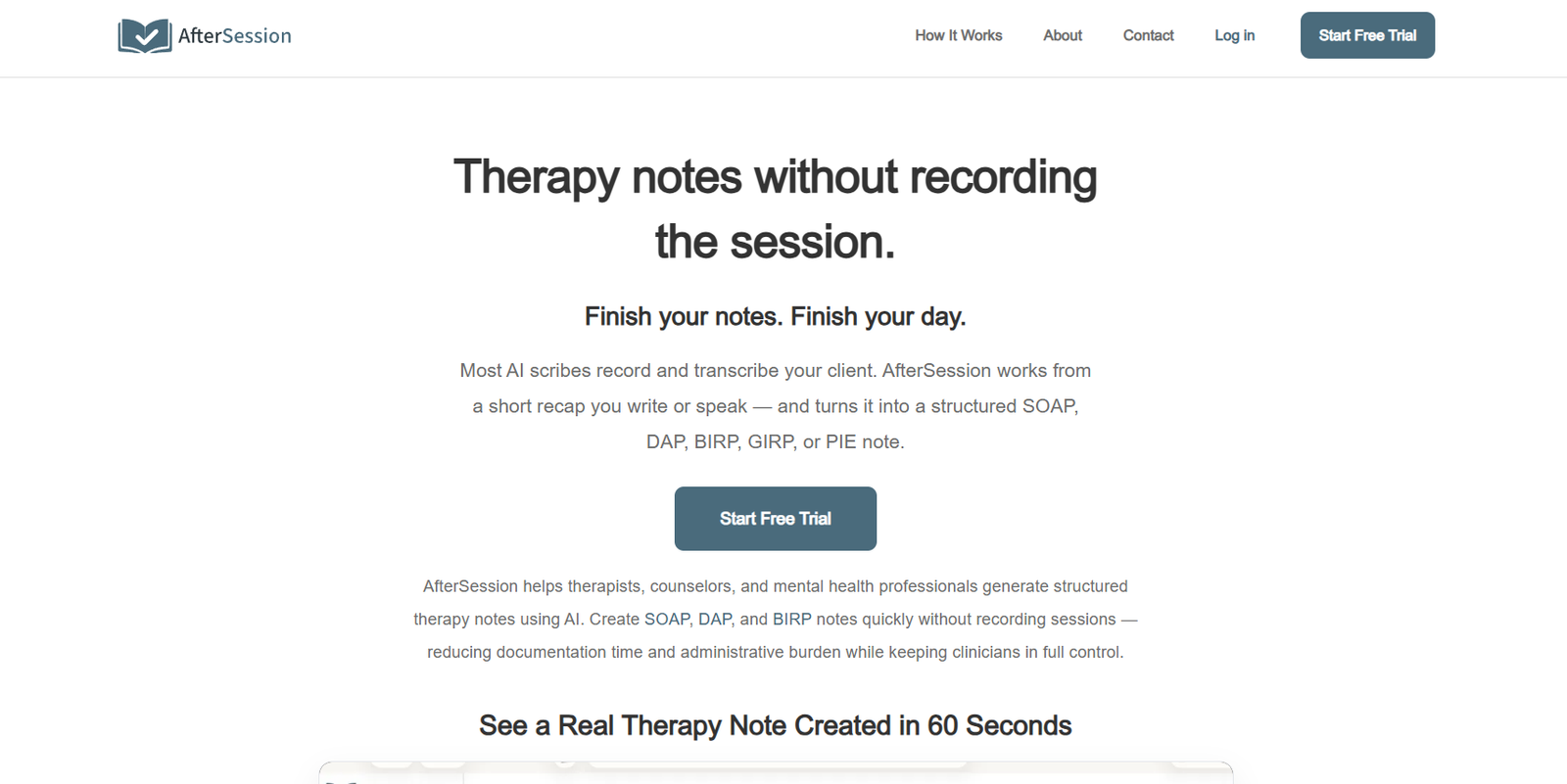
AfterSession is an AI powered clinical documentation tool created specifically for therapists, counselors, psychologists, social workers and mental health professionals. It helps clinicians turn brief observations after a therapy session into structured clinical notes.
Unlike AI scribes that record and transcribe an entire therapy session, AfterSession follows a post-session approach. After meeting with a client, the clinician can type observations or provide a short voice recap. The AI then organizes this information into a structured therapy note.
The platform supports commonly used documentation formats including SOAP, DAP, BIRP, GIRP and PIE. Clinicians can review and edit everything generated by the AI before saving the final note.
AfterSession places considerable emphasis on privacy. It states that it does not record therapy sessions, does not listen to live conversations and does not use client data to train public AI models. Voice inputs are deleted after processing, while stored notes are protected through encryption.
The platform is designed to complement an existing EHR rather than replace it. Clinicians can finalize their documentation in AfterSession and then copy it into the system they already use.
Features
AI Generated Therapy Notes
AfterSession converts a clinician’s brief post-session recap into a structured clinical note. Instead of manually organizing observations into a formal documentation format, users can allow AI to create the initial draft.
No Therapy Session Recording
One of AfterSession’s most distinctive features is that it does not record or listen to therapy sessions. Clinicians provide their own observations after the session has ended.
This approach may appeal to professionals who want AI assistance with documentation without creating a full recording of sensitive client conversations.
SOAP Notes
AfterSession supports SOAP documentation, organizing clinical information into Subjective, Objective, Assessment and Plan sections.
DAP Notes
Clinicians who use the DAP format can generate notes organized around Data, Assessment and Plan.
BIRP Notes
The platform also supports BIRP notes covering Behavior, Intervention, Response and Plan.
GIRP and PIE Formats
In addition to SOAP, DAP and BIRP, AfterSession supports GIRP and PIE documentation formats, providing flexibility for clinicians with different documentation preferences.
Voice or Typed Input
Clinicians can either type their observations or record a short voice note after the session. Voice input is optional, so users who prefer typing can use the platform without recording audio.
Custom AI Prompts
Paid plans include custom AI prompts. This allows clinicians to guide how their documentation is structured and written according to their preferred workflow.
Personalized Writing Style
AfterSession allows clinicians to guide the tone, structure and level of detail of generated notes. This can help maintain greater consistency with the clinician’s normal documentation style.
Full Editing Control
AI generated notes remain editable. Clinicians can change wording, add missing information or remove content before approving and saving the final version.
Secure Note Storage
AfterSession provides secure storage for finalized clinical notes. Users remain responsible for reviewing and approving documentation before it is saved.
PDF and Text Export
Completed notes can be exported as PDF or text, making it easier to transfer or retain documentation according to the clinician’s workflow.
Works Alongside Existing EHRs
AfterSession is not designed as a complete electronic health record system. Instead, users can generate and finalize a note and then copy it into their existing EHR.
HIPAA Aligned Workflow
AfterSession states that it is built around HIPAA aligned practices. Paid subscribers can obtain a Business Associate Agreement, or BAA.
Encryption
Clinical information is encrypted both while being transmitted and while stored.
Voice Note Deletion
Brief voice recordings used to create documentation are deleted after processing rather than being retained as session recordings.
No AI Training on Client Data
AfterSession states that customer clinical data is not used to train public AI models and that third parties are not permitted to use this information for model training.
Multiple Device Access
The service can be used from phones, tablets and desktop devices, giving clinicians flexibility in when and where they complete their documentation.
How It Works
Step 1: Complete the therapy session
The clinician conducts the session normally. AfterSession does not need to join, listen to or record the session.
Step 2: Enter a short recap
After the session, type relevant observations or create a brief voice note describing what happened.
Step 3: Select the documentation format
Choose an appropriate clinical note format such as SOAP, DAP, BIRP, GIRP or PIE.
Step 4: Generate the note
AfterSession uses AI to organize the clinician’s input into a structured clinical draft.
Step 5: Review carefully
The clinician reviews the AI generated content and checks that it accurately represents the session and their professional assessment.
Step 6: Edit where necessary
Any wording or section can be modified. Details can be added, changed or removed before the note is finalized.
Step 7: Save or export
Once satisfied, save the note securely or export it as PDF or text.
Step 8: Transfer to the EHR
If required, copy the completed documentation into the practice’s existing EHR or other clinical record system.
Use Cases
Therapists and Counselors
Private practice therapists can use AfterSession to prepare structured progress notes shortly after completing client sessions.
Psychologists
Psychologists who spend significant time on documentation can use the platform to turn brief clinical observations into structured notes that they can review and approve.
Social Workers
Clinical social workers can generate consistent documentation using supported formats such as SOAP, DAP and BIRP.
Small Mental Health Practices
AfterSession is designed for solo practitioners as well as small group practices. The website specifically identifies practices with approximately 2 to 10 clinicians among its intended users.
Clinicians Concerned About Session Recording
Mental health professionals who do not want an AI system recording complete client conversations may find AfterSession’s post-session approach useful.
Professionals Using Existing EHRs
Practices that already have an EHR but want assistance creating notes can use AfterSession alongside their existing system instead of replacing it.
Clinicians Managing Documentation Backlogs
The tool can help clinicians structure notes soon after sessions, potentially reducing the amount of administrative work that remains at the end of the working day.
Pricing
AfterSession offers a 7 day free trial or up to 5 generated notes, whichever limit is reached first. No credit card is required to start the trial.
Founding Clinician
The Founding Clinician plan is currently listed at $29.95 per month for the first clinician.
Each additional clinician costs $19.95 per month.
AfterSession states that this rate is locked in for as long as the subscription remains active. However, Founding Clinician pricing is available only to a limited number of early practices.
The plan includes unlimited note generation, SOAP, DAP, BIRP, GIRP and PIE formats, typed or voice input, custom AI prompts, secure note storage, PDF and text exports and availability of a BAA.
Standard
The Standard plan is listed at $49.95 per month for the first clinician.
Each additional clinician costs $29.95 per month.
It includes unlimited note generation, all supported documentation formats, typed and voice input, custom AI prompts, secure note storage, PDF and text exports and BAA availability.
There are no long term contracts, and subscriptions can be cancelled at any time.
Pricing and promotional availability may change, particularly because the Founding Clinician rate is described as limited early practice pricing.
Strengths
AfterSession is specifically designed around mental health documentation rather than functioning as a general purpose AI writing assistant.
Its post-session workflow is a major advantage for clinicians who want AI assistance without recording complete therapy conversations.
Support for SOAP, DAP, BIRP, GIRP and PIE gives users flexibility in choosing their preferred clinical documentation structure.
Clinicians remain responsible for the final documentation and can edit every part of an AI generated draft before saving it.
Custom prompts and writing preferences can help clinicians create notes that better reflect their normal documentation style.
Privacy focused features include encryption, deletion of voice inputs after processing and a stated policy against using client data for public AI model training.
Paid subscribers can also obtain a BAA to support HIPAA aligned workflows.
Drawbacks
AfterSession does not provide live session transcription. Clinicians who specifically want automatic transcription of entire sessions will need a different type of AI scribe.
It is not a complete EHR. Features such as appointment scheduling, billing and broader practice management are outside its primary purpose.
The official website states that it does not currently provide full EHR integration. Users generally need to transfer completed notes into their existing system.
Organizations requiring on-premise hosting may also find the platform unsuitable.
The free trial is limited to seven days or five notes, so regular use requires a paid subscription.
AI generated clinical notes should always be carefully reviewed by the treating professional. AfterSession assists with documentation and does not replace clinical judgment or professional responsibility.
Comparison with Other Platforms
AfterSession differs from many AI therapy scribes because it intentionally avoids recording the full therapy session.
Many clinical AI documentation platforms capture and transcribe conversations before creating a note. AfterSession instead asks the clinician to provide a short recap after the session and then uses that information to generate structured documentation.
This creates a different balance between automation and privacy. The clinician must provide the important clinical observations, but a complete recording of the client’s conversation is not required.
Compared with full EHR platforms, AfterSession has a much narrower purpose. It does not attempt to handle scheduling, billing and complete practice management. Instead, it concentrates on helping mental health professionals create structured notes efficiently.
Clinicians should therefore choose between AfterSession and other platforms according to whether they prioritize full session transcription, EHR integration, broader practice management or a focused post-session documentation workflow.
Customer Reviews and Testimonials
AfterSession displays testimonials from licensed mental health professionals on its official website.
The testimonials describe experiences such as completing documentation before leaving the office, reducing the amount of note writing taken home and spending less personal time on administrative work.
One testimonial is attributed to an LMFT in private practice, while another is attributed to an LCSW working in a group practice.
These testimonials are published directly on AfterSession’s website and should be viewed as company selected customer feedback rather than independent third party reviews.
Conclusion
AfterSession is a focused AI documentation tool for therapists and other mental health professionals who want to create structured clinical notes without recording complete therapy sessions.
Its ability to turn short typed or spoken post-session observations into SOAP, DAP, BIRP, GIRP and PIE notes can reduce repetitive documentation work while keeping the clinician responsible for reviewing and approving every final note.
Privacy is an important part of its approach. The platform states that it deletes voice inputs after processing, encrypts stored information, does not train public AI models on client data and provides BAAs for paid subscribers.
AfterSession is particularly suitable for private practice therapists, psychologists, counselors, social workers and small mental health practices that already have an EHR but want a dedicated AI assistant for post-session documentation.
It is less suitable for practices seeking full session recording, live transcription, scheduling, billing or a complete EHR replacement. For clinicians who specifically want a focused, privacy conscious approach to AI assisted therapy notes, AfterSession offers an interesting alternative to traditional AI scribes.