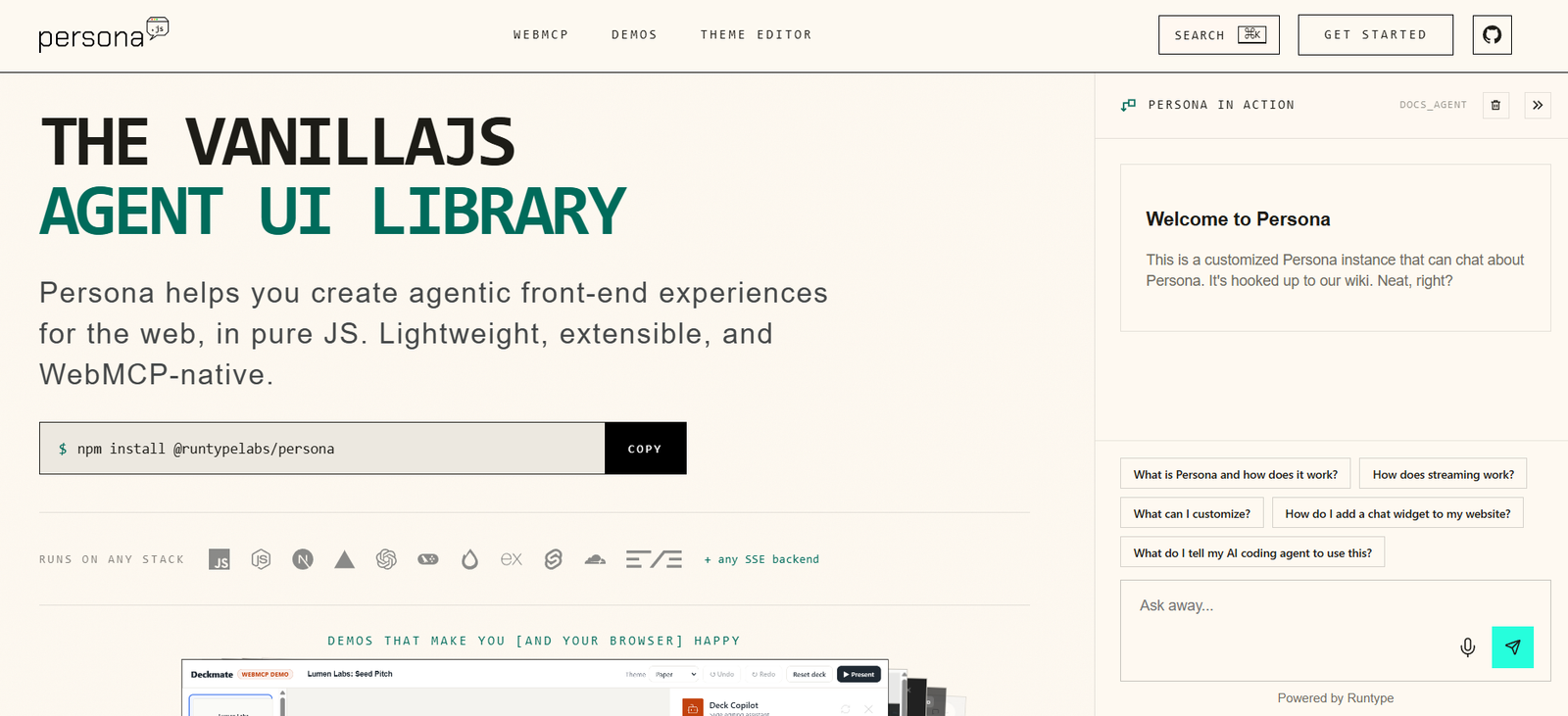
Persona is an open-source JavaScript library that enables developers to build AI-powered chat interfaces, copilots, and virtual assistants for web applications. Instead of creating an AI chat interface from scratch, developers can integrate Persona into existing websites or applications using only a few lines of code. It supports floating chat widgets, docked copilots, and full-screen AI assistants while remaining framework-independent.
Built with WebMCP (Model Context Protocol) support, Persona allows AI agents to interact with tools already available on a web page, such as search, booking systems, shopping carts, forms, and other application features. The library works with any Server-Sent Events (SSE) backend and can integrate with AI frameworks such as OpenAI Agents SDK, LangGraph.js, Vercel AI SDK, Express, Hono, and SvelteKit.
Features
Multiple Chat Interface Modes
Deploy AI assistants as floating chat widgets, docked side panels, or full-screen interfaces without changing backend logic.
WebMCP Integration
Persona supports the Model Context Protocol, allowing AI agents to safely discover and execute tools available within web applications after user approval.
Framework Independent
Works with plain JavaScript as well as modern web frameworks, making integration flexible for different development environments.
Theme Customization
Customize colors, components, design tokens, and dark mode settings to match your application’s branding.
Shadow DOM Isolation
Uses Shadow DOM to isolate widget styles, preventing CSS conflicts between Persona and the host website.
Streaming Support
Supports Server-Sent Events (SSE) streaming with customizable parsers, making it compatible with different AI backends.
Developer SDK
Install Persona using npm or a simple script tag and integrate it with OpenAI Agents SDK, LangGraph.js, Express, Hono, SvelteKit, or custom backends.
Open Source
Persona is released under the MIT License, allowing developers to customize and extend the library for commercial or personal projects.
How It Works
Install Persona using npm or a CDN script.
Configure the AI backend endpoint.
Choose a floating, docked, or full-screen interface.
Customize the widget theme and appearance.
Connect your AI agent or SSE backend.
Deploy the assistant and optionally expose WebMCP tools for interactive workflows.
Use Cases
- AI customer support chatbots.
- SaaS application copilots.
- AI-powered documentation assistants.
- Product onboarding assistants.
- Internal enterprise AI tools.
- AI shopping assistants.
- Booking and scheduling assistants.
- Developer AI interfaces using WebMCP.
Pricing
Persona is free and open source under the MIT License. Commercial support and hosted services are available through the Runtype ecosystem. Detailed commercial pricing is not clearly listed on the official website.
Strengths
- Lightweight JavaScript library.
- Open-source MIT license.
- Easy integration with existing websites.
- Supports multiple UI layouts.
- Native WebMCP compatibility.
- Strong customization options.
- Works with many AI backends.
- Prevents CSS conflicts through Shadow DOM.
Drawbacks
- Intended primarily for developers.
- Requires an external AI backend.
- Advanced integrations may require JavaScript knowledge.
- Hosted enterprise features are outside the open-source package.
Comparison with Other Platforms
Unlike complete chatbot platforms that bundle hosting, AI models, and backend infrastructure, Persona focuses exclusively on the frontend experience. It provides a flexible, customizable UI layer that developers can connect to virtually any AI backend while supporting modern standards such as WebMCP and streaming responses. This makes it particularly attractive for teams building custom AI applications rather than using an all-in-one chatbot service.
Customer Reviews and Testimonials
Customer reviews and testimonials are not clearly available on the official website.
Conclusion
Persona is a modern open-source AI agent UI library that helps developers quickly add professional chat assistants, copilots, and AI interfaces to web applications. With support for WebMCP, flexible layouts, streaming responses, extensive customization, and compatibility with multiple AI frameworks, it provides a strong foundation for building interactive AI-powered web experiences while keeping developers in full control of the backend.