
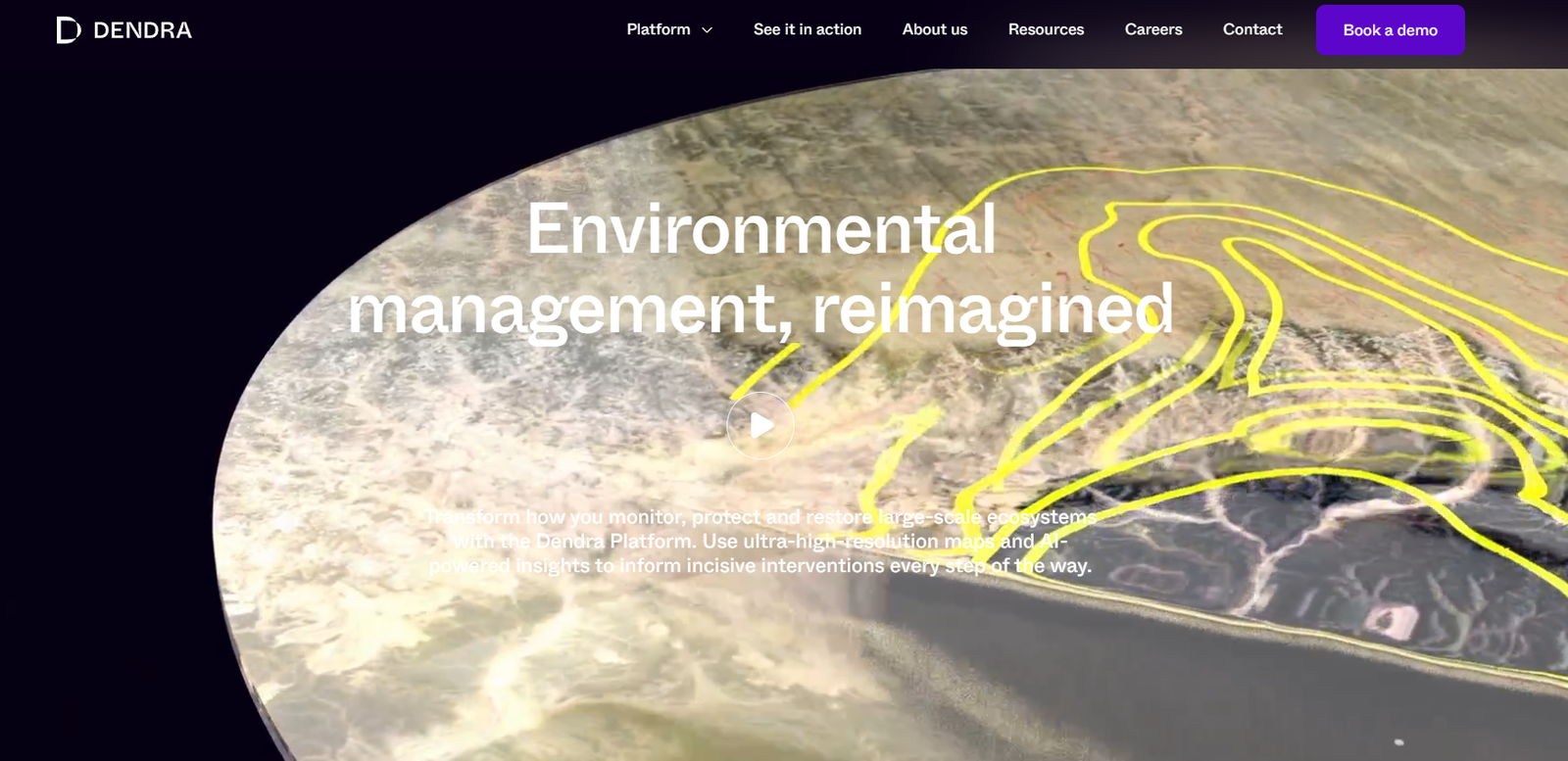
Dendra Systems is a technology-driven ecological restoration company that uses artificial intelligence, drones, and data analytics to restore natural ecosystems at scale. Headquartered in the UK and operating globally, Dendra focuses on reversing land degradation and biodiversity loss through precision seeding and intelligent monitoring.
By combining ecological expertise with advanced technology, Dendra Systems empowers landowners, industries, and governments to restore habitats more efficiently, cost-effectively, and at a scale never before possible. Their mission is to enable a biodiverse and climate-resilient planet by restoring nature with speed and accuracy.
The platform has been deployed across mining sites, infrastructure corridors, agriculture land, and conservation zones to accelerate recovery of native vegetation and meet environmental compliance goals.
Features
Dendra Systems offers a full-stack restoration technology platform that integrates AI, remote sensing, drone automation, and ecological modeling.
A key feature is drone-based seeding, which uses customized unmanned aerial vehicles (UAVs) to plant native seeds over degraded landscapes. This allows for large-scale, non-invasive restoration in remote or damaged areas.
The system includes AI-powered ecological monitoring, which uses high-resolution imagery and machine learning to assess land condition, vegetation health, species composition, and ecosystem changes over time.
Baseline ecological assessments are conducted using satellite data, aerial imagery, and field verification to identify restoration potential, track biodiversity indicators, and guide intervention planning.
The platform offers automated mapping and analysis, creating digital twins of degraded land and enabling accurate, repeatable interventions.
A centralized dashboard allows stakeholders to monitor project progress, measure ecological impact, and report against sustainability and regulatory goals.
Dendra’s platform is designed for scalability, with the ability to manage thousands of hectares across multiple geographies and climate zones.
It is aligned with key global frameworks including the UN Decade on Ecosystem Restoration, Science Based Targets for Nature (SBTN), and biodiversity net gain policies.
How It Works
Dendra Systems operates through a multi-stage process that begins with ecological assessment and ends with measurable biodiversity outcomes.
First, the team conducts a digital ecological survey, using drones, sensors, and AI to gather data about the land’s current condition—such as vegetation cover, erosion, species presence, and soil condition.
This data is fed into Dendra’s AI models to analyze degradation patterns and create restoration blueprints tailored to the specific biome and climate conditions.
Next, precision drone seeding is carried out using drones fitted with seed dispersal units, enabling the planting of native species at scale without disturbing the soil.
The platform continuously monitors restoration progress using aerial imagery and satellite feeds. AI algorithms detect changes in land cover, identify invasive species, and assess vegetation regrowth rates.
Stakeholders can track all metrics via the online restoration dashboard, which provides visualizations, KPIs, and compliance-ready reporting tools.
This closed-loop system ensures transparency, accountability, and ecological success over short and long-term project durations.
Use Cases
Dendra Systems serves a wide array of clients across environmental, industrial, and governmental sectors.
Mining companies use Dendra to restore post-extraction land and meet environmental reclamation requirements, helping reduce their ecological footprint.
Infrastructure developers apply Dendra’s technology to rehabilitate areas affected by construction activities such as roads, pipelines, or rail lines.
Agribusinesses and landowners use the platform to recover degraded farmland and support sustainable land use practices.
Conservation organizations and governments use Dendra for biodiversity restoration, reforestation projects, and national habitat recovery efforts.
Energy firms leverage the system to manage ecological risk around oil fields, wind farms, and solar installations.
Financial institutions interested in climate risk mitigation and biodiversity-linked investments also explore partnerships with Dendra to validate ecological outcomes.
Pricing
Dendra Systems does not list fixed pricing on its website, as its services are customized based on project scope, land size, ecosystem type, and client needs.
Key pricing factors include:
Area to be restored (in hectares)
Type and volume of drone seeding required
Complexity of baseline ecological analysis
Monitoring frequency and data resolution
Reporting requirements (regulatory or ESG-linked)
Location-specific logistics and climate conditions
Organizations interested in using Dendra Systems must contact the company for a custom quote and project assessment. The platform supports both one-time restoration projects and long-term ecological monitoring engagements.
Strengths
Dendra Systems’ biggest strength lies in its integration of AI and ecological science, offering scalable, data-driven restoration that is faster and more cost-effective than traditional manual methods.
Its drone seeding technology allows rapid replanting of large, hard-to-reach areas without disturbing the existing soil or requiring heavy equipment.
The platform’s analytics and dashboard provide transparent tracking of ecological outcomes, ideal for ESG reporting and regulatory compliance.
By focusing on native species and ecosystem-specific strategies, Dendra ensures ecological integrity and long-term biodiversity benefits.
The service aligns with global frameworks, helping clients meet climate, nature, and sustainability targets more effectively.
Its end-to-end solution—from assessment to seeding to monitoring—reduces complexity and provides confidence in restoration investments.
Drawbacks
As a technology-driven solution, Dendra requires specialized drones and equipment, which may not be available in all geographies without advance deployment planning.
There is no public pricing or off-the-shelf product, making it less accessible for small-scale or grassroots conservation initiatives.
The platform is optimized for land-based ecosystems, with less focus on freshwater or marine restoration.
Custom ecological modeling and species selection can add time and cost to project preparation.
Dendra may require on-site ecological support in some cases, depending on data quality or local regulatory requirements.
Comparison with Other Tools
Compared to traditional ecological restoration methods, Dendra offers significantly higher speed, scalability, and data transparency.
While drone mapping providers like DroneDeploy or Pix4D focus on imaging, Dendra offers a full-stack restoration platform, including seed delivery and AI-driven ecosystem management.
Unlike general climate data platforms such as Planet Labs or Google Earth Engine, Dendra is action-oriented, combining monitoring with direct ecological intervention.
Compared to tree planting platforms like Treeapp or One Tree Planted, Dendra focuses on ecosystem restoration, not just afforestation, and emphasizes native biodiversity.
It aligns with global restoration goals better than many offset marketplaces, by providing real-world ecological impact rather than just carbon metrics.
Customer Reviews and Testimonials
Dendra Systems has been recognized globally for its innovation in nature tech and restoration.
Clients highlight its ability to deliver high-accuracy monitoring, speed up restoration cycles, and generate compliance-ready ecological reporting.
Mining and infrastructure clients praise the platform for meeting regulatory land rehabilitation targets efficiently, while reducing manual labor and cost.
Environmental organizations value the system’s ability to track biodiversity outcomes and support science-based land recovery.
Dendra has been featured in major outlets such as BBC, CNBC, The Guardian, and World Economic Forum, where it was named a Technology Pioneer.
Conclusion
Dendra Systems is revolutionizing ecosystem restoration by bringing automation, intelligence, and scalability to a field that has long relied on manual labor and slow processes. Through drone-based seeding, AI-powered monitoring, and ecological modeling, Dendra enables faster, smarter, and more measurable recovery of degraded landscapes.
For industries and governments looking to meet biodiversity, carbon, and land restoration targets, Dendra Systems offers a powerful, science-backed solution that delivers real-world impact.


