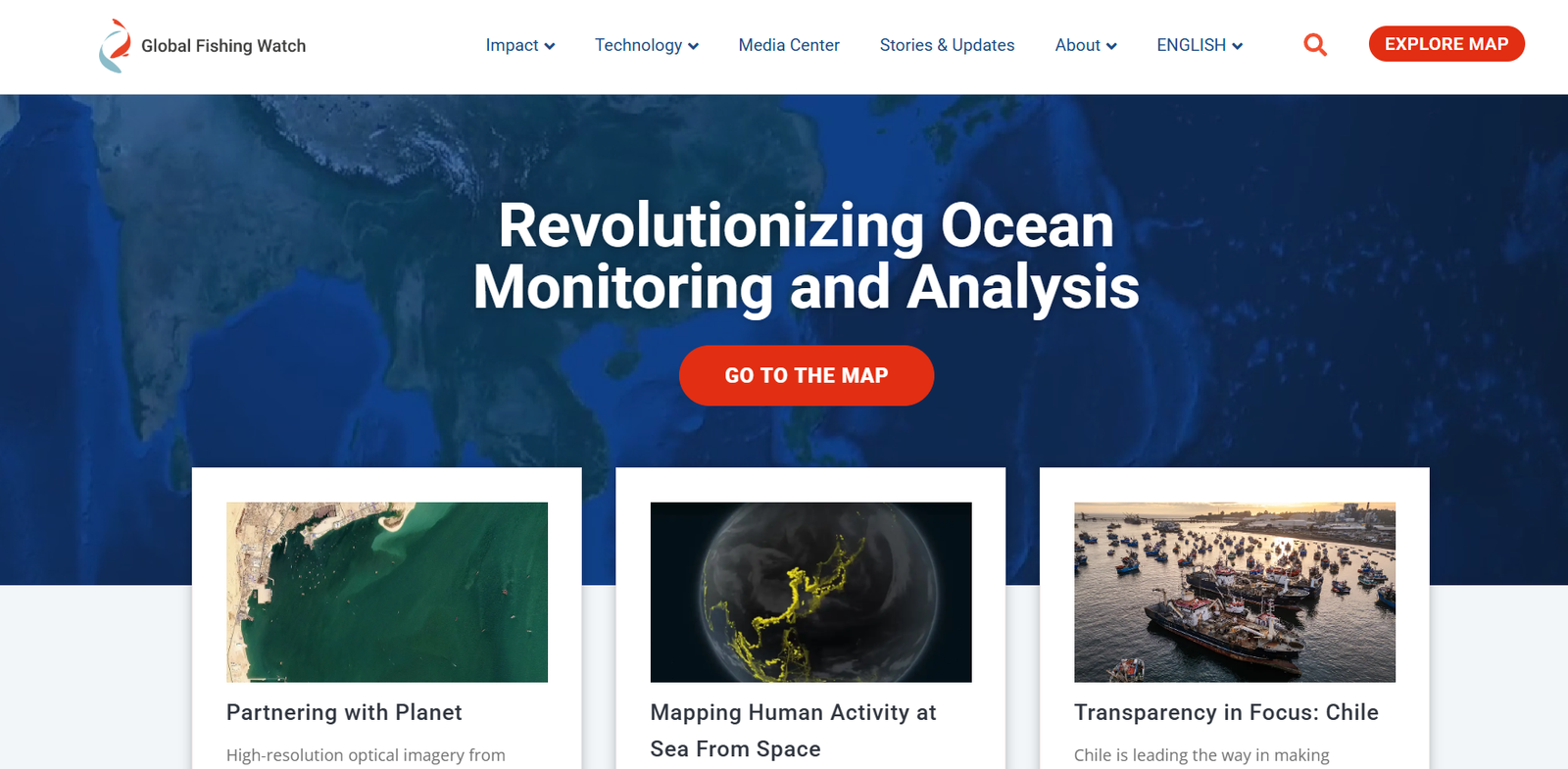
Global Fishing Watch is an international nonprofit organization that harnesses the power of satellite technology, artificial intelligence (AI), and big data to monitor and visualize global fishing activity in near real-time. Founded by Oceana, SkyTruth, and Google in 2016, the organization works to advance ocean governance, combat illegal, unreported, and unregulated (IUU) fishing, and promote transparency in marine activities.
By making fisheries data accessible and interactive, Global Fishing Watch enables governments, researchers, journalists, and the public to see and understand the movements and behaviors of commercial fishing vessels around the world. The platform empowers sustainable fisheries management and marine conservation through transparency, data-driven policy, and science.
Features:
Real-Time Vessel Tracking
Monitors global fishing vessel activity using Automatic Identification System (AIS) and satellite-based data.Interactive Global Map
A public, web-based platform showing vessel positions, fishing activity, port visits, and exclusive economic zones (EEZs).Fishing Effort Detection
AI algorithms distinguish between fishing and non-fishing activity based on vessel behavior and movement patterns.Carrier Vessel Monitoring
Tracks refrigerated cargo ships (reefers) to analyze transshipment patterns and identify potential IUU hotspots.Marine Protected Area (MPA) Oversight
Visualizes fishing activity inside and around MPAs to support enforcement and biodiversity protection.Data for Science and Policy
Offers datasets and APIs for researchers, policymakers, and NGOs to conduct marine studies and guide regulation.Port Visits and Vessel Identity
Provides insights into vessel ownership, registration, and port visit history, supporting due diligence and enforcement.Open Access Platform
Free and publicly accessible data platform designed for collaboration, transparency, and informed decision-making.
How It Works:
Satellite Data Collection
Global Fishing Watch uses data from AIS, VMS (Vessel Monitoring System), and satellite imagery to track vessels.AI & Behavior Modeling
Proprietary machine learning algorithms analyze vessel movement to detect likely fishing behavior (e.g., trawling, longlining).Geospatial Visualization
Vessel activity is plotted on an interactive map, showing routes, fishing events, and port stops.Data Layer Integration
Users can overlay layers such as EEZs, MPAs, bathymetry, and port boundaries for more detailed analysis.Public Access and Research Use
Researchers and regulators can download datasets, use APIs, and access visual tools to inform science and policy.
Use Cases:
Government Fisheries Management
Governments use Global Fishing Watch to monitor fishing in their EEZs, enforce MPA boundaries, and support licensing systems.IUU Fishing Detection
Track suspicious vessel activity, unlicensed transshipments, and non-reporting behavior to combat illegal fishing.Marine Conservation
NGOs and conservation groups use the data to protect biodiversity and support marine spatial planning.Academic Research
Scientists access datasets to study fishing pressure, migration impacts, ocean governance, and climate change.Journalism and Advocacy
Investigative journalists and advocacy groups use the platform for visual storytelling and to hold actors accountable.Supply Chain Transparency
Seafood companies and certification bodies monitor vessel behavior to ensure ethical and legal sourcing.
Pricing:
Global Fishing Watch is a nonprofit and provides its platform and core data services free of charge. This includes:
Public map access
Open datasets
Research collaborations
Educational tools
For specialized data partnerships or technical collaborations, organizations can inquire through the contact form:
https://globalfishingwatch.org/contact-us/
Strengths:
Free and Open Access
Provides an unprecedented level of transparency in global fishing activity at no cost to users.AI-Driven Analytics
Uses machine learning to deliver high-accuracy insights into vessel behavior and potential IUU activity.Global Coverage
Tracks vessels operating in international waters and national EEZs around the world.Cross-Sector Collaboration
Used by governments, NGOs, scientists, and journalists—bridging data with decision-making.Supports Law Enforcement
Assists countries in monitoring compliance and improving maritime surveillance without costly hardware.Tool for Sustainability
Directly supports UN Sustainable Development Goal 14 (Life Below Water) by enabling ocean accountability.
Drawbacks:
AIS Dependency
Main detection relies on vessels transmitting AIS signals, which can be switched off or manipulated.Not All Vessels Are Tracked
Smaller vessels or those in non-compliant fleets may operate without monitoring systems.Limited Enforcement Capabilities
While it provides the data, enforcement is up to national authorities, which may lack capacity or political will.Requires Technical Understanding
Advanced features (e.g., APIs, custom data layers) may require some geospatial or data science expertise.No Direct Mobile App
The platform is web-based and may not be optimized for all mobile users.
Comparison with Other Tools:
SkyTruth: Focuses on broader satellite environmental monitoring; Global Fishing Watch is dedicated to fishing and maritime behavior.
MarineTraffic: Commercial vessel tracking platform; Global Fishing Watch emphasizes transparency and is non-commercial.
Fish-i Africa: Regional enforcement initiative; Global Fishing Watch provides global datasets and broader analytics.
OceanMind: Offers enforcement-focused vessel monitoring; Global Fishing Watch provides open-access, research-grade datasets.
Customer Reviews and Testimonials:
Global Fishing Watch is widely recognized and trusted by:
Governments including Indonesia, Peru, Panama, and Costa Rica
NGOs like Oceana, Pew Charitable Trusts, and WWF
Academic Institutions such as Stanford University and University of California
Global Bodies like the UN Food and Agriculture Organization (FAO)
Praise from users and stakeholders includes:
“A game-changer in global marine transparency.”
“We rely on GFW data to monitor fishing efforts and implement effective MPA protection.”
“It brings accountability to areas of the ocean previously invisible to regulators and the public.”
The platform has been featured in major media outlets including The Guardian, BBC, National Geographic, and The New York Times.
Conclusion:
Global Fishing Watch is a powerful, free, and open platform revolutionizing how we monitor ocean activity. By leveraging satellite data and AI to expose fishing behaviors, it provides the transparency needed to drive better ocean governance, fight illegal fishing, and support sustainable seafood supply chains.
From policy makers to conservationists, the platform empowers a wide range of stakeholders to protect marine ecosystems, enhance accountability, and make data-informed decisions. For anyone working in or concerned with ocean sustainability, Global Fishing Watch is an indispensable tool.