
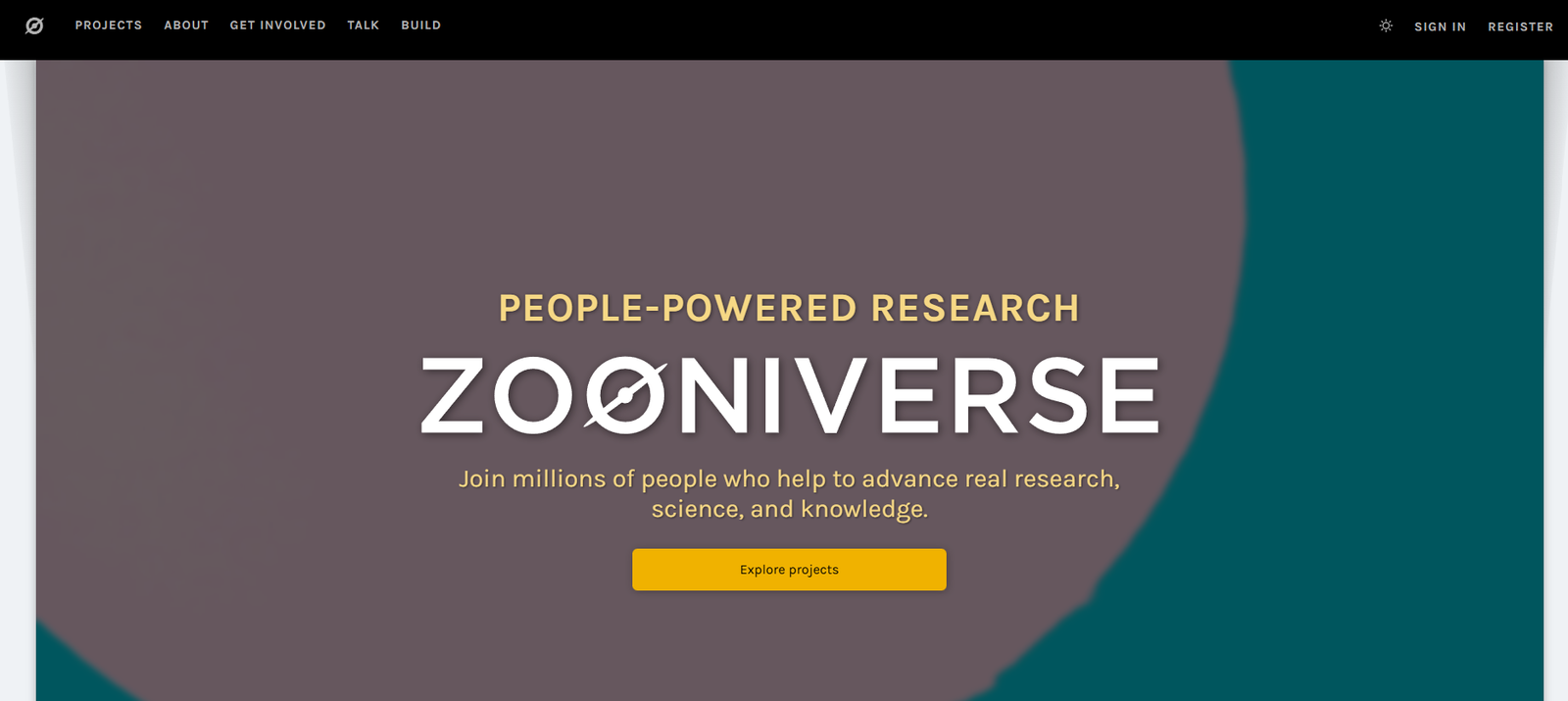
Zooniverse is the world’s largest and most popular citizen science platform, enabling people from all walks of life to contribute to real academic research. By crowdsourcing human insight, Zooniverse connects volunteers with research projects across disciplines such as astronomy, medicine, history, climate science, and ecology.
Developed by the Citizen Science Alliance and based at institutions including the University of Oxford and the Adler Planetarium, Zooniverse empowers researchers to analyze large datasets by engaging the public in data classification, pattern recognition, and annotation tasks that are difficult for algorithms to perform alone.
With millions of registered users and hundreds of active and retired projects, Zooniverse transforms the research process through inclusive, global participation.
Features
Zooniverse offers a suite of tools that enable collaborative, web-based research participation without requiring users to have scientific training.
A key feature is the Project Builder, which allows scientists and educators to create custom citizen science projects using a no-code interface. This tool enables the easy upload of data (such as images, videos, audio, or text) and the configuration of tasks like classification, annotation, or transcription.
Zooniverse supports interactive tutorials and training workflows so volunteers can learn how to contribute accurately. The platform guides users with examples and feedback to maintain high-quality data.
The Talk discussion forums enable volunteers and researchers to discuss findings, ask questions, and share interesting results. This builds a community of contributors around each project.
Zooniverse includes data export tools for researchers, enabling them to download structured results from volunteer contributions for analysis.
The platform is fully web-based and optimized for both desktop and mobile devices, making it accessible to users around the world without requiring software downloads.
Zooniverse also offers language support and accessibility features, promoting inclusivity and participation from a global and diverse community.
For research teams, the platform supports workflow branching and logic, advanced classification tools, and collaborative project management options.
How It Works
Zooniverse works by leveraging the collective efforts of volunteers to perform tasks that require human perception and judgment, which are often too complex or nuanced for AI or automated systems.
Researchers upload datasets and define tasks (such as identifying animals in camera trap images or transcribing historical documents).
Once a project is live, volunteers can participate by visiting the project page, completing a brief tutorial, and contributing classifications or annotations. Each task is typically completed by multiple users to ensure reliability through consensus.
The Zooniverse system aggregates responses and flags disagreements or unusual results for researcher review.
Researchers then export the data for scientific analysis, often combining human-labeled results with machine learning tools to improve accuracy and scale.
The open collaboration often results in co-authored papers, presentations, and significant academic findings powered by crowd participation.
Use Cases
Zooniverse serves a wide range of scientific and academic domains where large-scale data labeling or interpretation is required.
Astronomy projects, such as Galaxy Zoo, ask volunteers to classify galaxy shapes from telescope images, helping astronomers study cosmic structures.
Wildlife and ecology projects, such as Snapshot Serengeti or Penguin Watch, rely on volunteers to identify species in camera trap images or monitor animal behavior.
Medical research projects ask volunteers to annotate medical images, such as identifying cancer cells or analyzing heart scans.
Humanities projects involve tasks like transcribing handwritten manuscripts, annotating historical records, or decoding ancient texts.
Climate science and environmental monitoring projects include tasks like analyzing satellite imagery, identifying land use changes, or labeling flood damage in disaster zones.
Education and outreach programs use Zooniverse in classrooms to teach students about the scientific method, data analysis, and digital literacy.
Pricing
Zooniverse is completely free to use for both volunteers and researchers.
Creating a project, participating in research, and accessing the platform’s features do not require any payment.
The platform is funded by academic institutions, research grants, and donations through the Citizen Science Alliance and partner organizations.
While the core tools are open and free, large-scale projects that require dedicated support, customization, or integration with other research platforms may involve collaborative agreements with the Zooniverse team.
Researchers interested in building a project can do so via the Zooniverse Project Builder at no cost, subject to approval for public release.
Strengths
Zooniverse excels in engaging large, global audiences in meaningful scientific tasks, making it a powerful tool for accelerating research.
Its user-friendly interface and built-in tutorials make it accessible to anyone, regardless of academic background.
By distributing workloads across thousands of volunteers, Zooniverse enables rapid processing of massive datasets.
The platform is backed by trusted academic institutions, lending credibility and ensuring alignment with rigorous scientific standards.
Zooniverse is highly scalable and flexible, supporting a wide range of disciplines and research formats.
The built-in community features foster collaborative learning and discovery, increasing volunteer retention and engagement.
Drawbacks
While highly effective, Zooniverse does have some limitations.
Project success depends on volunteer engagement, which can vary depending on visibility, project appeal, and promotion efforts.
The platform may not be ideal for highly sensitive or confidential data, as projects are typically public and open to all.
Some types of tasks may be too complex to explain in a short tutorial, potentially reducing the accuracy of volunteer responses.
Because responses are crowdsourced, researchers must implement validation workflows and post-processing steps to ensure data quality.
Additionally, although the Project Builder is user-friendly, teams may require some technical guidance for advanced workflows or integrations.
Comparison with Other Tools
Zooniverse differs from traditional data annotation platforms like Labelbox or Scale AI, which are commercial, paid platforms used primarily for training AI models.
Unlike those tools, Zooniverse is focused on open, academic, and citizen-driven research, not commercial data labeling.
Compared to platforms like Crowdcrafting or Eyewire, Zooniverse offers broader project types, deeper community features, and a larger active user base.
Whereas tools like Amazon Mechanical Turk rely on paid workers, Zooniverse is volunteer-driven, making it ideal for non-profit or educational research.
Zooniverse also stands apart for its academic credibility and institutional support, having contributed to dozens of peer-reviewed publications.
Customer Reviews and Testimonials
Zooniverse is widely praised by researchers, educators, and volunteers for its impact on accelerating research and democratizing science.
According to testimonials on the website and academic case studies, researchers report significantly faster data processing times and valuable community engagement.
Volunteers express appreciation for the chance to contribute to real-world science, learn new skills, and connect with like-minded individuals.
Educational institutions incorporate Zooniverse into classrooms and outreach programs to teach data literacy, observational skills, and the importance of public science.
Dozens of scientific publications across fields like astronomy, biology, and history credit Zooniverse volunteers as co-authors or contributors.
Conclusion
Zooniverse is a transformative platform that bridges the gap between professional research and public participation. By enabling millions of volunteers to contribute to real scientific and scholarly projects, it enhances research capacity, democratizes discovery, and fosters global collaboration.
With its user-friendly interface, diverse project offerings, and strong academic backing, Zooniverse empowers both researchers and volunteers to be part of meaningful science.
Whether you’re a scientist looking to accelerate your study or a curious individual eager to contribute, Zooniverse makes collaborative research accessible and impactful.


