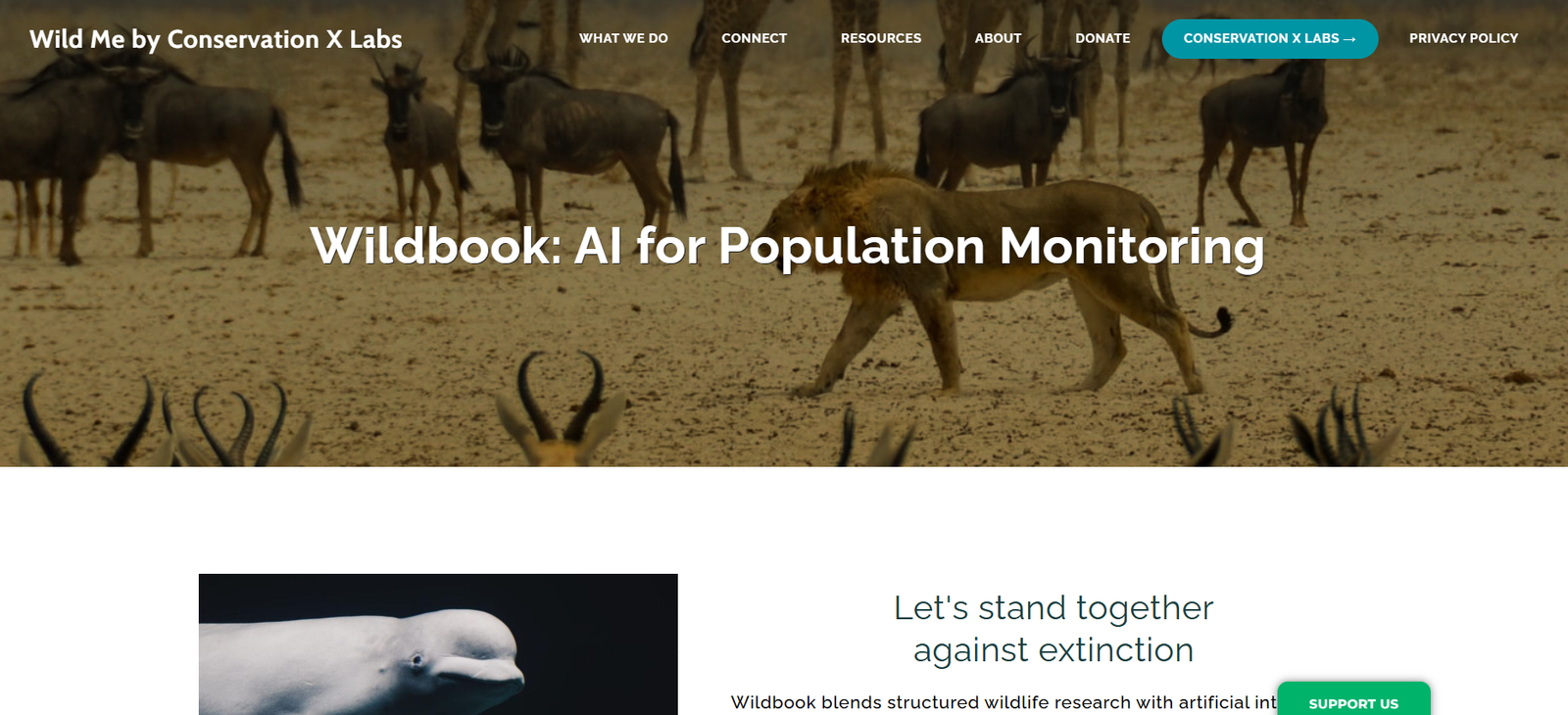
Wild Me is a nonprofit organization that leverages artificial intelligence (AI), machine learning, and computer vision to identify and track individual animals across wildlife populations. Designed specifically for conservation scientists and wildlife researchers, Wild Me enables non-invasive monitoring through photographs and videos collected by camera traps, tourists, drones, and researchers.
Wild Me powers platforms like Wildbook, an open-source, cloud-based software that recognizes individual animals using pattern and facial recognition algorithms. These platforms serve as centralized databases where researchers can store, analyze, and share wildlife data, transforming how animal populations are studied and protected.
By streamlining the process of identifying individual animals, Wild Me helps researchers spend less time managing data and more time focusing on conservation science.
Features:
AI-Powered Individual Identification
Wild Me’s tools use computer vision and pattern recognition to identify individual animals based on photos. These models work for species with unique patterns, such as whale sharks, zebras, giraffes, and leopards.Wildbook Platforms
Wild Me supports a growing number of species-specific Wildbooks (e.g., Whale Shark Wildbook, GiraffeSpotter, Flukebook), each tailored for a specific type of animal and research need.Crowdsourced Data Integration
The platform aggregates images from researchers, tourists, and citizen scientists, allowing public participation in scientific data collection.Cloud-Based Infrastructure
Data is stored securely online, with access controls and collaborative tools that support large-scale wildlife research projects.Automated Matching and Search
The system scans new images and automatically compares them to existing profiles to identify re-sightings of the same individual.Open-Source and Free to Use
Wild Me is committed to open science and provides its tools at no cost to users. The source code is freely available for developers and researchers.Data Visualization and Reporting
Built-in tools help users visualize population trends, migration patterns, and individual sightings over time.
How It Works:
Image Collection
Researchers, conservationists, or citizen scientists upload wildlife images or videos to the Wildbook platform. The images may come from fieldwork, camera traps, drones, or social media.Automatic Detection and Feature Extraction
The platform uses machine learning models to detect animals in the images and extract distinguishing features, such as patterns, scars, or fin shapes.Identification and Matching
The system compares new images to existing profiles in the database to determine if the animal has been seen before. If it matches, it logs a re-sighting; if not, a new individual profile is created.Data Management and Collaboration
All information is stored in a centralized, cloud-based database accessible by research teams worldwide. Access controls allow data sharing while respecting user privacy.Scientific Research and Conservation Action
The collected data supports research into population size, movement patterns, species health, and helps guide conservation interventions and policies.
Use Cases:
Marine Conservation
Platforms like Flukebook and MantaMatcher identify marine species such as whales, dolphins, and manta rays using fluke and fin images, aiding population monitoring.Big Cat Research
Tools like Wildbook for Carnivores help researchers identify individual cheetahs, leopards, and jaguars based on their unique spot patterns.Public Participation in Science
Tourists and divers contribute images via platforms like Sharkbook or Whale Shark Wildbook, making wildlife research more inclusive.Population and Migration Studies
Researchers use the platform to monitor long-term trends in animal populations, enabling insights into migration, habitat use, and social behavior.Non-Invasive Monitoring
By relying on imagery rather than tagging or collaring, Wild Me offers a humane, non-invasive way to track wildlife.Education and Outreach
Wildbook tools are also used in classrooms and community education programs to promote conservation awareness and citizen science.
Pricing:
Wild Me is a nonprofit organization, and all its core services are offered free of charge to users. This includes:
Access to Wildbook platforms
AI-powered animal identification
Data storage and management
Community support and documentation
There is no subscription or licensing fee for researchers, educators, or citizen scientists. Organizations with large-scale or customized needs may choose to contribute or partner with Wild Me for technical support or collaborative development.
Strengths:
AI-Powered and Non-Invasive: Automates wildlife identification without disturbing animals.
Open Source and Free: Makes advanced technology accessible to all users globally.
Collaborative Platform: Supports research collaboration across countries and disciplines.
Scalable and Species-Specific: Multiple Wildbooks designed for different species and ecosystems.
Crowdsourcing Enabled: Leverages public contributions for broader data collection.
Scientifically Validated: Peer-reviewed research supports the algorithms and methodologies.
Drawbacks:
Species Limitation: AI works best with species that have unique, visible markings. Uniform or unmarked species may not be supported.
Image Quality Dependency: Low-resolution or poorly angled images may hinder accurate identification.
Limited Offline Functionality: Wildbook platforms require internet access for uploads and identification.
Manual Validation Still Needed: AI matches may still need review from researchers for final verification.
Learning Curve: While intuitive, new users may need some orientation to use all platform features effectively.
Comparison with Other Tools:
Wildlife Insights: Focuses on camera trap images and AI for species-level classification, while Wild Me focuses on individual-level identification. Wildlife Insights is optimized for image volume; Wild Me specializes in identity tracking.
Rainforest Connection (RFCx): Uses acoustic monitoring for threat detection and species presence; Wild Me focuses on visual data from images or videos for individual recognition.
Zooniverse: Offers citizen science project hosting but lacks the integrated AI matching and individual tracking that Wild Me provides.
eMammal: Another camera trap platform with focus on species detection and project management; Wild Me offers more advanced computer vision models for identifying individual animals.
Customer Reviews and Testimonials:
Wild Me has received strong endorsements from conservationists, researchers, and wildlife organizations worldwide. Key highlights include:
Endorsement from National Geographic
Wild Me was featured as an innovative solution in AI-powered conservation technology.Used by Renowned Institutions
Organizations like the Wildlife Conservation Society, NOAA, and various universities actively use Wild Me tools in field research.Research Publications
Wildbook data and AI models have been cited in peer-reviewed journals, confirming its scientific reliability.User Testimonials
Researchers have praised Wild Me for reducing time spent manually identifying animals and improving population analysis efficiency.
A quote from a marine biologist using Flukebook:
“Flukebook has changed how we monitor whale populations. What used to take weeks of manual photo comparison is now done in minutes.”
Conclusion:
Wild Me stands at the forefront of wildlife research innovation, using artificial intelligence and open-source technology to transform how scientists identify and track animals. Its focus on non-invasive, image-based monitoring makes it an ideal tool for conservationists, researchers, educators, and citizen scientists alike.
With a mission rooted in collaboration, transparency, and accessibility, Wild Me empowers a global network of users to collect, analyze, and share wildlife data more efficiently. Whether studying whale sharks in the Pacific or cheetahs in Africa, users can rely on Wild Me to streamline research and strengthen conservation outcomes.
Wild Me represents more than just software—it is a movement towards smarter, scalable, and ethical wildlife monitoring powered by artificial intelligence.