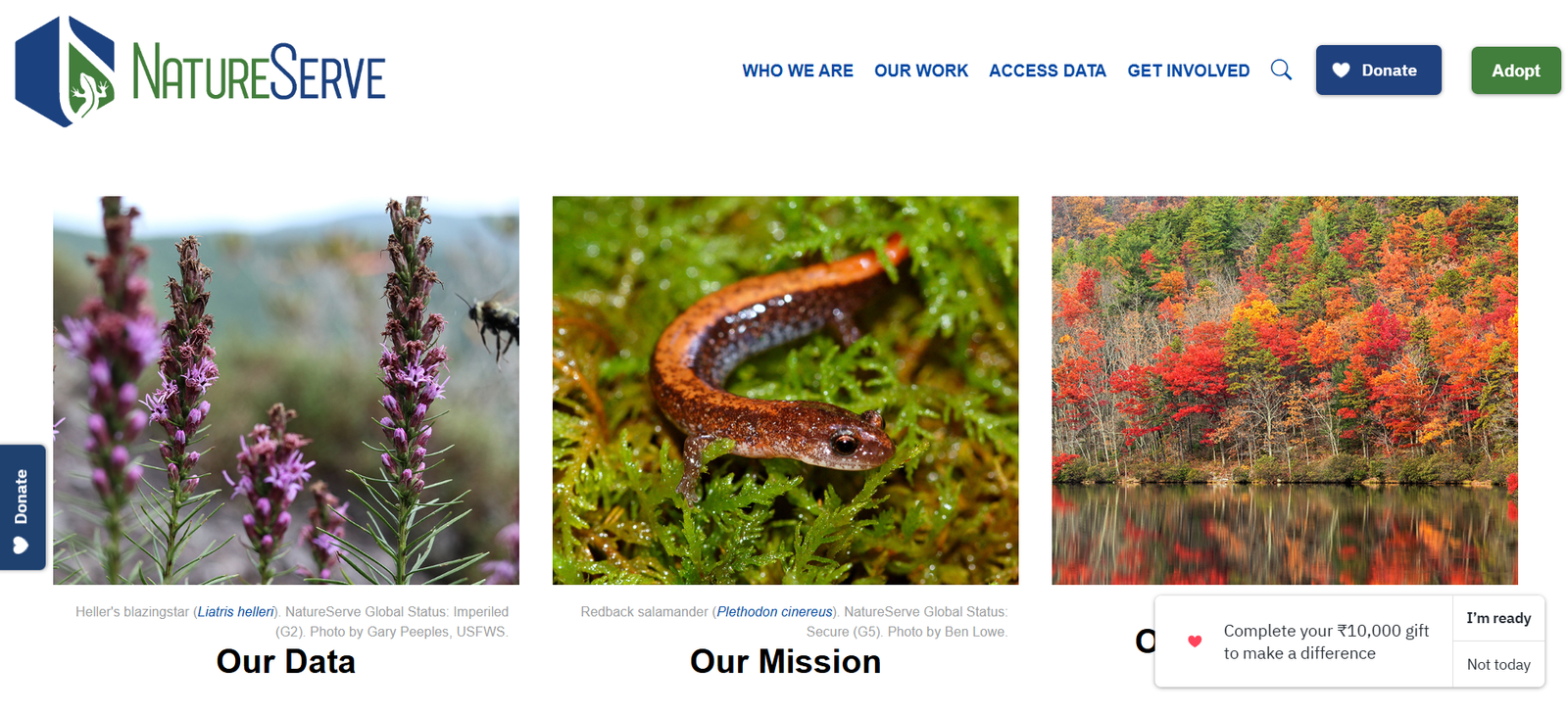
NatureServe is a leading nonprofit organization dedicated to providing high-quality biodiversity data and science-based tools for conservation decision-making. Based in the United States, NatureServe partners with a network of over 60 programs across the Americas, supporting scientists, governments, and conservationists with reliable information on species and ecosystems.
The organization’s mission is to guide biodiversity conservation by delivering the scientific knowledge needed to support effective actions. NatureServe maintains one of the most comprehensive databases on rare and endangered species, ecosystems, and natural heritage. Its data and methodologies are used to assess conservation status, prioritize habitat protection, and inform environmental policy at regional, national, and global scales.
NatureServe integrates field research, geographic information systems (GIS), and rigorous scientific standards to help organizations and governments safeguard biodiversity. It is widely recognized as a trusted source of biodiversity intelligence for land use planning, resource management, and ecological monitoring.
Features
Comprehensive Biodiversity Data
NatureServe offers an extensive database of more than 100,000 species and ecosystems across the Americas, focusing on rare, threatened, and endangered biodiversity.
Conservation Status Assessment
The organization applies a standardized ranking methodology to evaluate the extinction risk of species and the integrity of ecosystems at global, national, and subnational levels.
NatureServe Explorer
An online portal providing free access to conservation status, species distribution, and ecological information for researchers, educators, and decision-makers.
Map of Biodiversity Importance (MoBI)
A data-driven mapping tool that identifies critical areas for conserving imperiled species, supporting land use and conservation planning.
Environmental Review Tools
NatureServe offers environmental screening and permitting tools that help governments and developers assess the ecological impact of proposed projects.
Terrestrial and Marine Ecosystem Classification
NatureServe develops and maintains a consistent ecosystem classification system for use in conservation assessments and natural resource management.
Habitat Modeling and Mapping
Using remote sensing and spatial analysis, NatureServe builds detailed habitat models to predict species distribution and support proactive conservation.
Custom Data Services
Organizations and agencies can request customized datasets and analytical services for conservation planning, environmental compliance, or research.
Collaboration with Natural Heritage Programs
NatureServe partners with Natural Heritage Programs and Conservation Data Centres to ensure data accuracy and on-the-ground relevance across regions.
Scientific Publications and Methodologies
NatureServe contributes to peer-reviewed research, publishes conservation methodologies, and shares best practices in biodiversity monitoring.
How It Works
NatureServe functions by collecting, managing, and analyzing data about species and ecosystems. It works closely with regional Natural Heritage Programs and Conservation Data Centres, which conduct field surveys and compile biological data. This information is standardized and integrated into the central NatureServe database.
Each species or ecosystem is assessed using a robust methodology that considers factors such as population trends, range extent, and threats. These assessments result in conservation status ranks that indicate the level of risk to the species or habitat.
The data is then made accessible through tools like NatureServe Explorer, MoBI, and various GIS-compatible platforms. These tools allow conservation professionals, policy makers, and researchers to visualize biodiversity information, prioritize conservation areas, and evaluate ecological risks.
NatureServe also provides training, technical support, and consulting services to agencies and organizations seeking to apply its data and methods to real-world conservation challenges.
Use Cases
Government Planning
Federal, state, and local agencies use NatureServe data to inform land management, habitat protection, and policy development. It plays a critical role in Endangered Species Act assessments and environmental impact reviews.
Conservation Organizations
NGOs and land trusts use NatureServe’s tools to identify high-priority areas for land acquisition, restoration, and long-term biodiversity protection.
Scientific Research
Researchers rely on NatureServe’s species occurrence data, habitat models, and conservation status ranks for ecological studies and academic publications.
Environmental Consulting
Consultants and developers use NatureServe’s data and screening tools to assess environmental risks and meet regulatory compliance for infrastructure and resource projects.
Protected Area Design
NatureServe’s mapping tools help in designing protected areas that maximize biodiversity conservation and protect critical habitats.
Climate Adaptation
By modeling future scenarios, NatureServe supports efforts to predict how climate change will affect species distributions and ecosystem health.
Indigenous Land Stewardship
Tribes and Indigenous groups use NatureServe data to manage natural resources and protect culturally significant species and landscapes.
Education and Outreach
Educators and nature interpreters use NatureServe Explorer and other resources to teach about local biodiversity, conservation science, and ecosystem health.
Pricing
NatureServe offers a mix of free and paid services depending on user needs and data access level.
Free Access
Basic access to conservation data for thousands of species and ecosystems is available through NatureServe Explorer. This includes conservation status ranks, distribution maps, and ecological summaries.
Paid Services
Custom data services, consulting, GIS analysis, and access to certain datasets (especially at detailed spatial resolutions) may require fees. Pricing for these services depends on the scope of the project and is typically negotiated through direct contact with the NatureServe team.
Organizational Membership
Government agencies, research institutions, and conservation organizations may choose to become NatureServe Network members, which may include additional data access privileges, technical support, and collaboration opportunities.
NatureServe is a nonprofit and uses funding from grants, donations, and service contracts to support its mission, ensuring affordability and accessibility for conservation efforts.
Strengths
Authoritative and Peer-Reviewed Data
NatureServe is widely trusted for its scientifically validated and peer-reviewed methodologies, ensuring reliability for policy and research use.
Broad Geographic Coverage
Its network of heritage programs allows NatureServe to gather regionally specific data while maintaining national and global standards.
Strong Conservation Focus
Unlike generic biodiversity databases, NatureServe specifically emphasizes conservation, making it highly relevant for habitat and species protection.
Decision-Making Support Tools
The platform’s mapping and modeling tools are designed to guide practical decisions in land use, conservation, and development.
Data Integration and Customization
NatureServe offers services to integrate data into GIS systems or develop custom tools, making it suitable for a wide range of professional applications.
Collaboration with Agencies and NGOs
Its strong partnerships with public and nonprofit organizations increase the reach and impact of its data.
Transparency in Methodology
All ranking and assessment criteria are published, allowing users to understand and trust the basis of conservation status scores.
Drawbacks
Limited Public Interactivity
Unlike platforms such as iNaturalist, NatureServe is not designed for public participation or citizen science contributions.
Some Data Behind Paywalls
While much of the data is free, detailed or high-resolution datasets often require a fee, which may limit access for small nonprofits or independent researchers.
Focus on North America
Although NatureServe has partners across the Americas, its data is strongest for the United States and Canada. Coverage for other regions may be more limited.
Requires Technical Knowledge
To fully benefit from NatureServe’s tools, users often need GIS skills or a background in ecology or conservation science.
Update Frequency
Although rigorous, the update process for certain datasets can be slower than real-time platforms due to the validation process.
Comparison with Other Tools
Compared to platforms like iNaturalist or GBIF, NatureServe focuses more on expert-verified, high-quality data specifically for conservation purposes. iNaturalist emphasizes public participation and AI-powered species ID, while GBIF aggregates biodiversity data from many sources without applying conservation ranks.
NatureServe differs by offering structured conservation status rankings, mapping tools tailored for policy use, and ecosystem assessments rather than just species-level data. While GBIF is excellent for global data aggregation, NatureServe provides more detailed, curated information critical for conservation actions in North America.
Other platforms like the IUCN Red List provide global threat assessments but may lack detailed regional context or mapping tools that NatureServe offers. In summary, NatureServe is best for professional conservation planning and risk assessment, whereas other tools cater to broader public or academic audiences.
Customer Reviews and Testimonials
NatureServe is highly regarded by conservation professionals, government agencies, and scientific institutions. Testimonials from U.S. Fish and Wildlife Service staff, state wildlife agencies, and large NGOs frequently cite NatureServe as an essential partner in biodiversity conservation.
Professionals appreciate the platform’s data integrity, scientific rigor, and usability in real-world conservation planning. Academic researchers use NatureServe’s datasets for peer-reviewed publications, while land trusts use its mapping tools for prioritizing acquisitions and easements.
Conservation blogs and environmental policy journals often mention NatureServe when discussing best practices in biodiversity data use. Its long-standing credibility in the field makes it a trusted choice for evidence-based decision-making.
Conclusion
NatureServe is a foundational tool in the world of biodiversity conservation. With a commitment to science, data integrity, and actionable insights, it empowers governments, NGOs, researchers, and planners to make informed decisions for protecting the natural world.
Unlike general biodiversity platforms, NatureServe focuses on high-quality, peer-reviewed data tailored for conservation priorities. Its strength lies in turning biological data into conservation action through clear methodologies, interactive mapping tools, and trusted partnerships.
If your work involves safeguarding biodiversity or understanding ecological risk, NatureServe provides the depth, accuracy, and support necessary to turn knowledge into impact.