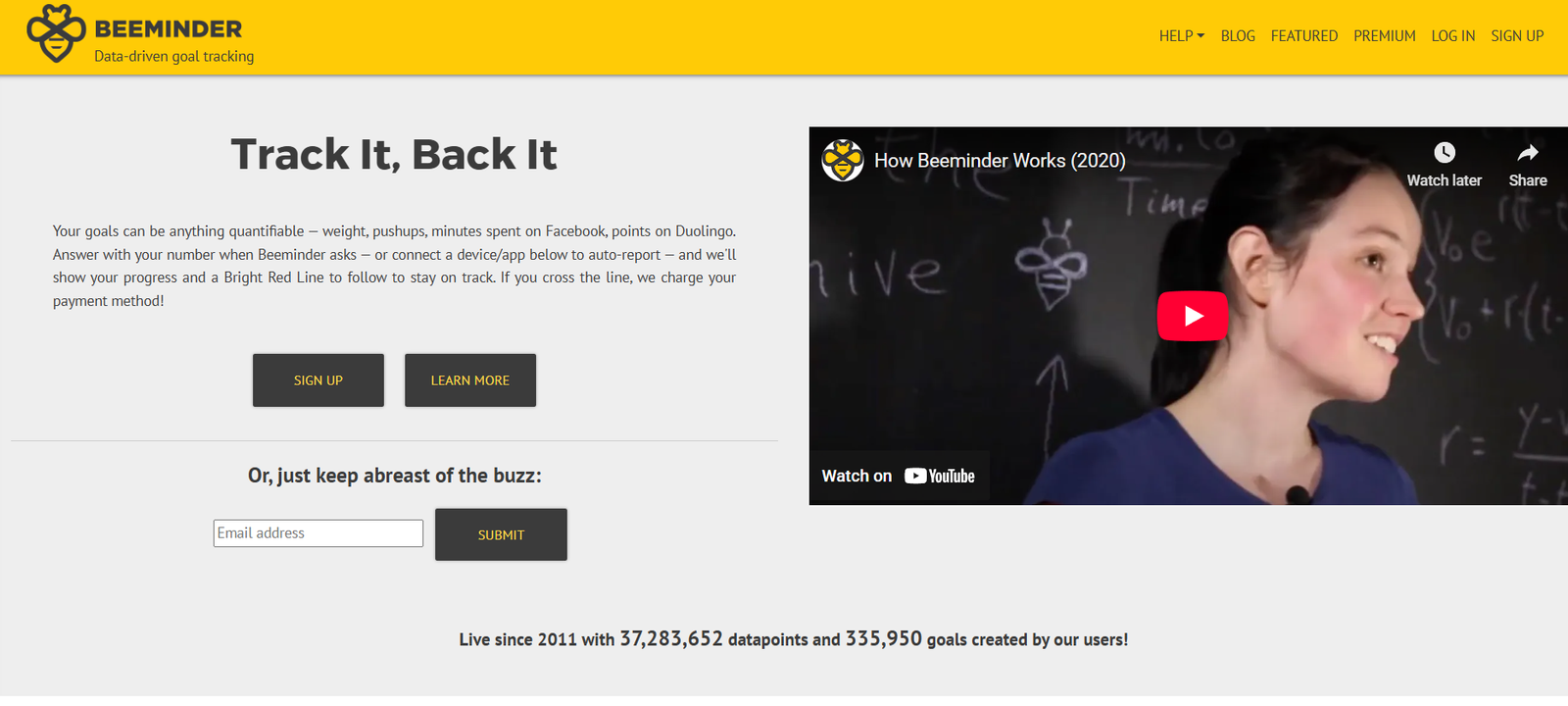
Beeminder is a unique goal-tracking tool that helps users stay accountable by putting money on the line. Unlike traditional habit trackers or productivity apps, Beeminder uses behavioral economics to motivate users. If you fail to stay on track, you pay a financial penalty.
Founded on the principle of commitment contracts, Beeminder is designed for people who are serious about following through on their goals. Whether you’re trying to write daily, lose weight, learn a new skill, or reduce screen time, Beeminder tracks your progress using real data—and holds you to your commitments.
It works by plotting your progress on a graph and keeping you inside a “Yellow Brick Road.” As long as you stay within that road, you’re on track. Fall off, and Beeminder charges your credit card. It’s a system that combines tracking, accountability, and real consequences to support lasting habit change.
Features
Beeminder offers a wide array of features that distinguish it from conventional goal-tracking apps.
The core of Beeminder is the commitment contract. Users set a measurable goal, choose a deadline, and commit to staying on track. If they derail—meaning they don’t meet the required progress—they pay a pre-agreed dollar amount.
Each goal is visualized on a dynamic graph, with the “Yellow Brick Road” showing the required trajectory for success. Progress is plotted in real time, and the graph adjusts as users report data or update goals.
Users can input data manually or connect Beeminder to a wide range of integrations and apps to automate data collection. Supported integrations include Fitbit, Apple Health, Duolingo, RescueTime, Todoist, Trello, GitHub, IFTTT, and many more.
Goals can be defined as weight loss, time spent, steps taken, tasks completed, or other quantifiable actions. Users can also set custom goals using units such as hours, words, calories, pages, or dollars.
Beeminder supports both cumulative goals (like reading 10 books in 3 months) and rate-based goals (like practicing piano 5 days per week).
Advanced goal types include do-less goals (like fewer social media hours) and weight loss goals with optional weigh-in verification.
Each goal can include a grace period, buffer zone, and fine-tuned pledge schedule. Users start with a free $0 pledge, which increases only if they derail.
How It Works
Beeminder operates on the basis of quantified self and behavioral commitment.
To start, users create an account and define a specific, measurable goal. They choose the metric (e.g., hours studied, words written, steps walked), set a target rate (e.g., 5 sessions per week), and determine the pledge amount they’re willing to risk.
Once the goal is created, a “Yellow Brick Road” is generated on a graph. This road represents the safe zone for your progress.
As long as you update your progress daily or maintain your pace through connected apps, you stay on track. If your progress veers off the road, you’re in the red zone and risk a charge.
Beeminder sends reminders and alerts when you’re approaching derailment, giving you time to catch up. If you miss your commitment, the system automatically charges your credit card according to the pledge.
Each time you derail, your pledge doubles (unless you manually cap it), increasing the financial stakes to help strengthen motivation.
Beeminder emphasizes honesty and transparency. It operates on a policy of “sting now, reward later,” making the consequences real and immediate.
Many users automate data entry via third-party tools, minimizing manual input and maintaining data accuracy.
Use Cases
Beeminder is used across a variety of personal and professional goals where consistency and accountability are critical.
Writers use Beeminder to track word counts and maintain daily writing goals for articles, books, or content marketing.
Fitness enthusiasts use it to track workouts, calorie intake, or weight loss progress, syncing with wearables like Fitbit or Apple Health.
Students and learners use Beeminder to log study time, complete assignments, or practice skills on platforms like Duolingo or Anki.
Freelancers and remote workers use Beeminder to manage productivity through integrations with tools like RescueTime, GitHub, and Todoist.
Entrepreneurs use it to build habits, track daily outreach, follow up with clients, or execute marketing actions consistently.
People looking to break bad habits also find Beeminder effective, especially with “do-less” goals such as reducing social media usage or unnecessary spending.
Pricing
As of December 2025, Beeminder offers both free and premium options.
The Free Plan includes:
Unlimited goals
Data input
Graph visualization
Basic integrations
Pledge system (pay only if you derail)
Beeminder only charges users if they derail a goal. The initial pledge is $0, and it only increases after the first failure.
The Premium Plans are optional and designed for users who want additional features and automation.
Infinibee at $4/month includes:
Unlimited short breaks on goals
Auto-confirmation of data entries
Bee Plus at $8/month adds:
Custom reminders
Graph resets
Scheduling for goal restarts
Bee Premium at $16/month includes:
Unlimited goal modification
Unlimited short breaks
Weekends off option
Higher API usage
Beemium at $32/month is the highest tier and includes everything above, plus:
Priority support
Fully unlimited customization
Beta feature access
Free derailments (no charges)
All premium plans can be billed monthly or annually, and Beeminder still requires users to commit to their goals with monetary pledges, even under a subscription.
Strengths
Beeminder is uniquely effective because it leverages loss aversion, a well-established principle in behavioral psychology.
It turns abstract intentions into measurable, trackable commitments with immediate consequences, increasing follow-through.
The visual graph and Yellow Brick Road offer clear accountability and progress tracking.
A wide array of integrations allows seamless syncing of real-world behavior with Beeminder goals, removing the burden of manual updates.
The incremental pledge increase prevents heavy financial penalties up front while maintaining motivation over time.
It supports a wide range of goals, from fitness and productivity to learning and mental health.
Its open API and developer-friendly environment allow for custom integrations and workflows.
Drawbacks
Beeminder’s interface and user experience may feel outdated or technical compared to newer habit trackers.
New users may find the concept of financial penalties intimidating or discouraging, especially if they are risk-averse.
While the flexibility of goal types is powerful, it also makes the setup process more complex for beginners.
There are limited in-app tutorials, so understanding how to structure goals correctly may require trial and error.
The model assumes users are honest with their self-reported data, though integrations help reduce this risk.
Beeminder lacks some of the visual polish, gamification, and social features that other habit-tracking apps offer.
Comparison with Other Tools
Beeminder is often compared with productivity and habit-tracking apps like Habitica, StickK, Goalify, and Streaks.
Compared to Habitica, Beeminder is more focused on data accuracy and real-world consequences, while Habitica uses gamification and rewards.
StickK also uses commitment contracts but is less data-driven and offers fewer integrations and automation options.
Streaks emphasizes habit building with visual streaks and reminders but lacks the accountability mechanisms of Beeminder.
Goalify offers coaching features and app integrations, but it does not use financial penalties as a motivator.
Beeminder’s strength is its commitment model, which uniquely combines behavioral economics, data science, and automation.
Customer Reviews and Testimonials
Beeminder has a loyal base of productivity-minded users who appreciate its honesty-based model and effectiveness.
Users often report significant improvements in consistency, especially for long-term goals like writing, coding, or health tracking.
Many users praise Beeminder for being the only tool that truly holds them accountable and keeps them on track.
Positive reviews highlight the integrations with data sources and the ability to automate goal tracking.
Some users say the potential for monetary loss helps them break procrastination habits more effectively than reminders or motivational quotes.
Criticism usually centers on the outdated UI, the complexity of advanced goal setup, and the pressure of financial stakes.
Despite this, most users who stick with Beeminder describe it as a life-changing tool for habit formation and goal achievement.
Conclusion
Beeminder is not your typical productivity app. It offers a unique, no-nonsense approach to habit tracking and goal management by putting money on the line.
Through data visualization, automatic tracking, and financial commitment, Beeminder provides a structure that helps users follow through where other systems fail.
While it may not be suited for those who dislike external pressure or financial stakes, it is a highly effective tool for people who need firm accountability to stay consistent.
For serious goal-setters and data-driven individuals, Beeminder is a powerful ally in the pursuit of better habits and long-term success.