
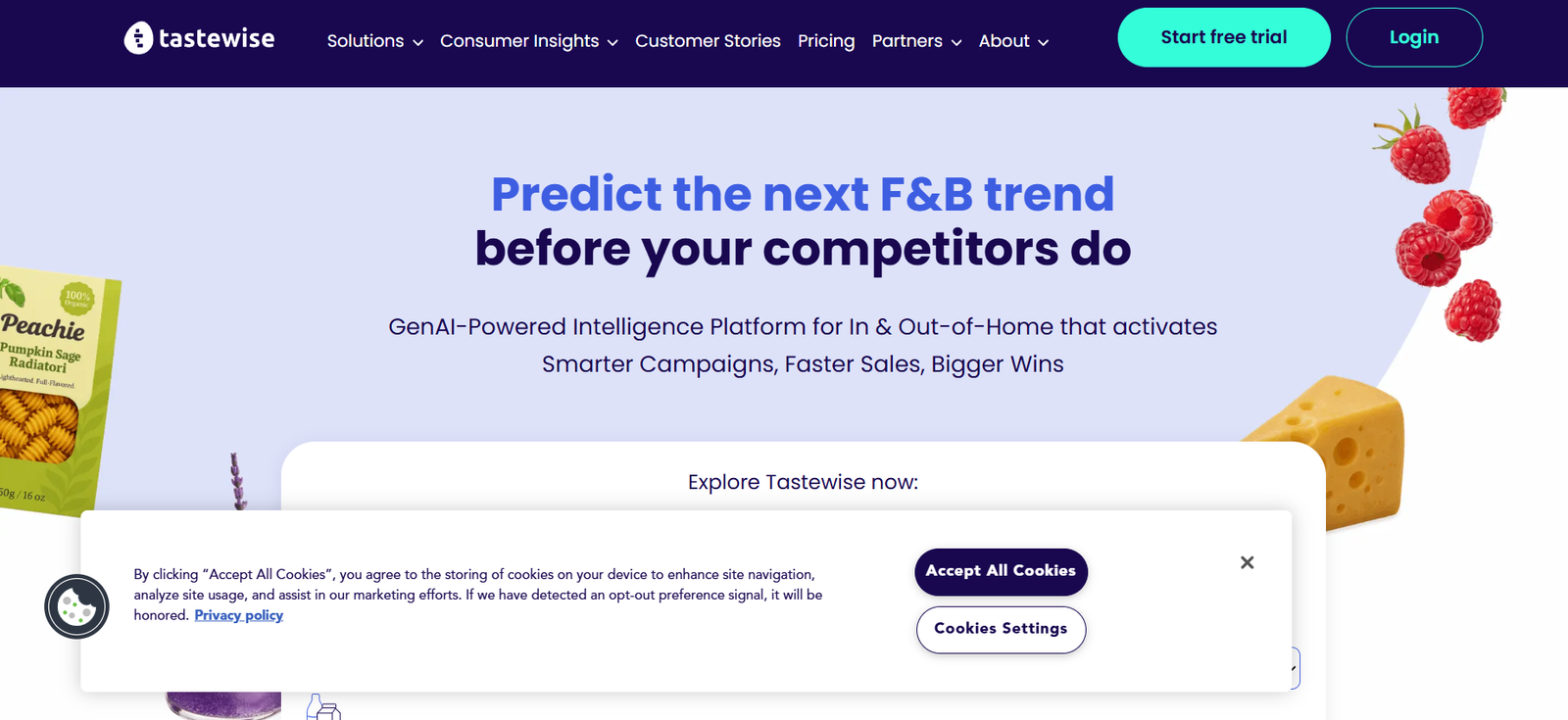
Tastewise is an AI-powered consumer insights platform designed specifically for the food and beverage industry. It helps brands, manufacturers, restaurants, and innovators understand consumer behaviors, uncover emerging trends, and create data-backed product and marketing strategies.
The platform analyzes billions of data points across online recipes, social media, restaurant menus, and consumer searches to deliver real-time insights. Unlike traditional market research, Tastewise uses machine learning and natural language processing to identify why consumers choose specific ingredients, flavors, or health claims.
Founded in 2017, Tastewise serves clients ranging from global CPG companies to niche food startups, providing them with the tools to stay ahead of market shifts and consumer demands.
Features of Tastewise
One of the most powerful features of Tastewise is its real-time food trend discovery. Users can search for any ingredient, dish, diet, or health claim and instantly see how its popularity has evolved, what’s driving the interest, and what demographics are engaging with it.
The platform offers detailed consumer behavior insights. This includes why people choose certain foods, the contexts in which they’re consumed, and which motivations—such as health, convenience, or sustainability—are behind the choices.
Tastewise provides trend forecasting by predicting what food trends are likely to grow or decline. This helps R&D and innovation teams prioritize investments based on future market demand rather than just historical performance.
The platform includes competitor benchmarking tools, allowing businesses to understand how their offerings or campaigns compare with industry peers. Users can also explore menu data from restaurants worldwide to identify gaps and opportunities in foodservice offerings.
Tastewise also supports campaign ideation and content strategy by identifying themes and keywords that resonate with specific audiences. Marketers can tailor messaging based on what’s currently relevant to consumers in real-time.
With Tastewise’s collaboration features, teams can save insights, build reports, and share dashboards with internal or external stakeholders. This facilitates faster decision-making across departments.
How Tastewise Works
Tastewise aggregates and analyzes billions of data points from public and proprietary sources, including online recipes, Instagram posts, Pinterest pins, restaurant menus, TikTok videos, and grocery product data. It uses natural language processing and AI algorithms to make sense of these unstructured data sources.
Users interact with the platform through a search-driven interface. They can type in any keyword or topic—such as “turmeric,” “gluten-free,” or “immune health”—and receive detailed analytics on how that topic is trending.
The system breaks down insights by motivation (such as health or indulgence), time (weekly, monthly, yearly trends), geography, and audience demographics. Users can also explore related concepts, such as complementary ingredients or emerging flavor pairings.
Tastewise also provides alerting and automation. Users can set alerts for when a specific trend spikes, helping teams act fast when new consumer behaviors emerge.
Behind the scenes, the platform continuously updates its data, ensuring users are working with the most recent and relevant information available.
Use Cases for Tastewise
Food and beverage companies use Tastewise to guide product development. By identifying which ingredients or claims are gaining popularity, R&D teams can formulate products that align with real consumer needs.
Marketing teams leverage Tastewise to optimize content strategy and campaigns. By understanding the motivations behind food choices, they can create messaging that resonates with target audiences, such as highlighting the functional benefits of ingredients or aligning with lifestyle trends.
Retailers and category managers use Tastewise to plan product assortments and adjust merchandising strategies. The platform helps identify gaps in offerings and anticipate consumer demand across locations.
Restaurants use Tastewise to design data-driven menus. By analyzing competitor offerings and trending dishes, chefs and foodservice operators can differentiate their menus and appeal to local tastes.
Foodservice suppliers and distributors rely on Tastewise to provide insights to their clients. With access to detailed trend data, they can advise restaurants and retail customers on how to adjust their offerings for better performance.
Innovation teams benefit from predictive analytics that help prioritize the most promising trends. This shortens the time-to-market and reduces the risk of failed launches.
Pricing of Tastewise
Tastewise offers custom pricing based on business needs, user seats, and data access requirements. The company does not list public pricing on its website, instead offering demos and consultations to create personalized plans.
Typically, Tastewise offers pricing tiers based on company size and use case. Enterprise clients with multiple users and departments may require broader access, while smaller teams may opt for limited feature sets.
Potential users are encouraged to book a demo through the official site to explore pricing options and determine the appropriate plan for their organization.
Tastewise also occasionally offers trials or proof-of-concept engagements for companies evaluating the platform before full implementation.
Strengths of Tastewise
Tastewise delivers real-time, AI-powered insights that are highly actionable for food and beverage companies. It significantly reduces the time required for market research and eliminates guesswork in product innovation and marketing.
Its ability to analyze consumer motivations—why people eat what they eat—is a unique feature that goes beyond surface-level trend tracking.
The platform is user-friendly, with visual dashboards and intuitive search capabilities that make it accessible to cross-functional teams, not just data analysts.
The continuous updating of data ensures relevance and accuracy, and the ability to monitor changes over time supports long-term strategic planning.
Tastewise’s global data sources and multilingual capabilities make it useful for companies operating in multiple regions or planning international expansion.
Drawbacks of Tastewise
One of the main drawbacks is the lack of transparent pricing on the website, which can be a barrier for startups or smaller food companies with limited budgets.
While powerful, the platform may require onboarding or training to fully understand its capabilities, particularly for teams not experienced in data analytics.
Some users may find the depth of data overwhelming at first, especially if they are used to traditional market research methods. Proper support and guided setup are important for getting full value from the platform.
Currently, there is limited community support or third-party resources for learning beyond the official materials provided by Tastewise.
Comparison with Other Tools
Tastewise differs from traditional food trend research services by offering real-time, AI-powered insights instead of relying on surveys or focus groups. It competes with platforms like Mintel, SPINS, and Innova Market Insights.
Compared to Mintel, which relies heavily on analyst reports and structured research, Tastewise provides dynamic and real-time trend discovery. This makes it more agile for innovation teams who need to move quickly.
SPINS focuses primarily on retail sales data in the natural and organic product sector. While valuable, SPINS lacks the broader consumer behavior data and social trend analysis that Tastewise provides.
Innova Market Insights delivers global food trend reports and databases but does not offer the same interactive and AI-driven interface for self-service analysis as Tastewise.
Overall, Tastewise stands out for its real-time data, predictive insights, and AI-driven approach to understanding consumer behavior at scale.
Customer Reviews and Testimonials
Tastewise is used by leading global food brands, including Nestlé, PepsiCo, Campbell’s, and Givaudan. These companies use the platform to improve product innovation, identify emerging trends, and optimize marketing strategies.
Users frequently mention how the platform helps them move from reactive to proactive decision-making. By knowing which trends are growing and why, teams can act faster and with more confidence.
Customer testimonials highlight the platform’s accuracy in predicting food trends and the value it brings in identifying gaps in the market. Marketers appreciate the contextual insights that go beyond keywords to understand what drives consumer interest.
Innovation managers and R&D professionals note the significant reduction in time spent on manual research and the increased success rate of new product launches when guided by Tastewise data.
Conclusion: Is Tastewise Worth It?
Tastewise is a powerful tool for any food and beverage company looking to drive innovation, stay competitive, and meet consumer expectations. Its AI-driven approach to food intelligence provides a faster, more detailed, and more predictive understanding of market trends than traditional research methods.
While it may not be the right fit for every small business due to pricing, the value it delivers for mid-sized to large companies is substantial. Its ability to uncover what consumers want, why they want it, and what’s coming next makes it an essential platform for future-focused food brands.
For teams involved in product development, marketing, retail planning, or foodservice strategy, Tastewise offers a modern solution to an age-old challenge—understanding the ever-changing tastes of consumers.


