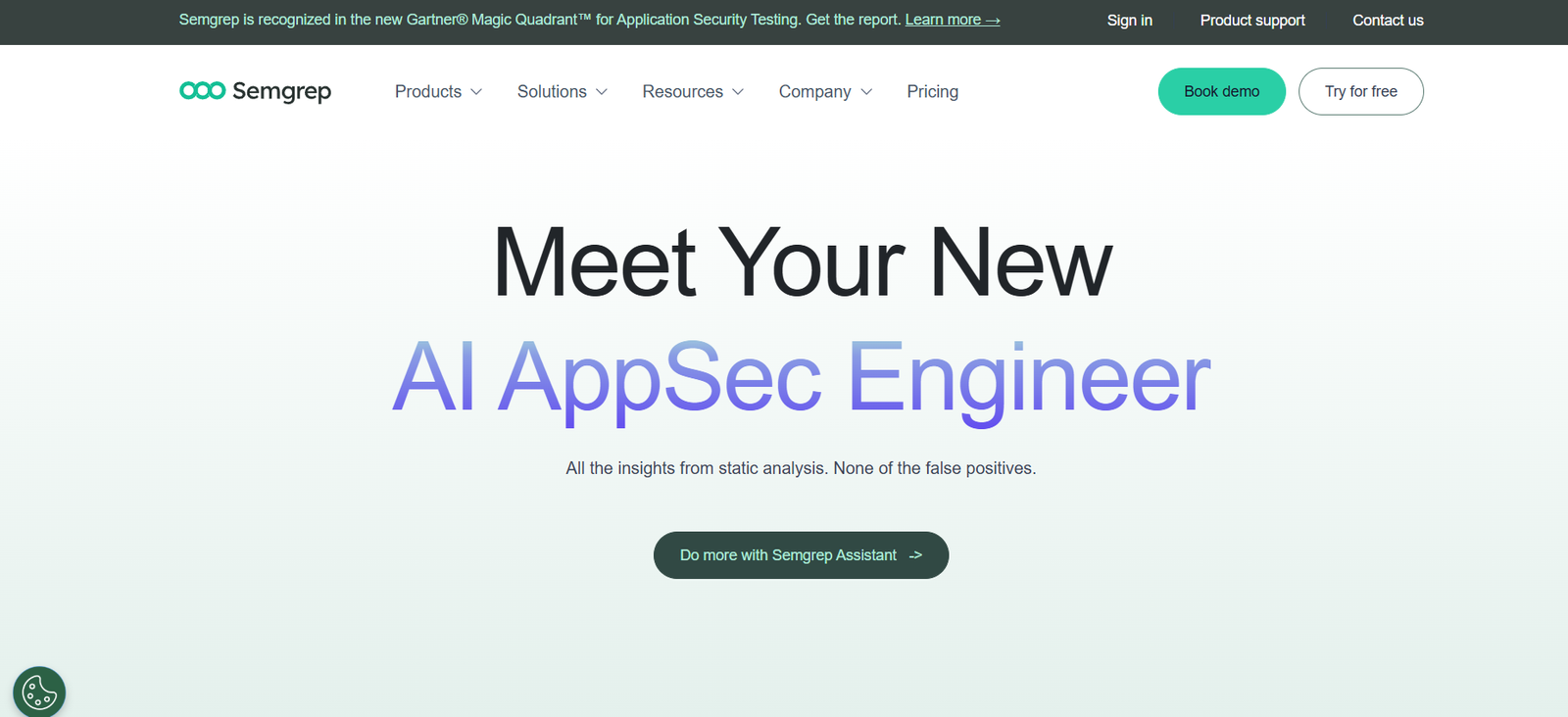
Semgrep is a modern static code analysis platform designed to help security teams and developers identify vulnerabilities, enforce code standards, and ship secure code faster. Unlike traditional static analysis tools that are complex and slow, Semgrep offers lightweight, developer-friendly scanning with high customization capabilities. It allows users to write custom rules or use community-developed rule sets to detect security flaws, bugs, and deviations from best practices across multiple programming languages. Semgrep integrates directly into the CI/CD pipeline, enabling real-time feedback and security checks early in the development process.
Features
Semgrep combines simplicity and power in its approach to static analysis. Key features include:
Custom Rule Engine: Write or customize rules using Semgrep’s readable syntax for precise, context-aware scanning.
Out-of-the-Box Rules: Access hundreds of ready-to-use, community and vendor-curated rules across security, code quality, and style.
CI/CD Integration: Seamlessly integrate with GitHub Actions, GitLab CI, CircleCI, and other pipelines.
Language Support: Works across major languages including Python, JavaScript, Go, Java, C, C++, Ruby, and more.
Policy-as-Code: Define and enforce security policies through code-based rule sets.
Open Source Core: The Semgrep engine is open source, encouraging transparency and customization.
Cloud Platform (Semgrep Cloud): Manage scans at scale, view dashboards, triage findings, and collaborate across teams.
Secrets and SAST Scanning: Identify hardcoded credentials and common security vulnerabilities like SQL injection, XSS, and insecure deserialization.
These features empower both AppSec teams and developers to catch issues early and enforce secure coding practices at scale.
How It Works
Semgrep analyzes code by pattern-matching abstract syntax trees (ASTs), allowing users to define search patterns that resemble the source code they’re targeting. Users can install Semgrep locally or configure it to run in CI/CD pipelines. The tool scans code files, matches patterns based on rules, and reports findings with contextual information. Semgrep Cloud extends these capabilities with centralized rule management, alert triaging, project-level dashboards, and team collaboration features. Findings can be filtered, assigned, and tracked over time, helping organizations build a repeatable and scalable AppSec program.
Use Cases
Semgrep is used by software engineering teams, security teams, DevSecOps practitioners, and open-source maintainers. A development team may use Semgrep to catch insecure coding patterns before code is merged. Security engineers use it to implement policy-as-code and continuously scan repositories for new vulnerabilities. In regulated industries, compliance teams leverage Semgrep to enforce internal coding standards or verify specific framework usage. Open-source maintainers adopt Semgrep to safeguard contributions and maintain code quality. It is especially valuable for shift-left security initiatives that aim to embed security earlier in the software development lifecycle.
Pricing
Semgrep offers a range of pricing plans, starting with a free tier that includes access to open-source rules, CLI scanning, and basic CI/CD integration. Paid tiers include:
Team Plan: Adds advanced features such as scan scheduling, findings triage, Slack integrations, and priority support.
Enterprise Plan: Offers SSO, RBAC, custom SLAs, self-hosting options, and enhanced scalability.
Pricing is based on the number of developers and repositories scanned. Full pricing details are available upon request, and users can start with the free plan to evaluate the platform before scaling up.
Strengths
Semgrep’s main strength is its balance between ease of use and powerful customization. Its lightweight setup and readable rule syntax make it accessible for developers, while its flexibility and scalability make it suitable for enterprise security teams. The open-source nature of the engine builds community trust and encourages shared innovation. Semgrep’s ability to integrate into the developer workflow—without slowing it down—is a key differentiator. The platform supports both security and quality use cases, helping teams enforce coding standards and detect flaws with one tool.
Drawbacks
One limitation of Semgrep is that, as a pattern-matching tool, it may produce false positives or miss complex issues that require data flow or control flow analysis. While the rule engine is powerful, creating advanced rules may require some initial learning. The full-featured cloud platform, while robust, is only available on paid plans. Additionally, compared to heavyweight SAST tools that offer full taint analysis and coverage of compiled languages, Semgrep may be more limited in deep analysis for certain enterprise use cases.
Comparison with Other Tools
Compared to traditional static analysis tools like Fortify, Veracode, or Checkmarx, Semgrep offers a faster, more developer-friendly experience. While legacy tools can be slow and hard to configure, Semgrep prioritizes speed, simplicity, and CI/CD compatibility. Versus open-source tools like SonarQube, Semgrep is more focused on security and is easier to customize via its rule syntax. Tools like CodeQL from GitHub offer deep query-based analysis but are less intuitive for beginner users. Semgrep fills the gap between simple linters and complex SAST systems, making it ideal for modern engineering teams prioritizing speed and security.
Customer Reviews and Testimonials
Semgrep is widely praised by developers and security teams for its simplicity, flexibility, and speed. Users report faster time-to-value compared to traditional SAST tools. Reviews highlight how easy it is to write and modify rules, as well as how well Semgrep integrates into CI/CD pipelines without slowing down builds. Many teams appreciate the transparency of the open-source engine and the active support from the Semgrep community. Case studies show improved code security, reduced bug introduction, and better collaboration between developers and security teams after adopting Semgrep.
Conclusion
Semgrep is a powerful, developer-centric static analysis platform designed to improve code security, enforce best practices, and support scalable AppSec programs. With customizable rules, open-source transparency, and seamless CI/CD integration, Semgrep empowers developers to take ownership of secure coding without slowing down their workflow. Whether you’re a security engineer building policies or a developer catching bugs early, Semgrep offers a modern alternative to outdated static analysis tools. For teams embracing DevSecOps and shift-left security, Semgrep is a practical, efficient, and trusted choice.