
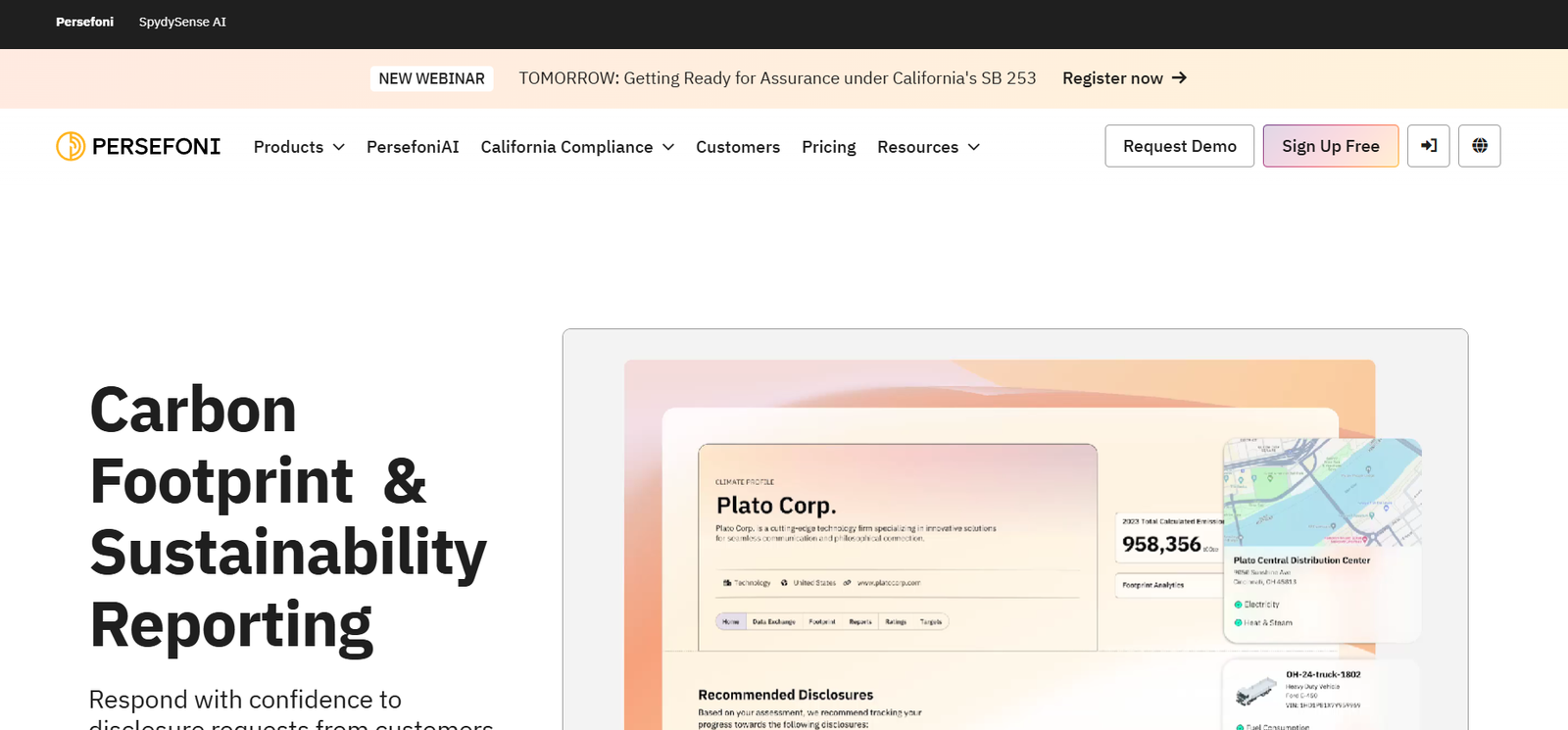
Persefoni is a climate management and carbon accounting software platform designed to help businesses, financial institutions, and government agencies measure, manage, and disclose their carbon footprints. With the growing need for transparency in Environmental, Social, and Governance (ESG) practices, Persefoni enables organizations to align with global climate reporting standards like the GHG Protocol, SEC Climate Rule, and TCFD. The platform acts as a centralized system of record for carbon data, supporting automated data input, real-time emissions calculations, and audit-ready reporting. It is tailored for enterprises seeking to navigate the complex landscape of sustainability compliance and decarbonization strategies.
Features
Persefoni offers an extensive suite of features tailored to simplify climate data management and reporting. Its primary features include automated emissions calculations across Scopes 1, 2, and 3, powered by a deep library of emission factors. The platform supports alignment with global regulatory frameworks such as the SEC’s proposed climate disclosure rule, the EU’s CSRD, and the ISSB standards. Users can create detailed emissions reports, manage emissions by business unit or supplier, and model future emissions using scenario analysis tools. Integration capabilities allow data to be pulled from ERP systems, utility providers, and internal databases. An AI-powered assistant, ClimateGPT, helps users query data and generate reports efficiently. It also supports audit-grade data lineage for compliance and investor scrutiny.
How It Works
Persefoni’s platform starts by ingesting operational and financial data from a business’s internal systems and external vendors. Once integrated, the system applies emissions factors to calculate the greenhouse gas emissions associated with various business activities. These calculations are categorized into Scopes 1, 2, and 3, providing a full-spectrum view of the organization’s carbon footprint. The dashboard displays real-time analytics, enabling stakeholders to track emission trends, set reduction targets, and align their sustainability strategy with regulatory frameworks. ClimateGPT, the platform’s AI layer, allows users to ask questions about their carbon data or reporting obligations and receive instant insights. The software is also designed to support audit trails, ensuring transparency and accountability.
Use Cases
Persefoni is used across various sectors including corporate enterprises, private equity firms, banks, and public institutions. A corporation may use Persefoni to fulfill sustainability reporting requirements mandated by regulators or to inform decarbonization goals. Financial institutions leverage the platform to assess the climate impact of their portfolios and meet climate-related disclosure requirements. Investors rely on Persefoni to evaluate ESG performance across their holdings. Governments and regulatory bodies use the platform to collect and standardize emissions data from entities under their jurisdiction. For companies preparing for IPOs or investor audits, Persefoni offers the reporting accuracy and transparency needed to build trust.
Pricing
Persefoni offers customized pricing based on the size, industry, and needs of the organization. The platform does not list fixed pricing plans on its official website, as pricing is determined through direct consultation. Organizations interested in the software are encouraged to book a demo or contact the sales team to receive a tailored proposal. This approach ensures that customers only pay for the features and data integrations they require. The company typically serves mid-to-large enterprises and financial institutions with complex reporting needs.
Strengths
One of Persefoni’s main strengths is its strict compliance with global climate reporting standards, ensuring organizations can prepare audit-ready reports with confidence. The platform is highly automated, reducing the manual workload associated with carbon accounting. Its integration capabilities support seamless data flow from existing systems, improving accuracy and efficiency. The inclusion of ClimateGPT gives users a powerful tool to interpret complex data and generate reports faster. The user interface is intuitive, offering real-time visualization of emissions and easy access to performance metrics. Persefoni also supports data security and governance through robust audit trails.
Drawbacks
While Persefoni excels in enterprise-grade carbon accounting, its pricing model and feature set may not be suitable for smaller businesses or startups with limited ESG needs. The platform focuses on deep compliance and high-volume data analysis, which may be more than necessary for companies at an early stage of sustainability tracking. Additionally, the lack of transparent pricing can be a barrier for organizations seeking quick comparisons. As with any sophisticated software, there may be a learning curve, especially for teams unfamiliar with carbon reporting standards.
Comparison with Other Tools
Compared to tools like Watershed and Normative, Persefoni positions itself as an enterprise-grade solution with strong alignment to financial disclosure regulations and investor requirements. While Watershed focuses heavily on helping companies reduce emissions through action plans, Persefoni emphasizes audit-ready compliance and carbon transparency for large institutions. Normative, on the other hand, automates sustainability reports with a focus on EU compliance, but may not offer the same level of data governance and reporting customization found in Persefoni. For financial institutions needing to measure portfolio emissions, Persefoni offers specialized features not found in many general ESG platforms.
Customer Reviews and Testimonials
Persefoni has received positive recognition on platforms like Product Hunt and industry analyst reviews. Users often praise the platform’s alignment with regulatory frameworks and the robustness of its data management features. Corporate sustainability officers report that Persefoni makes it easier to centralize carbon data and produce reports suitable for investor relations. Financial institutions have highlighted the software’s ability to handle financed emissions and portfolio-level reporting. While users note that onboarding can take time due to data complexity, the overall experience is described as transformative for ESG operations.
Conclusion
Persefoni is a powerful climate management and carbon accounting platform tailored for organizations that need to meet increasingly stringent climate disclosure regulations. By combining automated emissions calculations, regulatory compliance support, and AI-powered analytics, it offers a comprehensive solution for enterprises and financial institutions. Its ability to centralize and standardize carbon data makes it an essential tool for any organization serious about ESG transparency and decarbonization. While it may not suit small businesses due to its enterprise focus and custom pricing, Persefoni is an industry leader in the carbon accounting space.


