
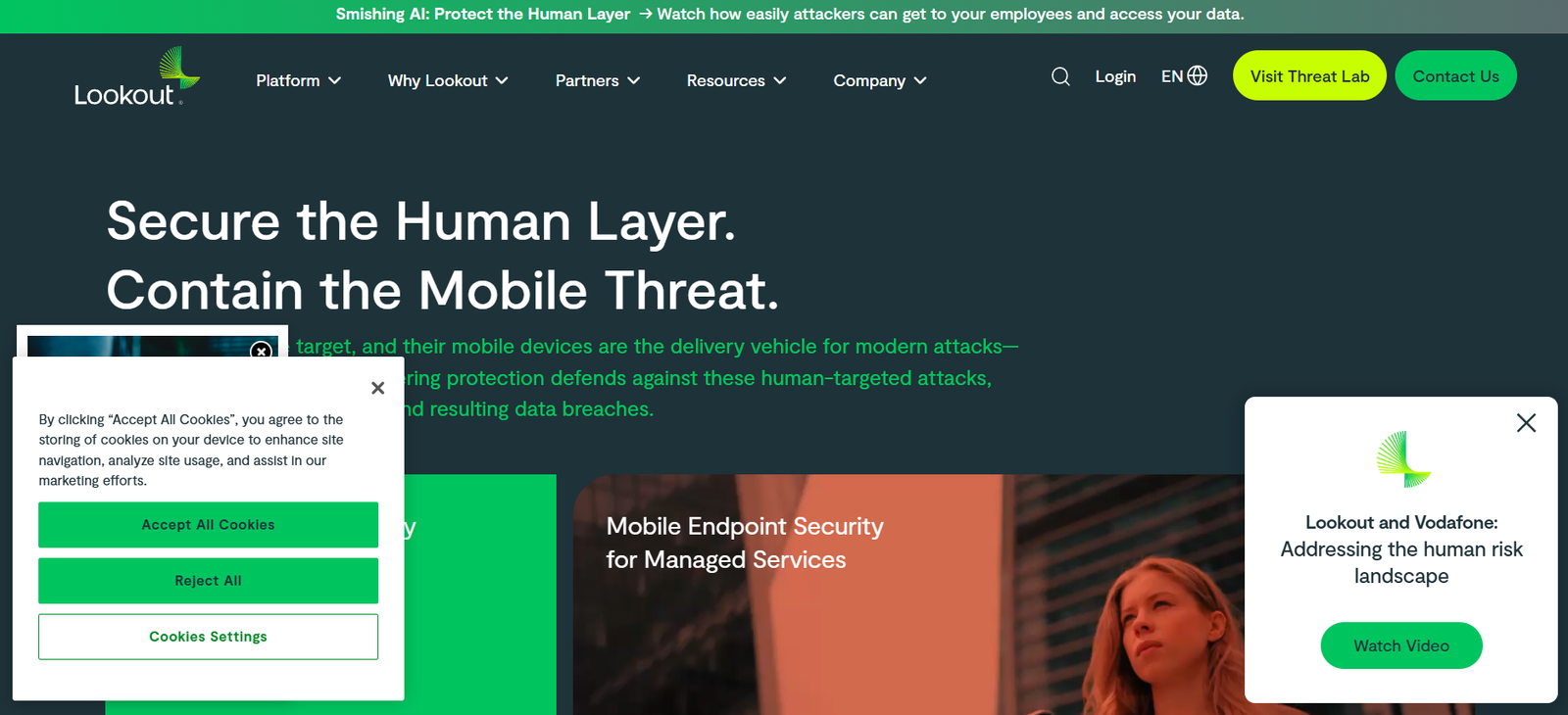
Lookout is a cybersecurity platform focused on protecting sensitive data in an increasingly mobile and cloud-first world. Originally launched as a mobile security solution, Lookout has expanded to provide full-spectrum protection for endpoints, cloud services, and user access. Its solutions are built to help businesses secure data across devices, applications, and networks without interrupting productivity or complicating user experience.
As enterprises adopt SaaS platforms and hybrid work becomes the norm, traditional perimeter-based security models are no longer sufficient. Lookout addresses this challenge by delivering modern security tools rooted in zero trust principles. It secures data where it moves—across mobile devices, public cloud environments, and software-as-a-service applications like Microsoft 365, Google Workspace, Salesforce, and more.
Features
Lookout offers a comprehensive suite of security features that cover device protection, threat detection, access control, and data loss prevention across both mobile and cloud environments. One of its core features is mobile threat defense, which safeguards smartphones and tablets against phishing, app-based threats, device vulnerabilities, and network attacks. This protection is continuously updated based on Lookout’s global threat intelligence network, which analyzes millions of devices and apps in real time.
The platform also includes advanced data protection capabilities through secure access and cloud security modules. These include CASB (Cloud Access Security Broker) functionality to monitor and control how users access and share sensitive data across cloud applications. Lookout’s Zero Trust Network Access (ZTNA) provides secure, adaptive access to internal and external apps without relying on traditional VPNs, reducing both complexity and risk.
Another standout capability is continuous risk assessment. Lookout evaluates the posture of both users and devices before granting access to resources. If a device is compromised, running outdated software, or exposed to threats, Lookout can restrict access automatically, keeping sensitive systems protected.
Lookout also integrates threat intelligence, behavior analytics, and AI-driven risk scoring to detect abnormal activity and prevent data exfiltration. It helps organizations enforce policies that govern what users can do with data, whether on the device or within a cloud application.
How It Works
Lookout’s platform works by establishing visibility and control over every endpoint, user, and cloud interaction. It starts with lightweight agents deployed on mobile devices, which monitor system health, network activity, and app behavior. For cloud security, Lookout integrates directly with SaaS platforms via APIs and proxies, analyzing file transfers, sharing permissions, login patterns, and user actions.
When a threat or risky behavior is detected, Lookout applies dynamic policy enforcement. This could mean blocking access to a specific cloud app, encrypting a file, warning a user, or logging them out altogether. These actions are based on real-time risk scores calculated from user behavior, device health, and threat indicators.
All events and activities are logged in a centralized console that gives security teams complete visibility. Administrators can use this console to customize access rules, set policies for mobile and cloud apps, review threat activity, and generate compliance reports.
Because Lookout is cloud-native, deployment is fast and doesn’t require extensive on-premises infrastructure. It scales easily across devices and users, supporting both BYOD (bring your own device) and corporate-owned hardware.
Use Cases
Lookout is used by organizations across industries to secure mobile workforces, protect sensitive data in the cloud, and enforce zero trust security models. A common use case is securing mobile devices used by employees in remote or hybrid work settings. With Lookout, companies can ensure that devices are free of malware, running updated software, and operating on secure networks before allowing access to internal systems.
Another critical use case is preventing data loss in cloud applications. Whether it’s unauthorized file sharing in Microsoft 365 or risky third-party app integrations with Google Workspace, Lookout provides the visibility and control needed to stop accidental or malicious leaks.
Regulated industries such as healthcare, finance, and government also rely on Lookout to help meet compliance requirements like HIPAA, PCI DSS, and FedRAMP. The platform’s logging, access controls, and real-time monitoring help enforce security policies and support audit readiness.
Lookout is also beneficial for companies adopting zero trust architecture. Its ability to evaluate risk continuously and enforce dynamic access ensures that only trusted users and devices can reach protected apps and data.
Pricing
Lookout does not list standardized pricing on its website. Pricing typically varies based on the number of users, devices, and specific modules selected—whether an organization is only deploying mobile threat defense or combining it with CASB, ZTNA, and endpoint protection.
To receive a tailored quote, businesses need to request a consultation or demo through Lookout’s website. During this process, Lookout works with prospective customers to assess their needs and recommend a suitable plan.
Lookout is positioned as an enterprise-grade solution, though it also supports mid-sized businesses that require strong mobile and cloud security without building large internal security teams.
Strengths
One of Lookout’s greatest strengths is its ability to provide unified visibility and protection across mobile endpoints and cloud applications. While many platforms specialize in just endpoint or cloud security, Lookout merges both into a single interface and policy engine, making it easier to manage risk holistically.
Its mobile threat defense is among the most mature on the market, offering continuous protection without slowing down device performance. The app-based risk scoring and behavioral analysis are particularly effective at identifying hidden malware and malicious network activity.
Another advantage is the platform’s zero trust capabilities. By evaluating device and user risk continuously, Lookout ensures that access decisions reflect real-time conditions. This is especially useful for companies moving away from perimeter-based security models.
Lookout’s cloud-native architecture also simplifies deployment and management. IT and security teams can roll out protection quickly and scale it across geographies without needing complex infrastructure.
Drawbacks
While Lookout offers deep capabilities, its full potential is best realized by organizations with a clear understanding of cloud and mobile security challenges. Smaller businesses or those without dedicated security teams may need support in setting up policies and integrating cloud applications.
The platform’s broad scope means the initial configuration phase can be detailed, especially when connecting multiple cloud services or rolling out across a global mobile workforce. Time and training may be required to fine-tune policies and interpret behavior analytics effectively.
Pricing transparency is another consideration. Because pricing is tailored, some organizations may find it harder to evaluate Lookout against other security tools until they go through a formal consultation.
Additionally, while Lookout covers mobile and cloud environments extremely well, companies looking for on-premise network protection or traditional endpoint antivirus may need to complement it with other tools.
Comparison with Other Tools
Compared to traditional mobile device management (MDM) solutions, Lookout offers more in-depth threat detection and risk-based access. MDM tools manage devices but often lack the advanced security features needed to block phishing or app-based threats. Lookout fills that gap with real-time protection and threat intelligence.
When compared to cloud security platforms like Netskope or Zscaler, Lookout stands out for its mobile-first approach and deep integration with device behavior. While those tools focus more on network-level controls, Lookout combines device health, app risk, and cloud usage into a single risk profile.
In the endpoint protection space, Lookout complements rather than replaces antivirus or EDR solutions. It focuses specifically on data protection and zero trust access rather than malware remediation or system recovery.
Customer Reviews and Testimonials
Lookout receives strong feedback from enterprise customers who value its ease of deployment, accuracy in detecting mobile threats, and unified visibility across cloud services. On review platforms like Gartner Peer Insights and G2, users praise the platform for being intuitive, scalable, and effective at reducing data leakage and phishing attacks.
Security teams appreciate the depth of risk analytics, the real-time alerts, and the ability to automate policy enforcement. Several organizations highlight how Lookout helped them implement zero trust strategies more effectively, especially in environments with a large remote or BYOD workforce.
Users also mention responsive support and helpful onboarding processes, particularly during integrations with Microsoft 365, Google Workspace, and cloud storage apps.
Conclusion
Lookout offers a modern, integrated approach to securing data in the mobile and cloud-first era. With its AI-driven threat detection, strong mobile security, and zero trust access controls, it helps organizations protect sensitive information wherever it moves—on any device, in any app, across any network.
Whether you’re looking to secure remote work, protect against phishing and data breaches, or meet compliance goals, Lookout provides the visibility, intelligence, and control to manage risk proactively. Its flexible architecture, advanced analytics, and seamless integrations make it a strong choice for security-conscious organizations aiming to stay ahead of today’s evolving threats.


