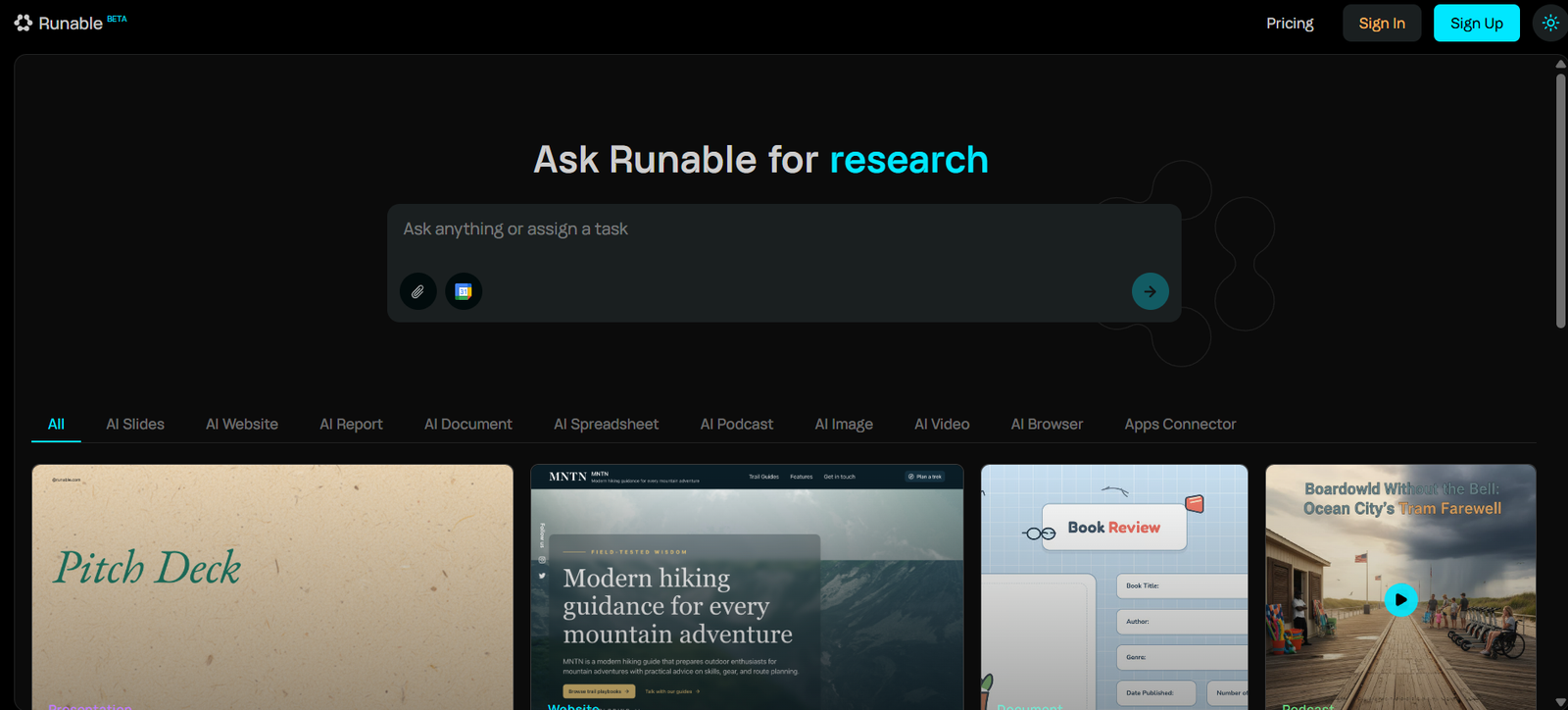
Runable is a code execution and hosting platform for backend developers. It allows users to create, run, and share backend services instantly—without any setup or deployment hassles. Think of it as a developer playground combined with live hosting, where your backend code becomes instantly accessible via a shareable API endpoint.
Designed for rapid prototyping, internal tools, microservices, or quick demos, Runable handles everything behind the scenes—from containerization and execution to routing and scaling. All you need to do is write your code and click “run.”
This makes it ideal for developers who want to share backend functionality in real time, test APIs across devices, or spin up a working backend for small projects—all without setting up a server or configuring cloud infrastructure.
Features
Runable offers instant backend execution, allowing developers to write code in their browser and get a live API endpoint in seconds.
It supports multiple backend programming languages out of the box, including Python, Node.js, Go, and more, letting you choose your preferred stack.
The platform automatically provides public URLs for each deployed backend function, so you can easily test your code or share it with others for feedback or integration.
You can build and expose REST APIs instantly, which makes Runable great for backend prototypes, webhooks, bots, and microservices.
There is no need for manual deployment, Docker setup, or server provisioning—Runable handles infrastructure, scaling, and security under the hood.
The code editor is built into the browser, with real-time logs and execution results so you can test and iterate quickly.
Each project on Runable can be shared as a link, allowing others to view, run, or fork your code, making it collaborative and perfect for learning, teaching, or team debugging.
The platform includes built-in environment variable support, enabling you to secure keys and sensitive data in your backend code.
It runs your code in isolated environments, ensuring security and performance while allowing unrestricted access to most standard libraries and modules.
How It Works
Using Runable begins with selecting a language (like Python or Node.js) and creating a new function or backend block in the web editor.
You write your code directly in the browser, optionally setting up input/output handling as needed. You can define routes, write logic, call APIs, and interact with standard libraries—all from the code window.
Once your code is ready, simply click “Run” and Runable will execute your function in a secure, containerized environment. The output is shown instantly in the log pane, and a public API URL is generated on the fly.
This API endpoint can be used to call your backend logic from any client—mobile, web, or server. You can also share the link with others to test, collaborate, or review.
If needed, you can save and manage multiple functions, update versions, or delete outdated endpoints from your dashboard.
The entire process takes seconds from code to deployment, making Runable one of the fastest ways to prototype and share backend code live.
Use Cases
Developers use Runable to build and test backend APIs before integrating them into frontend applications or mobile apps.
Startups and indie hackers use it for rapid MVP development, allowing them to launch backend functionality without spending days on infrastructure setup.
Educators and instructors use Runable to demonstrate backend concepts in real-time during lessons or workshops.
QA teams and testers use Runable to create mock endpoints and test services for simulating backend behaviors in staging environments.
Hackathon participants and coding bootcamps use it to accelerate project creation, especially when time is limited and quick iteration is key.
Freelancers use Runable to showcase code samples or logic to clients before full deployment or integration.
Data engineers use Runable to build quick webhooks or data processing functions, especially when working with external APIs or automation flows.
Pricing
As of October 2025, Runable is free to use and open for sign-ups. The official website does not currently list any pricing tiers, suggesting that the platform is either in early release or committed to free access for prototyping and public use.
Users can sign up directly on the Runable website and begin deploying backend code without cost.
While no premium plans are listed, it is likely that in the future Runable may introduce paid tiers for enterprise features such as team collaboration, custom domains, higher resource limits, or integration with CI/CD workflows.
Strengths
Runable offers an unmatched speed of deployment, letting you go from code to live API in under a minute.
It removes backend friction entirely—no DevOps, no Docker, no cloud configuration, just code and go.
Its multi-language support and API-centric model make it flexible for a wide range of backend applications.
The browser-based editor and logs make it developer-friendly and beginner-accessible, ideal for prototyping or learning.
It supports collaboration and sharing, enabling teams to work faster without needing to clone or spin up environments locally.
Security is handled via isolated execution environments, and environment variables offer a way to protect sensitive inputs.
The platform is lightweight and efficient, making it a go-to solution for microservices, bots, and internal tools.
Drawbacks
Runable is best suited for lightweight and small-scale backend logic. It is not intended for large-scale production deployments or heavy computational tasks.
Currently, the platform lacks database integration or persistent storage, so stateful applications are limited in scope.
There is no version control integration (like GitHub) visible at the time of writing, which may limit workflow integration for professional dev teams.
The platform does not yet support user authentication or rate limiting, which may be required for more secure or public-facing applications.
As with any browser-based editor, there may be limitations around large-scale codebase handling or IDE-like features.
Since there is no public pricing or usage tier at this point, it’s unclear how the tool scales with frequent usage or larger workloads.
Comparison with Other Tools
Compared to tools like Replit or Glitch, Runable is focused entirely on backend code and API exposure, rather than full-stack app development.
Unlike cloud providers like AWS Lambda or Google Cloud Functions, Runable removes all infrastructure complexity, focusing purely on the developer experience.
It’s simpler than Firebase Cloud Functions and easier to onboard than serverless frameworks like Vercel or Netlify for backend functions.
While tools like Postman let you test APIs, Runable lets you build and host the APIs themselves, providing live code execution behind each endpoint.
Compared to low-code backend builders, Runable provides full-code control, which appeals to developers looking for flexibility without abstraction.
Customer Reviews and Testimonials
The official Runable website currently does not include user reviews or testimonials. However, the product messaging suggests strong appeal for developers, educators, and builders who value speed, simplicity, and shareability.
As adoption increases, community feedback is likely to appear on developer forums, Product Hunt, and GitHub repositories where code sharing is common.
Early users can sign up for access and provide feedback directly through the site to shape the roadmap.
Conclusion
Runable is a powerful, developer-friendly tool that makes backend development instant, accessible, and shareable. By removing all the setup traditionally required to run server-side code, it empowers developers to focus on writing logic and shipping ideas—not managing infrastructure.
Whether you’re prototyping a feature, teaching backend development, or creating a microservice, Runable makes the process seamless. Just write your code, run it, and share the link. No setup, no deploy steps—just results.