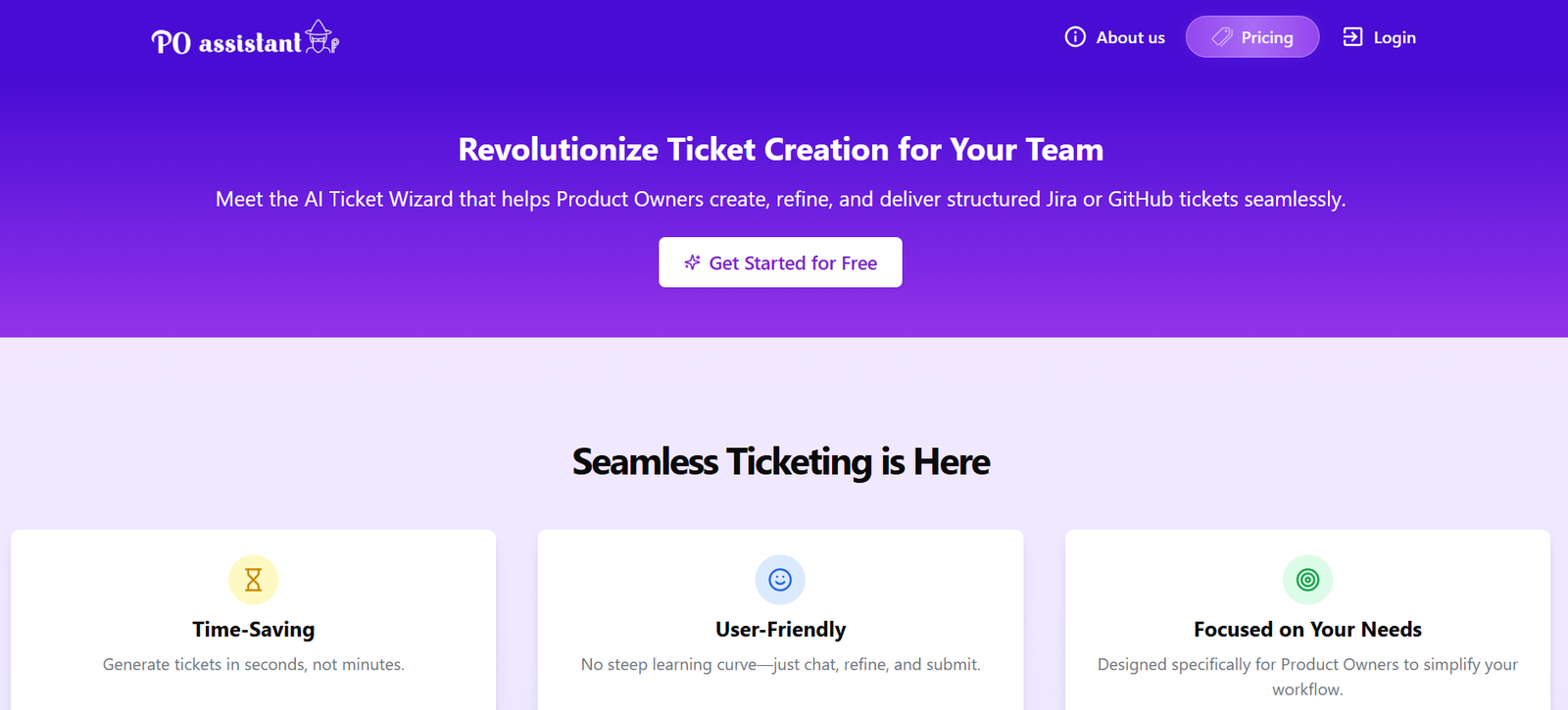
PO Assistant is an AI assistant designed for agile product owners to accelerate product development tasks. The platform uses generative AI to convert unstructured ideas or requirements into well-formed user stories, complete with acceptance criteria and effort estimations.
This makes it especially useful for teams that follow Scrum or Kanban frameworks, where story clarity and backlog hygiene are critical. Instead of starting from a blank page or writing stories manually, product owners can describe features in natural language, and the AI translates them into structured agile artifacts.
The tool acts as a co-pilot for product owners, saving time on routine tasks such as writing epics, refining tickets, and formatting Jira cards. It supports English language inputs and is accessible through a clean, browser-based interface.
Features
PO Assistant enables story generation from plain text. You can type a brief idea or feature request into the input field, and the AI will instantly generate a complete user story. This includes the title, user story format, acceptance criteria, and optional business context.
The tool supports epic and task creation. If your input represents a larger feature or initiative, PO Assistant can generate an epic with multiple related stories and tasks. This helps organize big ideas into sprint-ready deliverables.
PO Assistant offers backlog refinement capabilities. Users can paste in existing Jira tickets, rough requirements, or brainstorm notes, and the AI will clean up the content, format it properly, and suggest improvements.
Effort estimation support is built-in. While not a replacement for team discussions, the tool offers suggested story point ranges or complexity levels to help guide early planning.
The platform includes AI-powered suggestions for prioritization. Based on the content and clarity of a story, the assistant can recommend whether it’s ready for the next sprint or needs refinement.
PO Assistant offers contextual editing. You can regenerate, edit, or expand stories using smart prompts. This is helpful when you want to tweak acceptance criteria, change the scope, or reword the output.
The tool maintains simplicity in design. There’s no need to configure projects or link third-party tools. It works as a standalone AI utility that helps you generate content faster and then copy-paste into Jira, Trello, or your preferred PM tool.
How It Works
Using PO Assistant is simple and intuitive. Users visit the website and enter a natural language prompt describing a product feature, idea, or requirement. For example, you might enter: “Allow users to reset their password using email verification.”
Once submitted, the AI generates a formatted user story, following the conventional template: “As a [user], I want [feature] so that [benefit].” It then produces acceptance criteria using a Given-When-Then format, along with optional business context and story point suggestions.
If the input is vague or too broad, PO Assistant may recommend splitting it into multiple stories or converting it into an epic. The assistant provides flexibility in how you handle large or evolving requirements.
Users can copy the output and paste it directly into Jira, Notion, Confluence, or wherever their product backlog is maintained. There is no signup required to try the tool, though heavy users may benefit from registering or subscribing, depending on future feature rollouts.
The AI is optimized for English input and can understand both technical and non-technical language. This makes it accessible for product owners from a variety of backgrounds.
Use Cases
Agile product owners can use PO Assistant to speed up writing user stories and preparing for backlog grooming sessions. This saves time and improves consistency in ticket formatting.
Scrum masters can use the tool to help teams refine their stories between sprints and ensure each ticket is sprint-ready with clear acceptance criteria.
Startups with small teams and no full-time product manager can use PO Assistant to document features and create tasks that developers can immediately act on.
Technical leads can draft initial feature specs using PO Assistant and later enrich them with technical implementation notes.
Freelancers working with multiple clients benefit from fast story creation that’s tailored to agile formats, helping them maintain professionalism and project clarity.
Agile coaches and consultants can use the platform during workshops or training sessions to demonstrate good user story practices using AI-generated examples.
Pricing
As of October 2025, PO Assistant offers a free-to-use tier directly from the official website. Users can generate user stories and acceptance criteria without logging in or subscribing.
There is no pricing page currently available, suggesting that the platform is in early access or public beta. Advanced features, such as saving stories, project history, or integrations, may be introduced under a paid plan in the future.
For updated information about pricing, subscriptions, or enterprise features, users should visit the official PO Assistant website or subscribe to product updates if available.
Strengths
PO Assistant is extremely fast and efficient. What usually takes product owners 10 to 15 minutes per story can now be completed in seconds.
It produces properly structured stories, complete with formatting, making it easier to paste content directly into project management tools.
The platform lowers the barrier for junior product managers or non-technical team members who may not be familiar with agile story formats.
It’s useful for brainstorming and refining. Even if you don’t use the AI-generated story word-for-word, it provides a solid base to start from.
There is no setup required. Users can get started immediately without creating an account, making the tool frictionless to try.
It enhances consistency across the backlog. AI-generated stories tend to follow a uniform structure, which helps development teams navigate tickets more easily.
Drawbacks
PO Assistant currently lacks integration with tools like Jira, Asana, or Trello. Users need to manually copy and paste stories into their workflows.
It may not fully understand project-specific language or context, especially when dealing with highly technical requirements or internal acronyms.
There is no team collaboration feature or workspace management, which limits its use for larger agile teams working within shared environments.
There is no visible roadmap or support channel linked on the website, which might concern enterprise users looking for long-term support or SLAs.
It currently supports only English, which may restrict accessibility for international product teams working in other languages.
Comparison with Other Tools
Compared to general AI tools like ChatGPT or Claude, PO Assistant is purpose-built for agile workflows. While large language models can generate stories, PO Assistant adds structure, consistency, and refinement tools specific to product management.
Traditional PM tools like Jira offer templates and plugins, but they require manual input. PO Assistant fills this gap by generating story content faster and in more detail.
Other AI tools like Linear’s built-in AI assistant offer similar features, but only within that specific tool. PO Assistant is standalone and can be used with any backlog or project management platform.
While tools like Notion AI can help draft stories, they lack the acceptance criteria formatting and agile-specific optimization that PO Assistant provides out-of-the-box.
Customer Reviews and Testimonials
As of now, the official PO Assistant website does not feature customer testimonials or user reviews. However, based on early mentions across tech forums and product communities, the tool has been well received by agile practitioners looking for AI support in their workflows.
Users appreciate the instant generation of user stories and say it helps reduce mental fatigue during sprint planning. Some note that it’s also a useful learning tool for junior PMs to see how well-structured stories are written.
Because the platform is relatively new, more verified testimonials are expected to surface as adoption grows and features expand.
Conclusion
PO Assistant is a specialized AI tool that brings speed, structure, and clarity to the agile product development process. It helps product owners and agile teams write better user stories, refine backlogs, and prepare for sprints faster—all with the support of AI.
Whether you’re a solo founder writing your first backlog or a product owner juggling dozens of tickets each week, PO Assistant can save you time and improve the quality of your output. Its simple interface and focus on agile story formats make it a valuable tool for modern product teams.
While it lacks integrations and advanced features for now, its core functionality is strong and offers immediate value. As the platform evolves, it may become an essential companion for any agile team looking to automate repetitive PM tasks.